
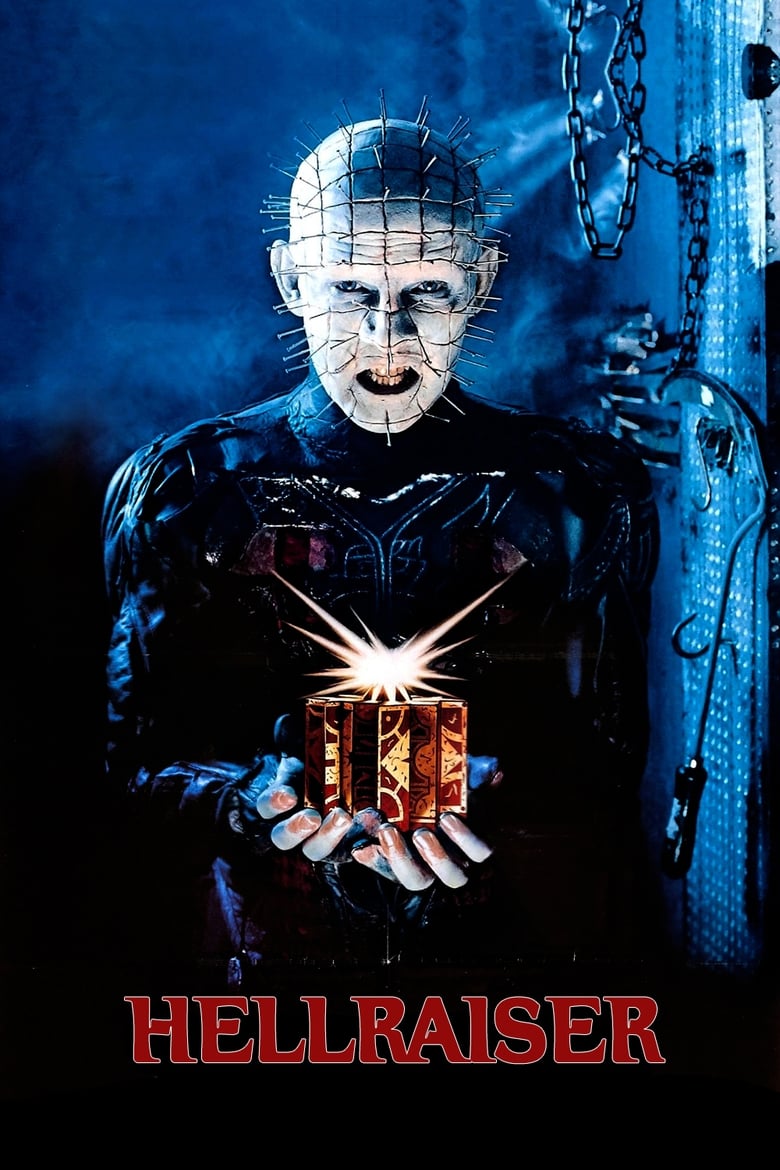
Hellraiser
“Demon to some. Angel to others.”
A hedonistic man finds a mysterious puzzle box that summons a group of gruesome beings known as the Cenobites. These otherworldly entities open the doors to a dominion where pain and pleasure are indivisible.
About Hellraiser
Why Hellraiser still stands out
It starts with a simple transaction: a hedonist buys a mysterious puzzle box in Morocco hoping for new pleasures. The box is a neat, wicked trick — a small object that opens a very big problem.
Clive Barker directs, and in just 93 minutes he squeezes an idea so tight it hurts. The film’s central shock — Frank solving the box alone in an attic and having hooked chains tear him apart — announces from the first reel that this isn’t suburban horror with polite manners. And yet the story keeps returning to one person you can follow: Kirsty Cotton. Played by Ashley Laurence, she’s the touchstone the film hands you when rules collapse and the house becomes the dangerous thing it was meant to shelter.
The idea that sets Hellraiser in motion
The engine of the film is tidy and terrible: the Cotton house contains something that should have stayed buried. Larry moves in, trying to reboot a family life he hopes will be quieter than the last.
Kirsty notices Julia bringing strange men to the house and follows her one night to the attic — and there she finds Frank, the loose end from earlier sins. She manages to get away clutching the puzzle box, which the movie treats as both a treasure and a trap.
That escape doesn’t close the story. After being dragged into adult horrors outside the house, Kirsty ends up in hospital and, through a dangerous curiosity, summons the film’s otherworldly visitors — the Cenobites and a hulking creature called the Engineer.
When the hunters return, the stakes are household-sized: Kirsty must use what she has — the box and a quick wit — to turn the rules back on the thing that started it all.
Why Kirsty Cotton matters
Ashley Laurence is the face the film asks you to trust when everything else turns traitorous. Kirsty is written and placed as the family member left to count the costs of other people’s bad choices.
Her importance isn’t glamour or power; it’s proximity. Larry moves the family back into the house hoping for normality, but Kirsty is the one who sees the cracks and follows them upstairs, where the past still breathes.
Kirsty’s role compresses the film’s themes: family, protection and survival. She becomes the person who must call out the truth about Frank — even when that truth is wrapped in skin and lies.
And crucially, she doesn’t carry the story alone. When the house finally collapses around them, it’s Kirsty and her boyfriend Steve who make the physical escape, which keeps the finale rooted in the idea of ordinary people getting free.
Hellraiser has more on its mind than the plot suggests
On the surface it’s a horror about forbidden pleasure and terrible bargains. Underneath, a few quieter ideas keep nudging: freedom, what counts as safety, and how family ties can protect or betray you.
The film keeps recycling the language of identity. Frank literally steals a neighbour’s life by wearing his skin; that grotesque theft makes identity in Hellraiser both a costume and a confession.
Parental protection and family obligations are threaded through the action. Larry returns to the house to rebuild something resembling a family life, whereas Kirsty ends up defending that life from the consequences of past adults’ appetites. And freedom — the thing Frank chased to ruin — is presented as an appetite with a cost. The box promises release, but the film asks whether the kind of freedom Frank wanted is freedom at all.
Hellraiser could not belong to any other decade
Released in 1987, Hellraiser sits comfortably in a late‑80s moment where horror was happy to be both transgressive and intimate. It’s not retro flair the movie trades in; it’s a particular appetite for pushing boundaries.
The period gives it licence to be uncompromising about what pleasure and pain might mean. That flavour — bold, raw and a touch confrontational — feels of its era without relying on nostalgia as a crutch.
Put simply: Hellraiser reads as an 80s movie because it mixes a compact, direct story with a willingness to shock in ways mainstream horror had mostly skirted before.
What has aged — and what hasn't
The core idea still hits: a private object that opens a private hell is a tidy storytelling device, and the moment Frank is torn apart by the chains in the attic remains a grimly effective opener.
The domestic angle — a family trying to patch things together while something monstrous waits beneath the floorboards — also keeps the movie emotionally immediate. Home and safety are repeatedly undermined in ways that still feel unsettling.
Where the film shows its age is mostly in what it expects the audience to accept quickly: the affair that implicates Julia and the mechanics of resurrecting Frank demand you lean into the premise without too many questions.
But the relationship dynamics — a daughter watching adults’ mistakes unfold and having to act to protect herself — travel well. Those choices still make the story feel relevant today.
Why Hellraiser still matters
There’s a handful of images and ideas the film leaves behind that people keep returning to: the puzzle box itself, Frank’s desperate search for sensation, and the Cenobites as something less like caricatures and more like explorers of extremes.
The film’s moral compact is tidy and haunting: Frank explains he exhausted ordinary pleasures, went looking for something beyond, and paid for it. That story of appetite and consequence keeps the film from being mere shock.
Kirsty’s arc — from curious teenager to the one who bargains her way out of doom — gives viewers an anchor. Her clever reversal with the box is the moment the film turns its rules against the very thing that started the trouble. Finally, the closing traces — the box thrown on a pyre, then picked up again and offered to another customer — leave the story as a small, unsettling loop. It’s a tidy final note: the thing that causes harm survives, and the choice to engage with it is what gets repeated.
Does Hellraiser still hold up?
Yes — if you want a short, sharp horror that trades in ideas as much as shocks. Clive Barker’s direction keeps the movie focused (it’s a compact 93 minutes) and concentrates the weird into a few decisive beats.
Kirsty’s thread through the terror gives the film something to care about: she’s the person who keeps the story human when bodies and bargains take over. The hospital sequence where she unwittingly summons the Cenobites and the subsequent bargain—where they agree to spare her if Frank confesses—are moments that still register.
You should be prepared, though: the film asks you to accept grotesque premises and moral bluntness. Frank’s theft of another man’s life by wearing his skin and the casual brutality Julia shows in helping him are not subtle comforts.
Bottom line: watch Hellraiser if you want a horror that treats freedom and pleasure as dangerous ideas and doesn’t apologise for the consequences. It’s a thrillingly nasty little movie that leaves you with an uncomfortable truth — some boxes shouldn’t be opened, and some curiosities are inherited.