
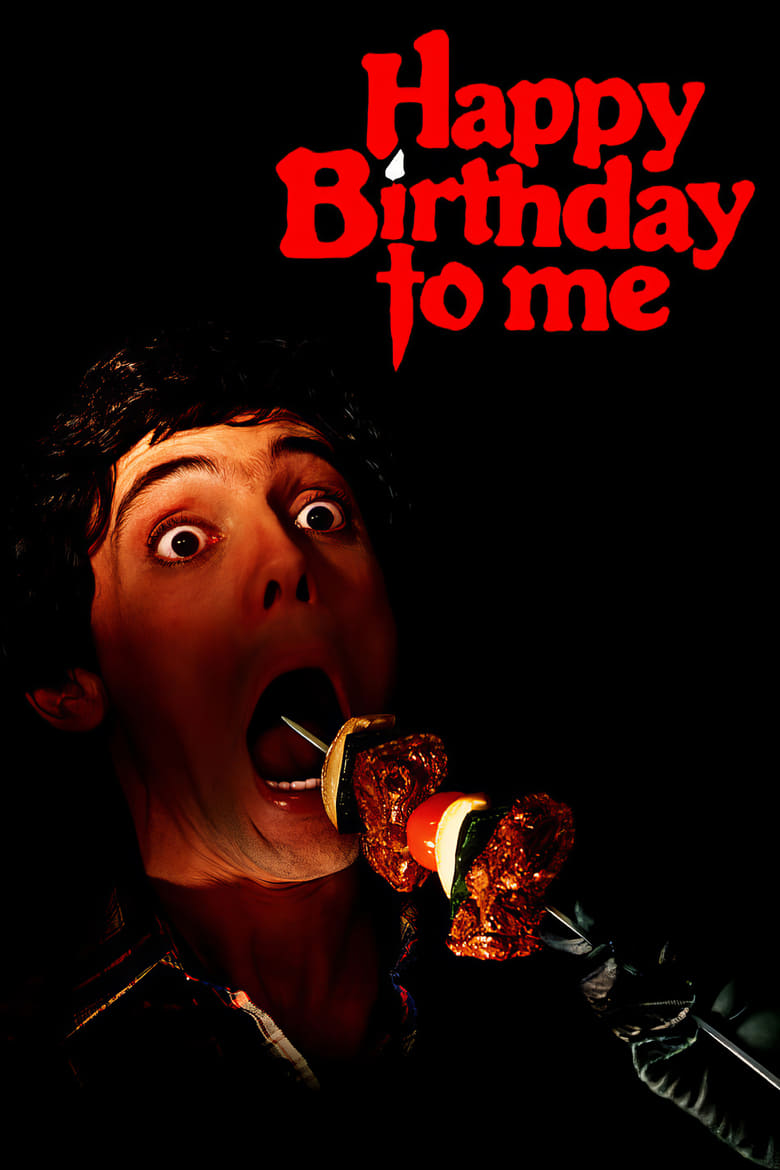
Happy Birthday to Me
“Six of the most bizarre murders you will ever see.”
Virginia is proud that she belongs to a clique. The best students at a private school. But before her 18th birthday, a gruesome set of murders take place and her friends are the ones who are falling prey. Could it be her? She suffers from blackouts due to a freak accident one year earlier. We soon learn the truth behind her accident and what is going on.
About Happy Birthday to Me
What Happy Birthday to Me gets right
There’s an immediate perversity to this film: it dresses itself as a glossy teen thriller — a pretty heroine, an exclusive clique, pub nights with mates — then keeps tugging that safe cloth until the holes start to show. Virginia “Ginny” Wainwright is the popular member of the “Top Ten,” a social circle whose ease with privilege makes every rupture feel meaner.
J. Lee Thompson directs a 110‑minute picture that doesn’t hurry. It lets the ordinary bits — meeting at the Silent Woman Tavern, school parties, a teenage row about whose birthday to attend — sit beside stranger, darker moments until the contrast itself becomes unsettling. If you remember the movie, you probably remember the sense that this is a horror about private lives falling apart: family trouble, a ruined birthday, and a set of friendships that suddenly look brittle rather than solid. That’s where Happy Birthday to Me still finds traction.
The idea that sets Happy Birthday to Me in motion
At its simplest, the film gives us a tight social world — the Top Ten meet every night at the Silent Woman Tavern — and then lets that world be punctured. The first practical blow is when Bernadette doesn’t turn up and alarm spreads through the group: absence becomes a question mark that keeps getting angrier.
That question mark intensifies because Ginny brings her own baggage: she survived a horrific drawbridge accident and, haunted by repressed memories, has undergone an experimental brain‑tissue restoration with Dr Faraday. The movie uses that procedure to seed paranoia — is Ginny simply traumatised, or might she be responsible for things she can’t remember?
Meanwhile, ordinary adolescent nastiness keeps nudging the plot: a game of chicken on a raising drawbridge, a prank that goes wrong and leaves Ginny in a car that barely clears the gap. Little cruelties bloom into calamities.
So the setup works because the premise is both social and psychological: an enclosed circle of friends with messy loyalties, and a heroine whose fractured past makes her both vulnerable and a suspect.
Why Virginia "Ginny" Wainwright matters
Ginny is not a “final girl” in neat, textbook terms. She’s introduced as the pretty, popular senior at the centre of the Top Ten’s orbit, which makes her social world a pressure cooker: every slight or humiliation has a public life as well as a private sting.
Her importance comes from that collision. The film keeps returning to Ginny’s grief — she visits her mother’s grave, swims free from a drowned car as a child, and carries the aftershock of that loss into adolescence. Those moments colour everything she does, from paranoia about blackout episodes to the way other characters circle her.
Because family and friendship are threaded through her story, Ginny functions as the knot the movie keeps tugging. She is the point where personal trauma, teenage rumours and the film’s violence meet.
And when revelations land — about betrayals, about blood on a birthday — Ginny is never just a plot device. The film insists that the messy stuff in her family life matters to why the killings feel so intimate.
Happy Birthday to Me has more on its mind than the plot suggests
Strip away the slasher mechanics and you’re left with a handful of interpersonal knots: family fracture, the loss of a parent, and the collapse of home as a place of safety. The late‑film sequence with the guest cottage — and the eerie tableau of bodies seated at a table — drags the domestic into the grotesque.
Mortality and lifespan appear in how the movie treats survivorship: Ginny’s childhood rescue and the experimental procedure that follows make survival itself a complicated affair, not a tidy happy ending. Survival comes with scars and gaps in memory.
Fear here is social as much as physical. Betrayal among friends — and the revelation that family secrets, like an affair, have quietly poisoned lives — turns ordinary relationships into sources of dread. Put simply: the film’s horror often comes from the idea that the people you trust are the ones who can ruin you. That keeps the terror feeling close, not distant.
Happy Birthday to Me could not belong to any other decade
Released in 1981, Happy Birthday to Me arrives when teen‑centred horror was sharpening into the slasher mode that dominated the decade. The film shares that era’s appetite for mixing adolescent rituals — dances, parties, cliques — with sudden, graphic ruptures.
That combination is very much of its moment: the idea that youthful sociability could be both carefree and lethal felt like a new, thrillingly malicious possibility for horror in the early 80s.
So while the movie wears its period on the sleeve of its setup rather than its visuals, its interest in teenagers, rites of passage and domestic fallout slots it firmly into its decade.
What has aged — and what hasn't
A lot of the film’s core still holds: the domestic betrayals, the idea that safety can be theatricalised (the guest cottage table is a cruel, indelible set piece) and the emotional logic linking Ginny’s childhood trauma to later suspicion. Those story bones are straightforward and translate across decades.
Some moments feel blunt now. The intrusion into Ginny’s bedroom — Etienne stealing underwear — and the casual nastiness among the Top Ten read differently to a modern eye; they underline how adolescent entitlement is part of the film’s problem, but they also can land awkwardly without the context contemporary audiences bring.
What survives best is the film’s nervousness about home. The thunderstorm, the discovery of blood in Ginny’s bedroom and the lit guest cottage suggest that domestic spaces are never entirely safe — that unease doesn’t date.
And the personal reveal — Ann unmasking her grievance about her father’s affair and claiming a familial wound — still gives the film a sharp, human motive beneath the slasher surface.
Why Happy Birthday to Me still matters
People who remember this movie often recall its particular mix of teenage social life and intimate horror: the Top Ten clique, nights at the Silent Woman Tavern, and the way ordinary party drama escalates into something murderous. Those elements stick because they fold domestic grievance into genre theatrics.
Certain sequences tend to linger in memory — Bernadette’s attack while driving, the near‑fatal drawbridge crash, the discovery that a friendly chum is actually making prosthetic heads — because they’re vivid, nasty interruptions to the film’s social texture.
The story’s willingness to make family trouble the engine of the plot — Ginny’s ruined childhood party, the drowned mother, the affair that gets named late on — gives it an emotional crank that separates it from slashers that are purely about body counts. If you’re the sort of viewer who likes your shock with a small, personal motive rather than pure mystery, this film’s last act — the birthday tableau and the unmasking of a family grievance — explains why it still turns up in conversations among fans.
Does Happy Birthday to Me still hold up?
Short answer: yes, for certain tastes. This is a 1981 horror‑slasher that makes a deliberate choice to keep the nastiness local — inside a friend group, inside a house, even inside a birthday celebration — and that intimacy still delivers a chill.
If you enjoy slashers that pair violence with a human motive and domestic mess rather than an abstract serial killer puzzle, Ginny’s story and the way personal betrayals are revealed will feel rewarding. The film’s shape — teenage ritual, a traumatic childhood incident, an experimental medical procedure and then escalating murder — reads as a coherent chain rather than random set pieces.
If you’re less keen on blunt adolescent cruelty or scenes that trade on private invasions, parts of the movie will feel dated or uncomfortable. The film doesn’t hide its nastiness; it puts social nastiness and family ruin at the heart of its horror.
But for an audience who wants a slasher that cares about why the knife gets taken up as much as where it’s used, Happy Birthday to Me remains a peculiar, effective piece of early‑80s horror. It’s a birthday party you won’t want to attend — and that, in this case, is the point.