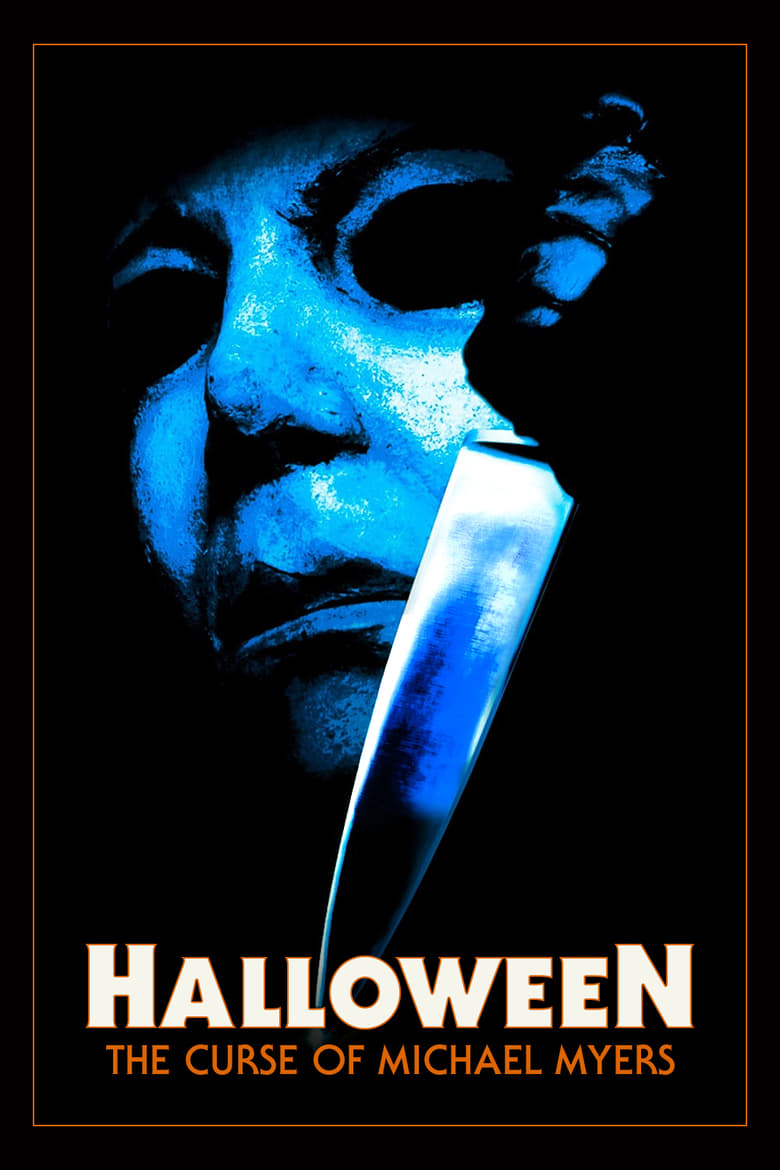
Halloween: The Curse of Michael Myers
“Terror never rests in peace.”
Six years after being presumed dead in a fire, and just as the town prepares to finally celebrate Halloween again, Michael Myers returns to Haddonfield to continue his reign of terror.
About Halloween: The Curse of Michael Myers
Why Halloween: The Curse of Michael Myers still stands out
If you remember this film, you probably recall the mechanics before the mood: a weird, Druid-tinged cult has Michael and his niece in custody, something awful happens to Jamie, and a baby becomes the prize everyone’s after. That grim set-up — all of it happening six years after Michael’s escape from a police station — gives Joe Chappelle’s 1995 entry a more conspiratorial, cranky energy than a straight slasher romp.
It’s also short and sharp: 84 minutes, no padding. George P. Wilbur is the shape that stalks the picture, and the cast includes familiar faces who give the story an odd family feel — Paul Rudd turns up as Tommy Doyle, Marianne Hagan as Kara Strode, and Mitch Ryan plays Dr. Terence Wynn, the man at the centre of the sanitarium thread. All of which means this Halloween is worth revisiting not because it polishes the original, but because it widens the frame: it treats Michael as part of a household problem — literal and institutional — and keeps asking what people will do to keep home and family safe when the rules have already failed them.
The idea that sets Halloween: The Curse of Michael Myers in motion
The film kicks off by taking the menace off the streets and putting him somewhere organised: Michael and his niece have been taken by a Man in Black and a cult who keep them at a medical facility. That move turns the usual killer-on-the-loose story into something nastier — removal, control and experiments.
When Jamie escapes, she’s pregnant and gives birth. With the help of a nurse she runs, but the quick promise of safety collapses when the nurse becomes the killer’s first victim and the newborn vanishes into the wider story. Suddenly the stakes are not about surviving a night, but protecting a child.
Back in Haddonfield the old Myers house is lived in by relatives of Laurie Strode’s adoptive family, and young Danny — Kara’s son — is being haunted by a voice that urges him to kill. The domestic set-up makes the threat personal: it’s not just strangers in danger, it’s family in the firing line.
That pressure point — an assault on home and kin — is what keeps the plot moving. Tommy Doyle hears Jamie’s radio plea, shows up, and the hunt for the baby and the effort to keep the Strode household intact drive the film forward.
Why Michael Myers matters
Michael in this instalment is less a mysterious force of nature and more the endpoint of a system that’s been tinkered with. He’s the man the cult keeps; he’s the thing the sanitarium staff study. That makes him feel like part of a larger machinery of evil rather than a lone, inexplicable presence.
That doesn’t make him any less dangerous. He’s shown committing brutal, impulsive acts — electrocution, axe attacks, relentless pursuit — and those scenes keep reminding us what’s at stake when the house is supposed to be a refuge.
What makes him memorable here is how the film links him to family. The idea of a curse — Thorn — is put forward as the reason he targets relatives on Halloween, turning him into a threat that follows bloodlines and homes rather than random victims.
And because he’s enmeshed with the story’s domestic fears, Michael functions as a catalyst. His presence forces characters to protect children, to re-examine old safe places, and to face the question of whether the institutions meant to contain him are actually making things worse.
Halloween: The Curse of Michael Myers has more on its mind than the plot suggests
On the surface it’s a slasher chasing victims; under the surface it’s anxious about what 'home' actually protects. The old Myers house is no longer simply a haunted address — it’s a lived-in family home where children can be terrorised from inside and outside.
Family threads run through the whole picture. The threat is hereditary, or at least presented as such: the film asks what happens when violence is treated like an inheritance, and how ordinary relatives cope with extraordinary danger.
Parental protection is a constant. Characters are pushed into protective roles — hiding children, breaking into places of authority, refusing to hand over kids to institutions that claim to control evil. Courage, in this film, is often practical and stubborn rather than grandly heroic. And there’s a quieter political note: the people who run the sanitarium and those who study Michael are figures of authority and power. Their desire to harness or understand the evil becomes another kind of threat to family life, suggesting that institutional curiosity can become a menace in its own right.
Halloween: The Curse of Michael Myers could not belong to any other decade
Released in 1995, this is a mid-90s horror that wears its era in the way it expands a franchise’s backstory rather than polishing a single, pristine idea. It’s not nostalgic for the original – it treats the mythology as something to tinker with and complicate.
That impulse — to add layers, conspiracies and institutional angles to an already-known monster — was a recognisable tack for sequels of the period. The film feels like a 1990s sequel trying to give fans more to chew on, fast and tightly packaged into a brisk runtime.
Being a 1995 entry also helps explain its temperament: there’s less appetite here for long setup and more for moving through beats that keep the plot surging toward the sanitarium and its answers.
Put simply: it reads like a 90s horror trying to reconcile old hauntings with newer, darker curiosities — and doing it without pretending to be the original again.
What has aged — and what hasn't
Some story choices land differently today. The thread where a fifteen-year-old Jamie is impregnated and gives birth is still a heavy, unsettling plot pivot, and it can feel abrupt and uncomfortable to modern viewers in a way it perhaps didn’t for all audiences in 1995.
Where it still works is in the film’s centre of worry: home and family. Having the old Myers house occupied by relatives and making a child — Danny — a focus of the haunting keeps the emotional stakes straightforward and immediate. The idea of a domestic life under siege is timelessly effective.
The Thorn notion — that whatever haunts Michael is tied to family lines and ritual — continues to give the movie a mythic, almost fairy-tale layer. That idea keeps the horror personal rather than abstract, and personal horrors age better than plot gimmicks.
On the other hand, moments of institutional intrigue — officials who want to study or control the evil — can feel like familiar sequel shorthand now. They still create tension, but the sanitarium-as-laboratory angle reads as part of a specific strand of 90s franchise thinking rather than a fresh fright.
Why Halloween: The Curse of Michael Myers still matters
People who grew up with this one remember it for the places it takes the mythology: Jamie’s pregnancy and the baby at the centre of the hunt, Tommy Doyle grown up and obsessive, and the idea that those who run the sanitarium might be manipulating events for their own ends. Those choices made the franchise feel messier, but also richer in backstory.
Tommy’s return, tracking a radio plea to rescue a child, gives the film a throughline that ties the old babysitting story to a new generation. His actions — finding and naming the baby, trying to keep him safe — are the practical heart of why some viewers defend the movie.
Then there’s the sanitarium payoff: Loomis confronting Wynn, the surgical preparations, and the night when Michael suddenly turns on the cult. That sudden reversal — killer against cult — is a memorable big beat that lingers. And finally, the image the film leaves us with — an abandoned mask lying in a lab while Loomis screams — is a grim, odd punctuation mark. It’s not neat. It’s not tidy. But for lots of fans, that lack of tidy closure is itself part of the appeal.
Does Halloween: The Curse of Michael Myers still hold up?
Short answer: yes, if you come for the mythology and the mood; less so if you want a clean, self-contained slasher. This 1995 chapter double-gestures — it expands the franchise’s backstory with the cult and the Thorn idea, and it keeps the focus on family, protection and terrified households. That gives the film its strongest reasons to be watched today.
It’s a film of sharp beats: Jamie’s pregnancy and desperate escape, the baby who becomes the axis of the plot, the return of Tommy Doyle to protect what Laurie once protected, and the sanitarium showdown where the people supposedly studying evil are revealed as another kind of threat. Those moments still have punch.
If you are curious about a Halloween that treats the monster as a problem to be contained, experimented on and, briefly, fought back against, this one delivers. It’s compact, sometimes ugly, occasionally muddled — and that messiness is part of its character.
So watch it with the right expectations: for extended myth, domestic dread and an ending that refuses neat closure. It won’t replace the original Halloween in most hearts, but it will show you how far the story can be stretched — and how protective people get when their home is the battleground.