Halloween: Resurrection
“Evil finds its way home.”
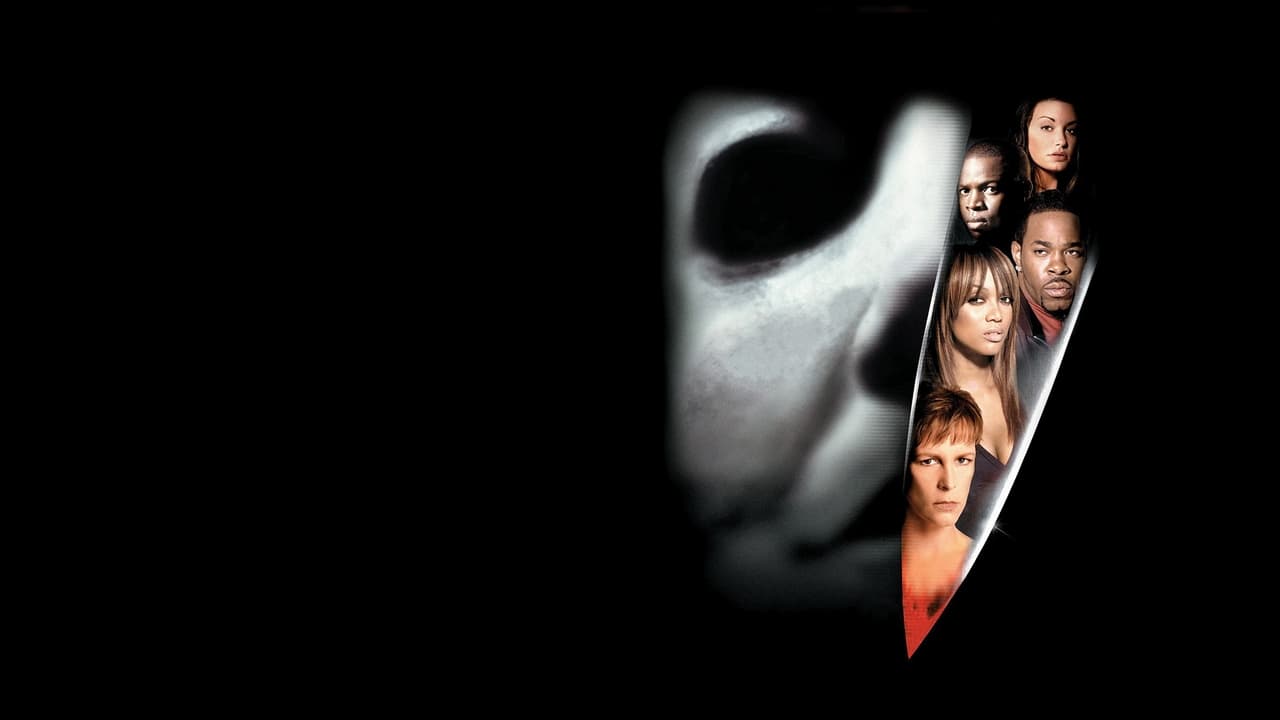
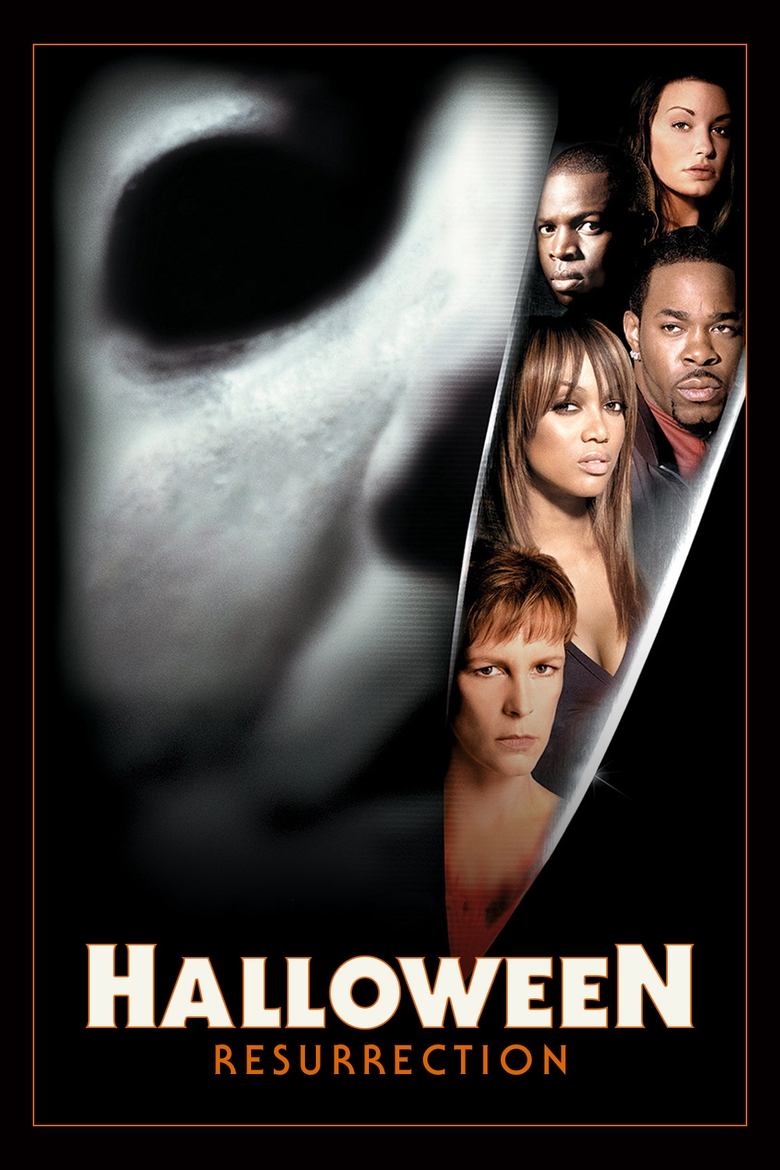
Reality programmers at DangerTainment select a group of thrill-seeking teenagers to spend one night in the childhood home of serial killer Michael Myers. Their planned live broadcast turns deadly when Michael decides to crash the party.
About Halloween: Resurrection
What makes Halloween: Resurrection worth revisiting
This is not the gentle nostalgia trip. Halloween: Resurrection starts by reminding you that Laurie Strode is exhausted by survival — three years on she’s confined to Grace Andersen Sanitarium and living with the consequences of being right too often.
Then the film speeds off in another direction: a year after Laurie’s story closes, a different set of people turn Michael Myers’s childhood house into a televised dare. That collision — institutionalised trauma meeting a televised spectacle — is the movie’s chosen mischief. It’s compact, too. At 86 minutes Rick Rosenthal keeps the pace neat: one long, ugly idea (Laurie’s fear of being wrong) and one loud, commercial idea (a reality‑show setup) stitched together with blunt efficiency. The cast ranges from Jamie Lee Curtis’s returning Laurie to new‑era names such as Busta Rhymes and Bianca Kajlich, and the film moves from sanitarium roofs to a burning garage without much faff.
The idea that sets Halloween: Resurrection in motion
At the film’s heart is a very simple engine: Laurie Strode can’t stop expecting Michael Myers to return, so she prepares — even traps herself into a final act of vigilance on the sanitarium roof.
That readiness matters because the movie later turns on a staged horror scenario that proves painfully real for those inside it. The deception is explicit: characters discover that the show’s shocks are faked, a wall of corpses among them, and the reveal flips the genre switch from prank to genuine threat.
The sequence of choices is stark. A character leaves the setup to keep the con running; others try to flee when reality bites back. Those choices carry the film to a climax in which an electrical fire and a desperate rescue break the scheme apart, leaving both survivors and viewers to reckon with what was meant to be entertainment versus what became survival.
Why Laurie Strode matters
Laurie exists in this film as the worn‑out sentinel. Jamie Lee Curtis returns to a version of the character who is exhausted by being the only one who can’t forget — institutionalised because the memory of Hillcrest keeps her awake.
Her significance isn’t heroic polish; it’s the opposite. Laurie’s anticipation — she literally rigs a trap on the sanitarium roof — is born from a history of having been wronged and then forced to act. That combination of guilt and preparation is the movie’s emotional pivot.
Crucially, Laurie’s story sets a tone for the rest of the film. Her inability to simply trust the world to be safe any more bleeds into a narrative that questions whether safety can be reclaimed by planning, or whether the act of trying to prove safety simply invites catastrophe.
Halloween: Resurrection has more on its mind than the plot suggests
On the surface it’s a slasher that swaps out suburban quiet for an on‑air prank gone wrong. Underneath, the film keeps circling two human concerns: what home really means, and how we live with the fact that death is possible — even imminent.
Home here is fragile. The sanitarium and Michael’s childhood house are both meant to be contained spaces that are violated. The film enjoys testing the idea that certain places should offer refuge, only to show how easily those boundaries are breached. Mortality is treated bluntly. Characters are positioned against lifespan questions — who survives, who doesn’t, and what preparation matters when death appears suddenly. The movie doesn’t dress this up; it’s interested in the raw arithmetic of living through a very bad night.
Halloween: Resurrection could not belong to any other decade
This is a 2002 movie through and through. Its release year anchors it in the early 00s — a moment when horror was willing to mix formats and ideas with brisk, commercial execution.
Being a short, tightly paced entry, it adopts a showbiz sensibility that feels of the period: quick setup, a hook you can explain in a sentence, and then straight into the spectacle.
Call it a product of its moment: made to be watched, discussed and moved on from. That economy — the film saying a lot in under an hour and a half — is one reason it still reads as distinctly early‑00s.
What has aged — and what hasn't
Laurie’s rooftop trap still carries emotional weight because it’s simple and inevitable: someone who’s lived with fear so long that they convert it into preparation feels tragically sensible. That clarity hasn’t dated.
Where the film creaks is in its instincts to treat spectacle and vulnerability as interchangeable. Laurie’s moment of hesitation — her fear of killing the wrong person — is narratively neat but morally messy, and modern viewers may find the consequence of that pause harder to swallow.
The concern about home also holds up. The idea that places we trust can be turned into stages for violence remains uncomfortably relevant; the movie’s curiosity about invaded safety still lands even when other parts of the film feel anchored to their era.
Why Halloween: Resurrection still matters
People keep coming back to this film because it’s audacious in the ways it messes with expectations. It opens with a Laurie who has been hollowed out by survival, and then hands the baton to a different generation whose entertainment becomes the catastrophe.
There are set pieces that stick in the memory: the revelation about who Laurie actually killed earlier, the sanitarium rooftop trap and its aftermath, the discovery of the faked corpses in Michael’s house, and the moment a staged scare becomes lethal. Those narrative beats are blunt and specific; they give the film something to be remembered by. Then there’s the ending business — Michael presumed dead, taken to the morgue, and suddenly awake again — which keeps the film in conversations about false endings and the franchise’s refusal to lie down. For some viewers the film’s legacy is that mixture of shock‑bait plotting and moments that genuinely unsettle.
Does Halloween: Resurrection still hold up?
Yes — if you understand what you’re signing up for. Halloween: Resurrection is a short, market‑minded slasher from 2002 that stitches Laurie Strode’s trauma to a live‑show conceit and then runs both to extremes.
The film’s strongest move is its bluntness: Laurie’s institutionalised state and the fact she prepares for Michael’s return (even setting a roof trap) give the story a pulse you can follow. When that fear leads to hesitation and tragic consequence, the film asks a plain, uncomfortable question about what preparedness costs.
If you want subtlety, look elsewhere. If you enjoy brisk, occasionally daft genre mechanics — the staged scare that goes real, the corpse wall reveal, a last‑minute rescue that ends in fire, and then a morgue jump‑start — this will deliver the evening’s adrenaline in under an hour and a half.
So should you watch it today? Absolutely, but with the right mood: bring appetite for a blunt, early‑00s horror that prefers shocks and narrative economy to quiet character study. It’s not sacred, but it’s oddly compulsive; and that’s a type of hold that outlives most jump scares.