
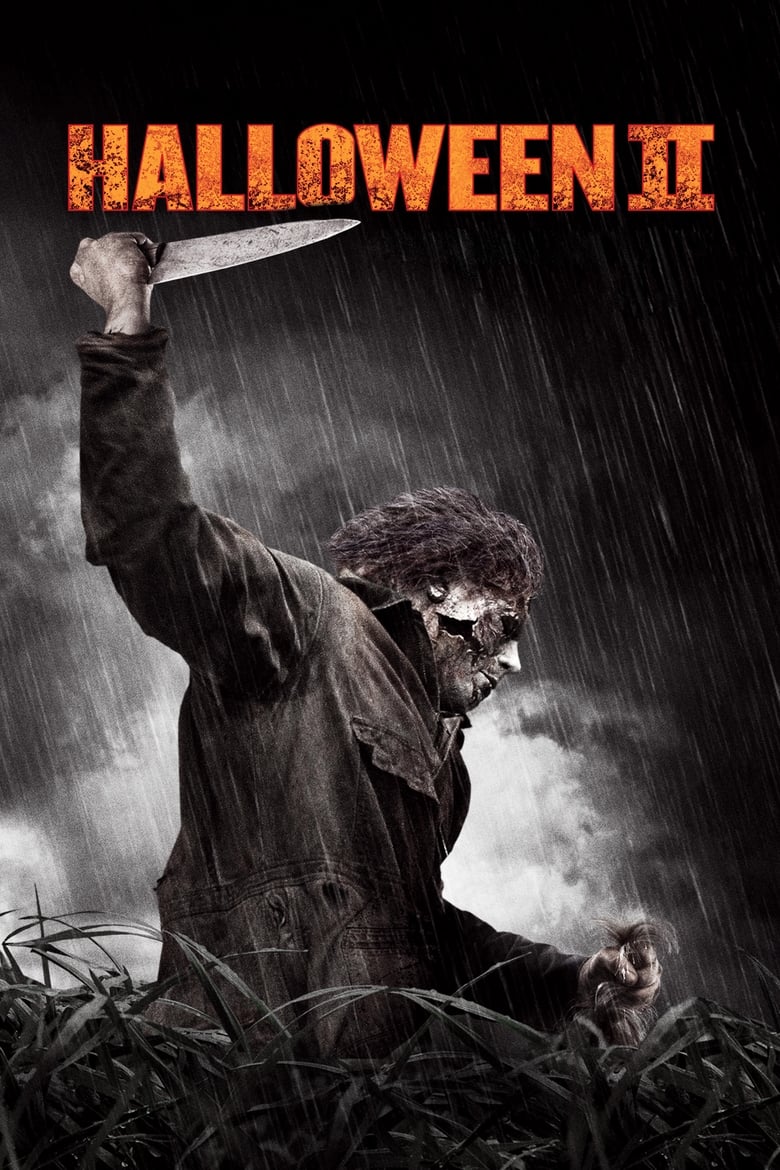
Halloween II
“Family is forever.”
Laurie Strode struggles to come to terms with her brother Michael's deadly return to Haddonfield, Illinois. Meanwhile, Michael prepares for another reunion with his sister.
About Halloween II
Why Halloween II is still worth talking about
Start with the white toy horse. In a flashback set during Michael Myers’ time at Smith’s Grove, his mother gives him that horse — a tiny object that the film keeps returning to until it reads less like a prop and more like an accusation. It’s a clever trick: a small domestic thing that drags the story’s quietest cruelty into focus.
Rob Zombie’s 2009 follow-up refuses to be a polite slasher sequel. It runs for 105 minutes and treats the Halloween myth as family business: Laurie Strode is a damaged survivor, Michael is the roaming ghost of a childhood, and Sam Loomis has a hand in dragging that private history into public view. That choice — to make the household the real crime scene — is where the film earns its arguments. The cast is full of familiar names who plug into those ideas: Malcolm McDowell as Samuel Loomis, Scout Taylor-Compton as Laurie Strode and Tyler Mane as Michael Myers. They’re not props; they’re the wiring that lets Zombie turn ordinary domestic threads — parents, protection, loss — into something ugly and persistent.
The idea that sets Halloween II in motion
The film picks up in the awkward silence after violence: fifteen years after she shot Michael, Laurie is drifting through Haddonfield in shock. That wandering — more stunned than heroic — is the human start-point the movie keeps coming back to.
At the same time, Michael’s corpse is being moved and then suddenly rouses: during transport he wakes and kills a paramedic after a crash. The simple fact of his return is less a plot surprise than the engine that forces people back into each other’s lives.
From there the mechanics are blunt and urgent: Michael works his way toward whoever keeps the family thread alive, striking at parties and homesteads until Laurie is dragged, again and again, into the middle of it.
It’s an efficient setup. Trauma plus unfinished business equals a chase that isn’t purely physical — it’s also a pulling of private history into public space, and that’s why the premise keeps the film taut even when the scenes get messy.
Why Samuel Loomis matters
Samuel Loomis is the practical conscience of the story — the man who turns private horror into a public narrative. Malcolm McDowell plays him, and the film uses Loomis not just as an investigator but as the person who monetises tragedy when his book leaks Laurie's real identity as Angel Myers.
That revelation — Laurie as a member of the Myers family — reframes everything Loomis touches. He’s not only trying to explain Michael; his actions reshape other people’s lives. In that sense, Loomis is the character who drags family out into the light, whether anyone wants that exposure or not.
The movie amplifies the family theme with repeated return visits to Michael’s past: the flashback where his mother gives him the white horse, and later shared visions of the Myers’ mother seen by Michael and Laurie alike. Loomis sits at the centre of that cyclone; his book and his presence keep turning private grief into a story everybody reads.
Which matters because the film keeps asking whether family is protection or contamination. Loomis is the force that insists we know the answer — not gently, but loudly and publicly.
Halloween II has more on its mind than the plot suggests
On the surface it’s a slasher: a killer returns and people run. Underneath, the film keeps steering back to family. Parent-child bonds, fractured households and the question of inheritance — moral and genetic — are constant returns in the story.
Loss is ever-present. Laurie’s shock, the Brackett family’s ruptures and the carnage of the party scenes make bereavement feel like the film’s weather: sometimes a quiet fog, sometimes a hurricane.
Home and safety are treated skeptically. Houses and hospitals are supposed to be sanctuaries, but here they’re invasion points: the violence that follows Michael into these places makes the idea of a safe house feel fragile rather than guaranteed. Mortality threads through all of it. Characters try to grasp freedom or protection within the limits of life and death, and those attempts — whether by retreat, confession or revenge — are what make the horror feel less like genre mechanics and more like human bargaining with fate.
Halloween II could not belong to any other decade
Being released in 2009 places this Halloween II firmly at the end of the 2000s, and that timing matters. It’s a film made when franchise reinterpretation and darker re-examinations of familiar characters were common impulses.
That moment in the 00s liked to pull established myths apart to see what held them together. Here, Rob Zombie does exactly that: he uses the recognised shape of Michael and Laurie to ask uncomfortable domestic questions rather than to reproduce comforting genre beats.
So while it’s a slasher in the technical sense, it wears its decade like a mood: one where horror often doubled as excavation, and where the personal histories of monsters were put under a microscope.
What has aged — and what hasn't
Certain things still land. Laurie’s wandering and the film’s refusal to paper over trauma give the story some emotional teeth: seeing a protagonist visibly unravel years after an attack keeps the stakes personal, and that feeling reads well for a modern viewer.
The movie’s teen angle sits awkwardly in places. The party sequences and ancillary young characters are textbook ‘teen-slasher’ elements — they’re serviceable, but they’re also the familiar scaffolding that can make parts of the film feel conventional.
Family and home remain potent. When Michael invades domestic spaces — the Brackett house, the party, the hospital — the violation feels meaningful rather than purely sensational. Those scenes still carry an edge because the film keeps returning to what a home is supposed to protect.
The violence is blunt and unflinching; deaths such as the attacks at the party and the Brackett home still shock because the losses are written as real ruptures in people’s lives, not just set pieces to clear the cast.
Why Halloween II still matters
There are a handful of images that stick in the memory: the white horse from Michael’s childhood, Laurie wandering Haddonfield in shock, the moment a paramedic realises the body in his ambulance isn’t as dead as everyone thought. Those beats give the film a handful of emotional anchors people can point to.
The movie also reshapes relationships audiences thought they knew. Loomis’s book turning Laurie's identity into public knowledge, and Michael’s ghostlike pull toward maternal images, make this version of the story about inheritance and shame as much as about brute force.
And then there are the losses that feel narratively important: the party attack, Annie’s death in Laurie’s arms, and the scene where the family structure finally snaps. These are the moments viewers remember because they change who the characters become. Finally, the film closes on a private, eerie note — Laurie isolated in a psychiatric ward with the same childhood horse reappearing — which makes the whole thing feel less like a concluded sequel and more like an uncomfortable coda about what trauma leaves behind.
Does Halloween II still hold up?
Yes — but with a health warning. If you go for tidy sequels or pure slasher thrills, this isn’t the place: Rob Zombie’s film is interested less in repeating beats and more in making the family map messy. Laurie’s post-traumatic drifting, Loomis’s publicising of private tragedy and the recurring white horse mean the movie rewards viewers who want the darkness to have roots.
It does demand patience. The story gives us a year of aftermath before Michael reappears, lets Loomis spin his book tour into the plot, and ties identity to inheritance in ways that feel deliberate rather than decorative. That’s where the film earns its emotional power, even when it’s uncompromising.
Some sequences are raw in a way that still works: invasions of supposedly safe spaces and the genuine human losses that follow make the horror feel personal. And because the movie keeps returning to family and mortality, its final images — Laurie confronting the past and the white horse reappearing — land as a bleak, coherent punctuation.
If you’re curious, watch it for the parts that bother you as much as the parts that thrill you. Halloween II doesn’t ask to be loved; it asks to be reckoned with. That makes it the kind of horror that won’t quietly fade — it clings to the house and the family, and it wants you to notice.