
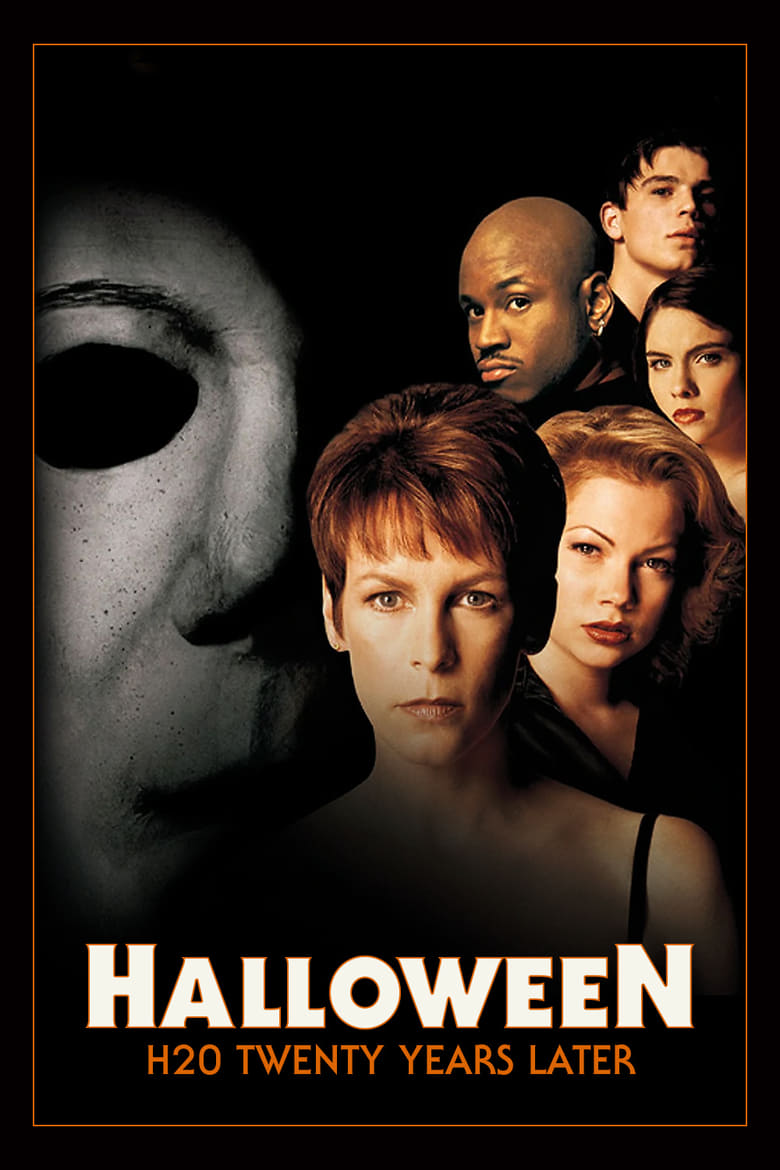
Halloween H20: 20 Years Later
“This summer, terror won't be taking a vacation.”
Two decades after surviving a massacre on October 31, 1978, former baby sitter Laurie Strode finds herself hunted by persistent knife-wielder Michael Myers. Laurie now lives in Northern California under an assumed name, where she works as the headmistress of a private school. But it's not far enough to escape Myers, who soon discovers her whereabouts. As Halloween descends upon Laurie's peaceful community, a feeling of dread weighs upon her -- with good reason.
About Halloween H20: 20 Years Later
What Halloween H20: 20 Years Later gets right
The film opens with a simple, unnerving fact: twenty years have passed since Michael Myers first hunted Laurie Strode. That gap is the engine: H20 is less interested in reinventing the wheel and more in asking what happens to the person who has been running for two decades.
Steve Miner keeps the whole thing tight — a lean 83 minutes that doesn’t linger on exposition. Jamie Lee Curtis returns as Laurie, and the movie uses her presence like a lens, forcing the audience to think about family and fear rather than clever twists for their own sake. Underneath the slasher beats, H20 sets up quieter themes — identity, parental protection and mortality — by placing Laurie in a new life she’s tried very hard to build and keep secret. That tension between a woman trying to be a mother and the inevitable return of the thing she fled gives the film a particular personality that still hooks viewers.
The idea that sets Halloween H20: 20 Years Later in motion
The simple hook is practical and ruthless: after an explosion at Haddonfield Memorial Hospital, Michael Myers’ body is presumed gone. That presumed death is the quiet lie the movie builds on — it gives Laurie a chance to bury the past, and the audience a reason to believe it might finally be over.
But the film shows you how fragile that peace is. A small security lapse — Ronny investigating a stolen truck at the school gate — is enough to let Michael slip back into the world he never really left. H20 makes the return itself banal, which is more unsettling than a grand reveal.
Laurie’s private logic matters here. Following Norma’s advice in the story she briefly lifts her mask and tells Will who she really is, and realises with a chill that her son John is now the same age she was when everything began. That arithmetic turns a routine chase into something generational.
Once the authorities flood the campus and the school becomes a crime scene, the set pieces narrow down to one thing: Laurie deciding she will not run anymore. The setup works because it keeps the stakes small and human while allowing the slasher elements to do what they do best.
Why Laurie Strode matters
Jamie Lee Curtis’s Laurie is the anchor. She’s not just a final girl who survived the first time; twenty years on she’s a woman who’s tried to make a life out of that survival. That shift — from scared teenager to mother and headmistress — is the film’s most interesting move.
Laurie lives under a new roof with her son and runs a private boarding school. She has people who support her at work and a relationship that holds up the new life she’s built. Those facts turn the movie’s central conflict into a domestic nightmare: this is about a mother fighting to protect everything she’s cobbled together.
You can see how the trauma has shaped her day-to-day. The story makes a point of Laurie suffering nightmares and alcohol problems rather than pretending she’s returned to normal; those details explain why her fear isn’t simple melodrama but the residue of a lifetime spent waiting.
She’s not idle either. When students go missing and friends are killed, Laurie joins the search, which culminates in a face-to-face with Michael — the first time in twenty years. That reunion carries weight precisely because she’s been living in the shadow of that possibility; this isn’t a random chase, it’s the confrontation the entire film has been winding towards.
Halloween H20: 20 Years Later has more on its mind than the plot suggests
At surface level H20 is a slasher: menacing presence, trapped teenagers, and a protagonist with an axe. Underneath that, the film keeps returning to family — what you inherit from your past and what you try to protect from it.
Mortality is threaded through the script. The idea that someone presumed dead could return forces characters to reckon with how long a threat can last and how it shapes ordinary life. Laurie’s choice to fake her death and live under an assumed name is an attempt to outrun both identity and fate.
Loss and friendship matter too. The movie treats the murder of neighbours and classmates as more than set dressing; those deaths calibrate Laurie’s desperation to keep her son safe. The friendships among the younger characters provide a human contrast to Laurie’s solitary vigilance. There’s also an identity question: Laurie’s double life as someone else, and the way she must reveal herself to protect her child, turns the final conflict into something about parenting as much as survival. It’s not just a hunt; it’s an argument about what a mother will risk to end a threat for good.
Halloween H20: 20 Years Later could not belong to any other decade
H20 arrived in 1998, right at the end of the decade, and it wears that timing like a positioning statement: a legacy horror title bringing back its original survivor for another round. The release year matters because the film is explicitly about two decades passing.
The movie leans on continuity and memory — small plot beats, like a former colleague returning to find Laurie’s file missing, are triggers rather than full explanations. That feels very 90s in its approach: reckon with the past, then move fast.
That late‑90s sensibility also gives the film a particular economy. It wants to get the characters in place and let the emotional hooks do the heavy lifting, rather than pausing for endless exposition or self‑aware commentary.
Put simply: this is a 1998 slasher that understands its job. It brings back a known character, counts the cost of time, and uses the decade’s appetite for sequels and continuations to ask what change really looks like.
What has aged — and what hasn't
What still works is the central idea: a survivor who has spent a life preparing for the inevitable return. That emotional throughline — Laurie as a mother and headmistress whose day-to-day is shaped by trauma — gives the film a seriousness many slashers skip, and that holds up.
The parental stakes still read clearly. The film repeatedly asks whether it’s better to shelter a child entirely or to prepare them for a dangerous world; that argument feels contemporary rather than quaint, and it gives Laurie choices that remain watchable.
Some individual beats are of their time, but the human logic behind them is durable. The sequence where Molly and John escape and then reunite with Laurie is effective because it’s about connection under pressure, and those moments don’t date easily.
Where the movie shows its age is in structure: it’s tight and economical in ways modern horror sometimes isn’t. That economy can feel briskly efficient or thin, depending on what you want. But if you come for a short, character‑centred slasher about loss and survival, H20 still does the job.
Why Halloween H20: 20 Years Later still matters
People who grew up with H20 remember it for its central reunion: Laurie alive, living under another name, and forced to reckon with a past she tried to make invisible. That return — Laurie as Keri Tate, mother and headmistress — is the film’s lasting image.
There are a handful of narrative moments that lodge in the memory: a neighbour’s file gone missing, the quiet way Michael slinks back into a campus via a stolen truck, and the personal cost when acquaintances are murdered. Those beats stitch fear to everyday life.
Laurie’s willingness to stop running — from hijacking a coroner’s van to taking an axe to end the chase — gives the film a grim, conclusive energy that viewers remember. It’s a final‑fight that feels like the end of a particular story and so lives on as a satisfying closure for some. Above all, H20 matters to its audience because it brought a survivor back into the spotlight and made her struggle the point. For fans who wanted to see Laurie confront Michael as a mother rather than a frightened teen, that was enough to keep the movie in conversation.
Does Halloween H20: 20 Years Later still hold up?
Yes — with a couple of important caveats. If you’re after a tight, late‑90s slasher that treats its survivor as an adult with real stakes, H20 delivers. It’s a brisk 83 minutes, directed with purpose by Steve Miner, and it gets to the emotional argument quickly: what does survival cost you when it becomes a way of life?
The film’s strengths are its focus and its central conceit: Laurie living as Keri Tate, trying to be a mother while haunted by her past. That combination of identity and parental protection keeps the horror grounded in human terms instead of turning every moment into spectacle.
If you watch for long, modern conversations about horror’s shape you might find it simple; but if you want a film that makes Laurie’s decades of fear the plot’s motor — and is willing to let her take agency in ending it — then H20 remains watchable and often affecting.
So yes, watch it. Not because it rewrites horror history, but because it finally gives the woman who ran for twenty years a chance to stop — and the movie remembers to ask what she had to give up to do so.