Halloween Ends
“Only one of them will survive.”
Four years after the events of Halloween in 2018, Laurie has decided to liberate herself from fear and rage and embrace life. But when a young man is accused of killing a boy he was babysitting, it ignites a cascade of violence and terror that will force Laurie to finally confront the evil she can’t control, once and for all.
About Halloween Ends
Why Halloween Ends still works
Right away the film gives you a concrete, awful thing to hang on to: a babysitting prank on Halloween night that goes catastrophically wrong. That single incident — a young man left alone with a child, a closed attic door, a fall — sets the moral and emotional freight the rest of the picture hauls around.
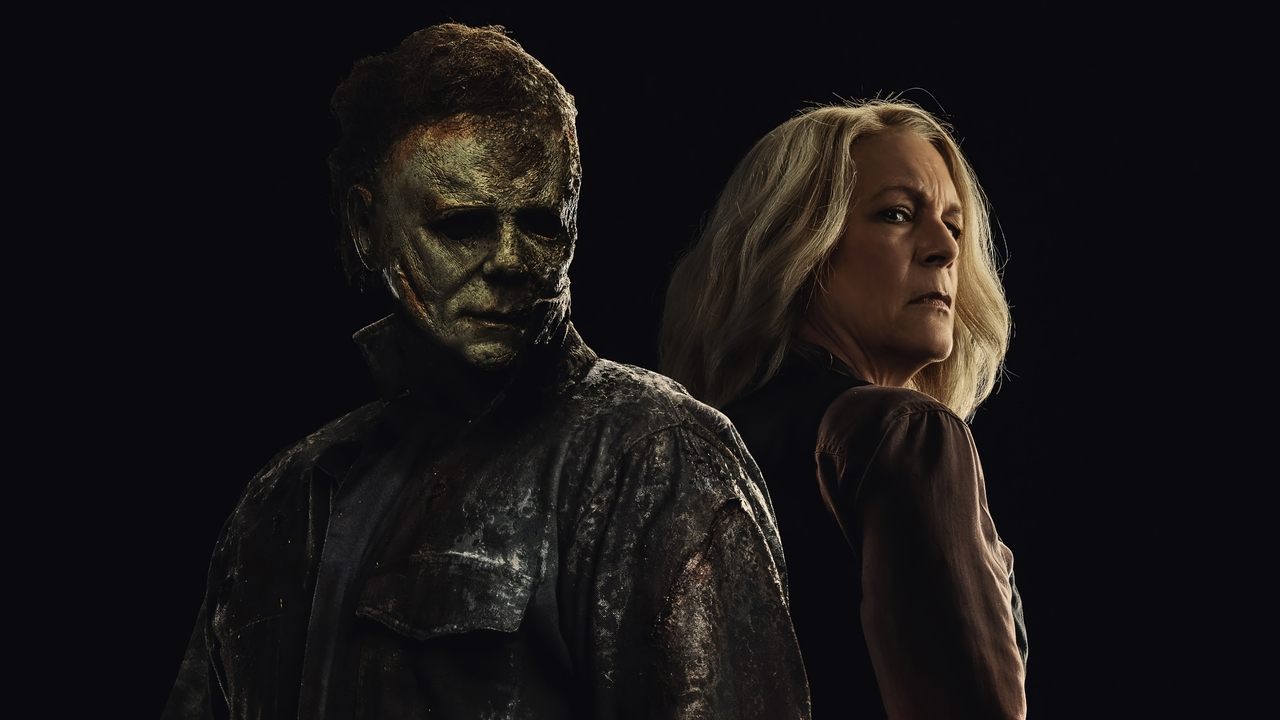
David Gordon Green directs this 111-minute 2022 instalment with the blunt aim of settling scores: Jamie Lee Curtis’s Laurie Strode is here, older and writing a memoir, living with her granddaughter Allyson — so the personal stakes are never abstract. At the same time the movie expands outward, following Rohan Campbell’s Corey Cunningham as the town turns him into an outcast. Call it horror and call it slasher — the labels fit — but what keeps the film talking is how those genre beats are braided with family, home and the costs of living under constant threat. That mixture is what makes this one worth revisiting.
The idea that sets Halloween Ends in motion
The film starts in a town still raw from recent carnage: Michael Myers has vanished, but Haddonfield hasn’t recovered. Into that unsettled quiet steps a young man whose life was ruined by one terrible accident years earlier.
Corey, who lives on the margins and works at a salvage yard, drifts toward Allyson — Laurie’s granddaughter — and for a while the movie lets them be a normal, if wary, couple. Normality doesn’t last. Old suspicions, petty cruelties and the town’s appetite for blame make a tinderbox of their relationship.
Parallel to that is Laurie’s own project: she’s writing a memoir and trying to keep a home that has been defined by loss for decades. When she realises the threat around Corey is not just social ostracism but something darker, her protectiveness fractures into suspicion.
From that point the set-up tightens into a last act where the town’s grief, a chain of violent choices and a final confrontation all collide — and the movie chooses to resolve its long-running question about Michael not by myth but by very human, bloody means.
Why Laurie Strode matters
Laurie Strode remains the film’s emotional fulcrum not because she is simply a survivor, but because she has spent a life building defences around a house that once failed her. Here she’s older, quieter in some ways, but still doubling as guardian — of memory, of family, of a small town that looks to her when it is frightened.
That domestic focus — Laurie writing a memoir, living with her granddaughter — gives the horror a human scale. The film keeps returning to the idea that violence doesn’t only arrive with a masked killer; it reverberates through relationships. Laurie’s instincts are shaped by those reverberations.
Her relationship with Allyson is where the character’s flaws and virtues meet. Trying to protect a younger generation, Laurie sometimes errs toward suspicion; that very protectiveness is what eventually strains her bond with Allyson when she comes to believe Corey has been changed by an evil beyond him.
In short, Laurie matters here because she personifies a question the movie won’t let go of: how do you live after being defined as the witness and the victim? The answer isn’t tidy, and that tension is what keeps her interesting.
Halloween Ends has more on its mind than the plot suggests
At a glance it’s a slasher: there’s a mask, there’s a body count. But the movie keeps pulling back to family — not just the nuclear unit, but the messy inheritance of trauma that passes between parents, grandparents and children.
Home and safety are treated like a ledger you can never quite balance. Houses that should protect people are where violence happens, and Laurie’s attempt to shore up a household becomes a central battleground.
Mortality and lifespan are constant companions. This is a film that counts years, that watches a life arc from youthful error through ostracism to rage, and it asks whether characters can ever be freed from the moments that define them. Loss and fear are the glue. Whether the threat is a mask in the dark or a town’s refusal to forgive, the picture stages fear as something social — a thing that spreads and warps community, not just an individual.
Halloween Ends could not belong to any other decade
Released in 2022, this is very much a 20s story: it expects audiences to accept a long, multi-film history and then asks them to sit with the emotional consequences of that history. It’s a decade comfortable both with revivals and with asking what extended narratives do to ordinary lives.
The film’s insistence on family, lifespan and the aftermath of violence feels contemporary. Rather than treating Michael as an eternal enigma, the movie folds the myth into the lives of people who must keep living afterwards — a preoccupation that matches other 2020s attempts to make legacy characters answerable to now.
There’s also a bluntness to its choices that suits the period. In a culture keen on tracing trauma maps across generations, Halloween Ends makes the slasher’s bloodletting a late chapter in a community’s ongoing story instead of an isolated spree.
Put simply: it’s a horror movie of the 2020s because it wants to close the loop on a decades-long narrative while talking about how that loop leaves ordinary people with very messy lives to clean up.
What has aged — and what hasn't
The central human drama — a young man ruined by an accidental death and then turned into a pariah — still lands. The idea that an entire town can turn an error into a life sentence for someone is grim, but recognisable; it still gives the film emotional teeth.
Themes about home and fear hold up. Laurie’s attempt to protect family against something repeating itself is, even now, a clear engine: viewers who respond to character-driven stakes will find that the domestic threads survive the years.
Some of the film’s violent choices — the way characters are threatened, pushed and then pulled into darker acts — will feel sharper or blunter depending on your tolerance for moral ambiguity. Scenes that hinge on mistreatment by bullies, the threat from a homeless person, or retaliatory killings ask the audience to accept morally messy reversals rather than tidy justice.
Ultimately the picture aged best where it kept the focus personal. When it lets townsfolk and relationships determine the course of violence, the story still reads as human—even if some of the specific plot turns remain difficult to swallow.
Why Halloween Ends still matters
This film matters because it wants to give an ending to several connected lives, not just to a mask. The story begins with a single traumatic babysitting incident and follows the ripple effects — a man shunned, a granddaughter caught between loyalties, a town that refuses simple closure.
Corey’s arc — from that one night to being relentlessly judged and pushed into something darker — is what stays with you. The movie turns the slasher into a social drama about blame and belonging: who gets punished, who gets forgiven, and who is allowed to walk away.
Laurie’s finale, and the scene where the town witnesses a closed chapter, matters because it translates a decades-long horror myth into civic ceremony. There’s a communal quality to the way the residents are involved in that ending; it’s not just a private reckoning. And yet the last image — Laurie keeping the mask — is a neat, unsettling afterthought. Even after the shredder and the procession, memory lingers. That unresolved hint is why people keep bringing the film back into conversation.
Does Halloween Ends still hold up?
If you want a straight slasher that lives for how inventive it can be with a knife, this isn’t the purest example: Halloween Ends is a slasher that keeps pulling you back into questions about family, blame and how communities remember violence. That approach will either be what you like about it or what frustrates you.
The film does something braver than repeat old beats: it uses Laurie — an older woman writing her life — to ask what happens when trauma outlives the people who first experienced it. The scenes in which Laurie and Allyson reckon with Corey's past, and where the town consumes those reckonings, give the movie emotional weight.
At the same time, some of the darker turns — the way Corey becomes a target and then a perpetrator, the messy chain of retaliations — are uncomfortable in ways that aren’t accidental. The picture invites discomfort; it isn’t trying to make everything tidy for the audience.
So yes, it’s worth watching today — especially if you care about endings that try to do more than simply dispatch a villain. Halloween Ends closes a long story by insisting its final act be about people, not legend. It won’t please everyone, but it leaves you thinking about what a town keeps when it thinks it has buried its ghosts.