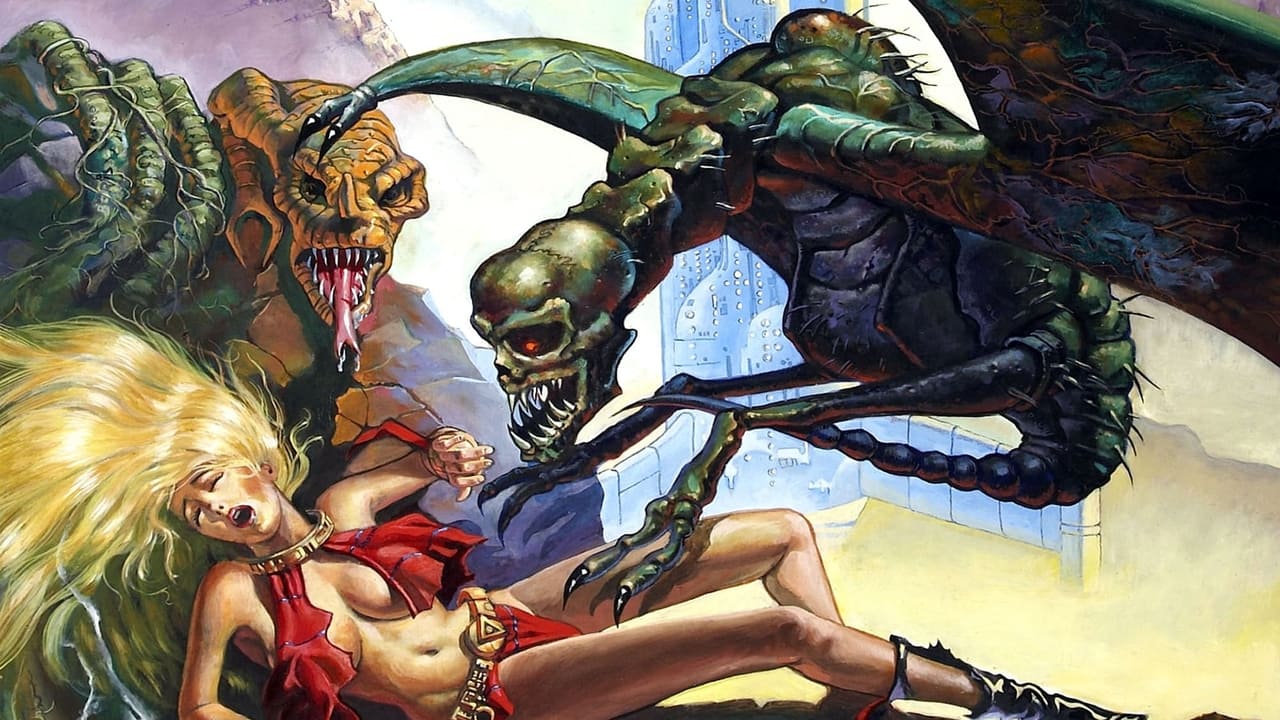

Galaxy of Terror
“ALIEN was the beginning… Hell Has Just Been Relocated!”
As a lone spaceship proceeds on its long voyage across space, the crew are surprised to encounter a strange pyramid form. Surprise turns to horror as one by one, they discover that their darkest nightmares are all starting to become real. The pyramid has to be behind it all somehow, but how can they save themselves from its influence?
About Galaxy of Terror
Why Galaxy of Terror is still worth talking about
There’s a bluntness to Galaxy of Terror that demands attention. It opens with a planet called Morganthus and a single, terrible fact: something on that world has already killed the last survivor of a crashed ship. It’s a tidy invitation to worry.
Bruce D. Clark directs at a sprint — the film is only 81 minutes long — and that sense of hurry becomes the movie’s personality. It brings together a small, recognisable cast (Edward Albert as Cabren, Robert Englund as Ranger, Taaffe O'Connell as Dameia and Erin Moran as Alluma among them) and funnels them into a straightforward mission that turns unexpectedly vicious. Why talk about it now? Because Galaxy of Terror takes a handful of high‑concept ideas (a mysterious Planet Master, a pyramid that’s more game than ruin, people facing literalised fears) and commits to their nastiest outcomes without hedging. That kind of single‑mindedness keeps it interesting in a way glossy, over‑polished sci‑fi often isn’t.
The idea that sets Galaxy of Terror in motion
At its simplest, Galaxy of Terror is a rescue mission gone wrong — but the film signals early that the wrongness won’t be a simple monster ambush. One crewmember, Cos, becomes terrified aboard the ship; that fear is shown in the film’s willingness to be grotesque and literal.
When Cos encounters an apparently harmless object, things escalate quickly and physically: a fragment slides through his skin, and in desperation he severs his own arm to stop it. The arm itself then animates and kills him. That sequence does two jobs at once — it shocks, and it underlines that whatever is happening on Morganthus doesn’t follow ordinary rules.
From that kind of moment the narrative grows: the stakes are personal, the threats intimate and unpredictable. The setpieces aren’t there to pad a runtime; they reveal a premise that turns private fear into a weapon.
And the film’s resolution plays on that exact idea. Cabren survives the sequence of tests, is declared to have “won” the game and, in an angry, ambiguous final turn, kills Kore — only to find himself transformed into the new Planet Master. The story begins as rescue and ends as succession.
Why Cabren matters
Cabren is the spine of the film. Edward Albert plays the specialist who, along with Ranger and Alluma, is separated from the rest of the crew and forced into the pyramid’s challenges. That confinement turns him from another face in a crowd into the story’s decision‑maker.
What makes Cabren memorable isn’t a single bravura moment but the arc built into his situation: he’s at the centre of the film’s mechanics — discovering that the planet conjures monsters tailored to people's fears and that the pyramid is, bizarrely, a test — and he’s the one who stays to finish it.
He is forced to kill the creatures that attacked his friends and even to dispatch zombified versions of the victims. When the game ends and Kore, the ship’s cook, is revealed as the Master, Cabren has to choose how to respond to that final provocation.
His choice is consequential. Cabren wins the game, tries to leave Morganthus, then kills Kore in anger — only to become the new Planet Master himself. That inversion — survivor becoming successor — gives the character a weirdly classical weight: he’s not just a man who survives, he’s the last link in a chain.
Galaxy of Terror has more on its mind than the plot suggests
The film’s central trick — that the planet manufactures monsters drawn from a person’s deepest fears — gives it an idea to chew on. Fear isn’t abstract; it gets physical, intimate and specific to each character. That makes the horror personal in a way that broadens its emotional reach.
The pyramid at the story’s heart reframes the whole planet as something resembling a lesson rather than a battlefield. We’re told the structure is an ancient toy built to test a vanished species’ children, which casts the film’s violence as a kind of perverse education: survival through mastering terror.
Those two concepts — fear made flesh and a testing mechanism built into the world — let the movie touch on broader questions without ever pausing for a lecture. Ideas of authority, power and control are smuggled into the plot simply by making the characters compete to survive an imposed system. Add in the recurring sense of limits — mortality, lifespan, the protection one might try to offer others — and Galaxy of Terror feels less like a series of shocks and more like a short fable about who gets to keep power once a cruel test ends.
Galaxy of Terror could not belong to any other decade
Released in 1981, Galaxy of Terror sits at a particular moment when genre filmmaking loved to mix and match: action, science fiction, monster spectacle and horror all rub shoulders in a compact runtime. That mash‑up sensibility feels very much of the early‑80s appetite for quick, high‑concept thrills.
It’s a B‑movie approach — big ideas cooked on a small scale — and that economy is part of its identity. The film doesn’t luxuriate; it drops the crew onto a strange planet, stages a handful of grotesque setpieces, and moves on. The result is lean and slightly reckless in a way that belongs to that era.
There’s also something comfortably period about the way the story treats authority as a game to be won or lost — an attitude that fits with other early‑80s films that toyed with institutional power by putting ordinary people under extreme pressure.
Put simply: the film’s shape — short, punchy, genre‑minded — reads as an early‑80s document. It doesn’t feel like a modern prestige reinterpretation; it’s a product of a time when a small crew and one weird idea could make a movie worth arguing about.
What has aged — and what hasn't
The core premise still punches. Turning inner terror into literal threats remains an effective trick: once the film commits to personalised, fear‑based monsters, the stakes are immediate and easy to grasp.
Because the pyramid is framed as a test — an ancient toy for a vanished race’s children — the movie keeps a clear logic behind its nastiness. That logic helps it survive awkward production moments: you accept a lot if the story gives you a reason for the ugliness.
Where the film less comfortably meets modern taste is in its willingness to push body horror and explicit brutality to shocking extremes. Those sequences still unsettle, but they’re also the shots most likely to feel gratuitous to viewers who prefer horror that leaves more to the imagination.
Ultimately, Galaxy of Terror plays as a piece of compact, ambitious genre filmmaking. Its central ideas about fear and the structure that enforces it remain the movie’s strongest card — and that card still pays off for viewers who can accept its rough edges.
Why Galaxy of Terror still matters
People remember this film because it keeps delivering moments that lodge in the mind. Whether it’s the crew discovering a crashed ship’s last survivor has been killed, Quuhod’s encounter with a living crystal star and the horrific consequences that follow, or the giant maggot sequence that brutally dispatches Dameia, the film accumulates images that are hard to shake.
There’s also a persistent narrative thread that lingers: the Planet Master — an aura‑shrouded figure who sends a commander to fetch the Quest and plays a chess‑like game with a seer who warns of ruin — gives the movie an oddly mythic frame. That distant, controlling presence explains why the tests happen and gives the ending a bitter symmetry.
The rescue mission itself furnishes small, memorable beats: the scarred Captain Trantor landing against the odds, the crew finding what looks like a massacre and bringing a single body back for analysis, the way the pyramid severs team members and forces them into lonely confrontations. Those beats make the film feel like a sequence of escalating moral and physical lotteries. Finally, the film’s last act — Cabren discovering Kore is the Master, being declared the winner and then becoming the new Planet Master after killing Kore — turns the story into something oddly fable‑like. It’s not a tidy moral, but it’s the sort of conclusion that keeps the picture in the head: survival can be succession, and winning can be a kind of entrapment.
Does Galaxy of Terror still hold up?
Yes — with a big asterisk. If you’re drawn to lean, idea‑driven genre movies that prize a single dark conceit over slick production values, Galaxy of Terror is worth a watch. It’s short, direct and unafraid to turn its premise — fear made literal, administered by a mysterious Planet Master — into a series of nasty, unforgettable moments.
If you’re sensitive to gratuitous body horror, some of the film’s setpieces will be hard to swallow. But those scenes are not random: they support a throughline about the pyramid as a test and the way the planet weaponises private terror. That coherence is why the film’s nastiness feels narratively justified rather than merely sensational.
What keeps the picture alive in memory is the combination of compact storytelling (81 minutes of brisk movement), the oddball frame set by the Planet Master and the final, unsettling twist in Cabren’s story. The film doesn’t wrap things in a neat bow — Cabren wins the game, tries to leave, kills Kore and becomes the new Planet Master — and that refusal to tidy the ending gives it teeth.
So yes: watch it if you like your sci‑fi horror lean, strange and willing to be uncomfortable. Galaxy of Terror isn’t polite company, but it’s the sort of uneasy, imaginative B‑movie that rewards a midnight screening and a brave palate. It doesn’t age into respectability; it ages into something sharper: a compact lesson in how fear can be both weapon and crown.