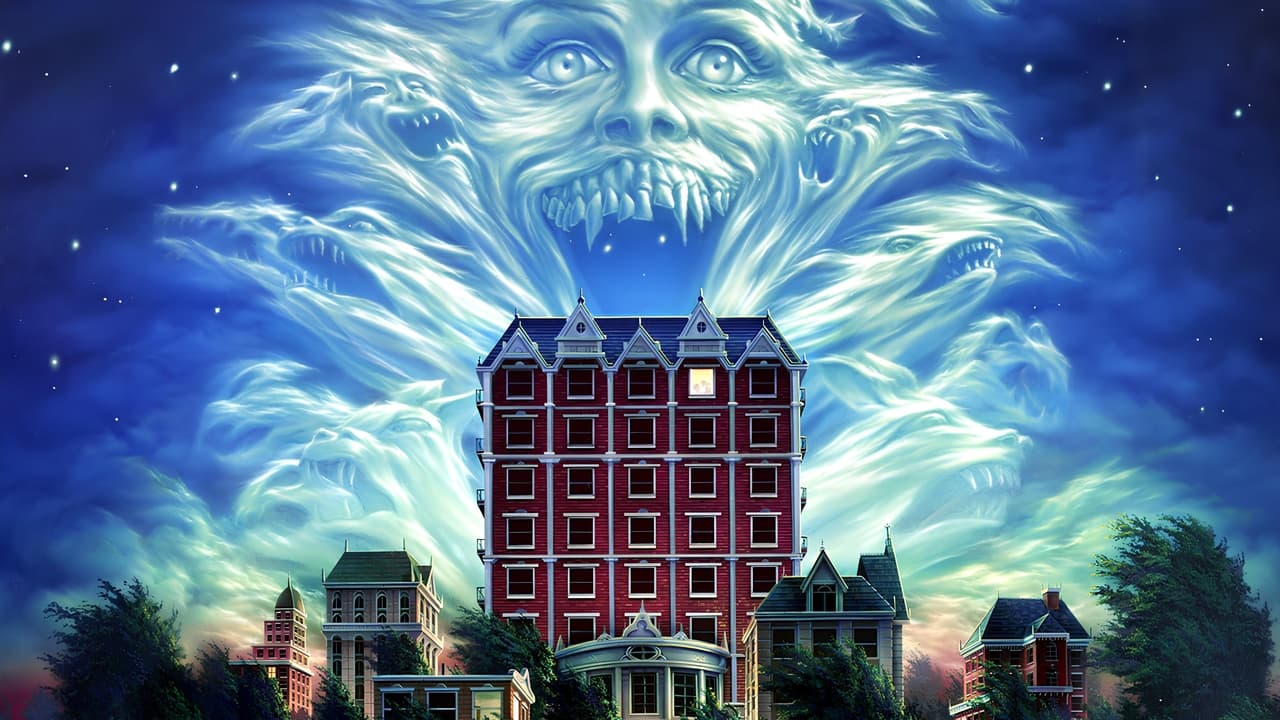
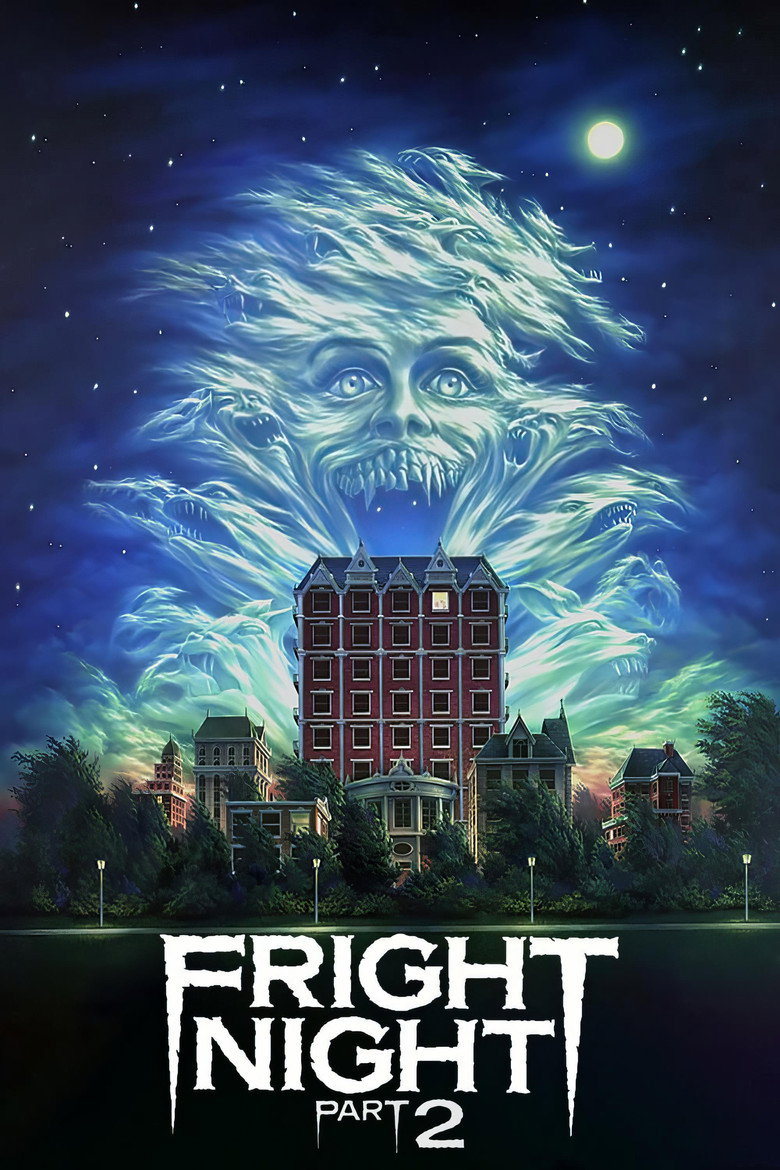
Fright Night Part 2
“Do you have a taste for terror? The suckers are back.”
After three years of therapy Charley Brewster, now a college student, is convinced that Jerry Dandridge was a serial killer posing as a vampire. But when Regine, a mysterious actress and her entourage move into Peter Vincent's apartment block, the nightmare starts again - and this time it's personal!
About Fright Night Part 2
What makes Fright Night Part 2 worth revisiting
There’s a particular kind of comfort in a horror sequel that resumes an argument rather than starting one. Fright Night Part 2 opens with Charley Brewster three years on from his first brush with the supernatural, now trying to be a normal college student and even sitting in on psychiatric therapy sessions to make sense of what happened.
Tommy Lee Wallace returns in the director’s chair for this 1988 follow-up, which keeps things compact — 104 minutes of vampire mischief, comedy and the occasional nasty surprise. It’s a film that wears its genre labels on its sleeve: comedy, horror, thriller and vampire all elbowing each other for attention. What still makes it worth a revisit is personality. Roddy McDowall’s Peter Vincent is back on the late‑night show circuit, Charley has a sensible (and baffled) girlfriend in Alex, and the movie turns the familiar into something slightly offbeat — friendship and fear are always present, but the film enjoys the in‑between moments where the trio argue, make mistakes and keep going.
The idea that sets Fright Night Part 2 in motion
The film’s engine is simple: Charley is trying to move on. Three years after surviving Jerry Dandrige, he’s a college student in therapy convinced that what happened was the work of a serial killer rather than something supernatural.
That shaky peace is broken when evidence mounts that Charley’s nightmare might not have been imagined. The discovery of Richie's body forces Charley to stop arguing with himself and face the possibility that vampires are real after all.
Peter Vincent’s role is the connective tissue — he’s Charley’s old friend and a public figure on a late‑night horror show, and when Charley runs to him with his concerns, Peter doesn’t just shrug and walk away.
The collision of denial, proof and a friend who will act even when no one believes him is the setup that keeps the movie moving without getting bogged down in mechanics. It’s less a mystery to be solved than a crisis to be handled by people who care enough to get messy.
Why Peter Vincent matters
Peter Vincent is not a throwaway gimmick. He’s an anchor — the kind of friend who gets dragged into the mud because he actually believes the person he cares about. Roddy McDowall plays him, and the script keeps returning to the idea that Peter is more than an on‑air personality.
Charley and Alex drop by Peter’s late‑night show to lean on someone who understands horror for a living. That setup gives the film a touchstone: Peter’s world is the public face of fear, whereas Charley’s is private, messy and stubbornly in denial.
Peter’s instincts matter in practical terms, too. He notices what others miss — the small telltale details that suggest Regine isn’t what she seems — and he acts on them even when he’s dismissed, which is why he later tries to stop Regine in front of the cameras.
In short: Peter is the friend who refuses to let Charley suffer alone. That loyalty — the simple, knobby‑kneed kind — is the movie’s emotional spine, and it’s why scenes where Peter barges into danger feel earned rather than theatrical.
Fright Night Part 2 has more on its mind than the plot suggests
On the surface it’s a vampire story; underneath it’s about friendship. The movie keeps returning to the ways people hold each other together when the world insists they’re wrong — friends who intervene, bail you out, break you out of a hospital and go after you when you can’t go yourself.
Denial is another key strain. Charley’s insistence that he’s simply misremembering events turns the movie into a small study of how fear can be explained away until it’s too late to ignore.
Those two ideas — friendship and fear — often play against each other. The friends are useful precisely because they refuse the easy, comfortable explanation: they see what Charley can’t or won’t admit. So while Fright Night Part 2 brings the gory beats and the set‑piece moments, its emotional currency is made up of messy loyalties and the panic of having to believe the unbelievable.
Fright Night Part 2 could not belong to any other decade
Released in 1988, Fright Night Part 2 arrives at the tail end of the decade, and that timing matters. It belongs to a particular moment in genre filmmaking when sequels were eager to keep a tone rolling rather than reinvent everything.
As an explicitly 1980s movie, it trusts audience familiarity with the first film and doubles down on character relationships rather than attempting a complete tonal reboot.
That confidence — of returning to characters and an established dynamic — is very much of its era: films that knew their audience and turned up the volume on what viewers had already loved.
So while it wears the decade on its sleeve in attitude more than in any single stylistic badge, its place in 1988 helps explain why it feels like a continuation instead of a reinvention.
What has aged — and what hasn't
Some parts of the film still land. The central dynamics — Charley’s denial, Peter’s stubbornness and Alex as the reasonable partner who gets pulled into the mess — are straightforward and relatable, even if the world around them feels of its time.
Vampire tropes used by the film are clearly signposted: Regine’s hypnotic seduction, the discovered lack of reflection, and the slow physical changes in Charley (aversion to garlic and sunlight) are all familiar shorthand that still communicates efficiently.
Twists like Dr Harrison turning out to be a vampire and the team racing to Regine’s lair to save Charley keep the plot brisk. Those beats work today because they are built from simple, high‑stakes choices rather than complicated mythology you need a glossary for.
What feels quaint is the film’s willingness to wrap things up with a wink — the embrace and the bat‑winged final note suggest the threat lingers, which is charmingly ambiguous but also very much the sort of coda 80s audiences expected. Whether that’s satisfying depends on how much you like open‑ended mischief.
Why Fright Night Part 2 still matters
The movie sticks in the memory because of its cast of characters and a handful of striking moments. Regine’s arrival — the crates, the party, the hypnotic dance and the odd companions who range from predatory to outright strange — gives the film a villain who doesn’t merely threaten; she seduces and undermines.
The minions — Louie, Belle and the bug‑eating Bozworth — add a flavour of unpleasant unpredictability that keeps scenes tense in an idiosyncratic way. Small details like Richie turning up fine at a party and later being found dead are the kind of jolts that people recall long after the credits.
Set pieces also linger: Peter trying to stop Regine on live TV, Alex discovering Dr Harrison isn’t what he seems and the break‑out from the psychiatric hospital are the sorts of scenes that give the film its peculiarly energetic pace. Finally, the ending — friends joking that nobody would believe them, then a winged hint that the threat continues — leaves the movie in the sweet spot between closure and lingering unease. For viewers who grew up with it, that mix of friendship, bravado and unresolved danger is the emotional residue they remember.
Does Fright Night Part 2 still hold up?
Short answer: yes — if you come for a character‑driven, late‑80s vampire romp rather than a reinvention of the myth. The film knows its cast and leans on relationships: Charley’s struggle to accept what happened, Alex’s practical role as his partner, and Peter as the friend who keeps acting even when everyone else doubts him.
It’s also pleasantly economical — Tommy Lee Wallace keeps the runtime tight at 104 minutes — and it doesn’t over‑complicate its antagonist. Regine is efficiently written into the story: she arrives, she seduces, she reveals a familial motive, and the stakes ratchet up quickly.
There are moments that will feel of their moment — the theatrical beats, the overt vampire signposts and the neat, slightly cheeky ending — but those same choices give the film personality. For viewers who like their horror with a chatty centre and friends who refuse to give up, it’s still worth a watch.
If you want subtle reinvention, look elsewhere. If you want an energetic, character‑led sequel that trades on friendship, fear and a deliciously uncomfortable villain, Fright Night Part 2 still delivers. And as it closes, with Charley and Alex holding each other and a bat taking off into the dark, it leaves you with the exact mood it aimed for: a satisfied shiver.