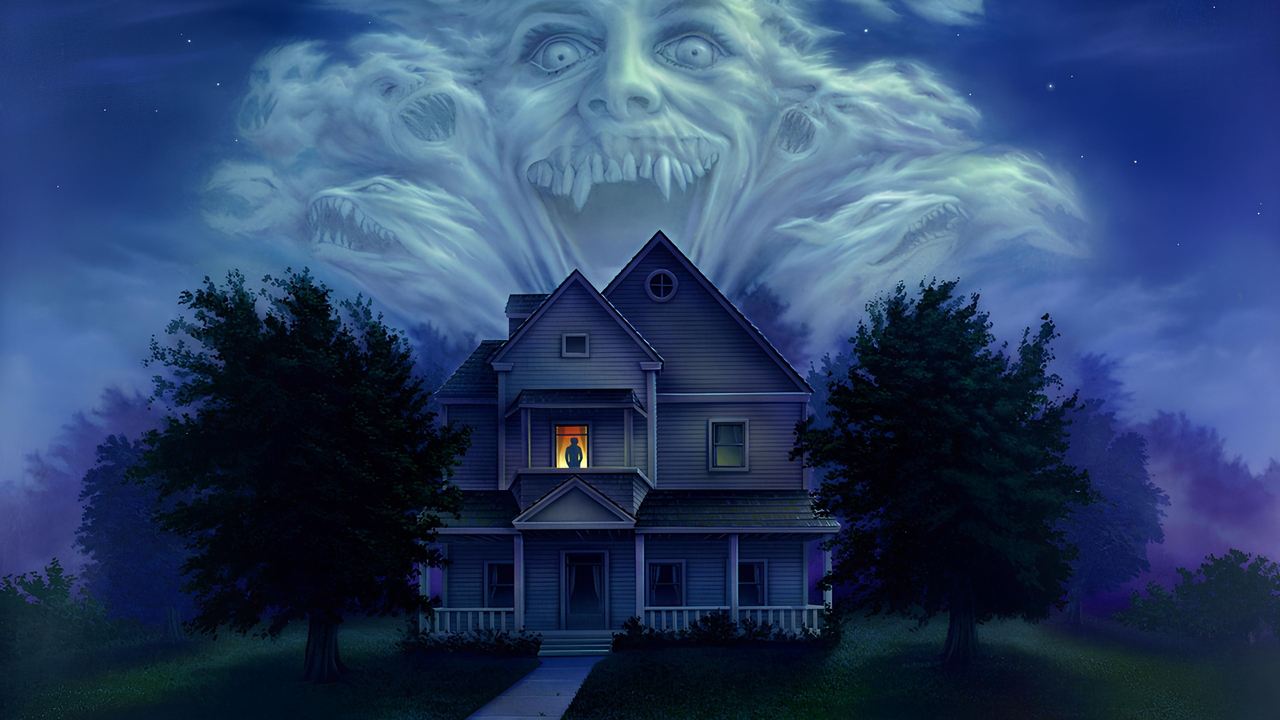

Fright Night
“There are some very good reasons to be afraid of the dark.”
Charley Brewster, a high school student, accidentally discovers the true and creepy nature of Jerry Dandrige, his dashing and enigmatic new neighbor; but no one seems willing to believe him.
About Fright Night
Why Fright Night still stands out
You remember the set‑up immediately: Charley Brewster is that kid who lives for late‑night horror, the type who keeps the telly tuned to a show called Fright Night and hangs on the host, Peter Vincent. That little fact is the movie’s opening handshake with the audience — it tells you we’re dealing with a fan’s world, not a highbrow meditation.
Tom Holland directs with an eye for squeezing suspense out of ordinary things: the neighbour you wave to, a phone call in the dark, a mother who invites a polite stranger inside. Chris Sarandon plays Jerry Dandrige, the neighbour whose politeness hides something lethal, and the film never lets the domestic setting feel wholly safe again. It’s economical filmmaking — 103 minutes, a handful of central players and a premise that keeps flipping between comedy and dread. That balance is what makes Fright Night worth revisiting; it’s a genre picture that still remembers how to tell a small, scary story without getting distracted.
The idea that sets Fright Night in motion
At its heart the film is a very simple door‑bell‑ringing premise: Charley suspects that his new next‑door neighbour, Jerry Dandrige, is more than friendly — he’s responsible for a string of disappearances. That straightforward discovery is enough to launch the whole film’s paranoia.
Charley does the sensible thing and tries to get help — his girlfriend Amy, his mate Evil Ed, even the police — but the adults either don’t believe him or actively get in the way. That refusal by authority forces the teens into improvisation, which is where the movie tightens: if no one will listen, you have to act.
The film doubles down on the tension by mixing a staged, comedic attempt to expose Jerry with a genuine, supernatural reveal. Peter Vincent’s pocket mirror gives the game away when it shows Jerry’s lack of reflection, and a dropped shard turns a trick into a real discovery — and, crucially, into real danger.
From there the stakes swell quickly: the pretend showmanship collapses into actual violence, allies are lost or turned, and the problem becomes less about proving anything and more about survival. It’s an effective escalation because the starting point was so recognisable and domestic.
Why Jerry Dandrige matters
Jerry Dandrige isn’t just another vampire; he’s the neighbour. That placement matters — Charley’s fear isn’t of a distant monster but of someone living next door, the kind of person who can be invited into your house by your own mother.
Chris Sarandon plays the part of Jerry, and the script treats him as an intimate threat: polite, plausible, and oddly tied into the idea of family. The film uses that proximity to make the danger immediate rather than theatrical.
Because Jerry’s actions start to infiltrate Charley’s home life, the emotional cost is higher. He isn’t an abstract villain at the edge of town — he’s the reason people stop sleeping with the curtains open.
That collapse of private safety is precisely why Jerry matters: he converts domestic space into a battleground, and the film asks how far a teenager will go to protect the people he loves.
Fright Night has more on its mind than the plot suggests
On the surface it’s a vampire yarn. Underneath, the film keeps returning to a handful of ideas: home and safety, fear, courage and the odd ways technology and showmanship intersect with truth.
Charley’s devotion to late‑night horror and the presence of Peter Vincent — a TV vampire hunter — make the film ask what it means to be prepared. Is watching horror a form of training, or a comforting fantasy? The film toys with both answers.
Family is threaded through the menace. Jerry’s infiltration of Charley’s household turns ordinary relationships into sources of risk, which is why scenes where a mother invites the stranger inside feel so corrosive. There’s also a neat inversion around performance: Amy hires Peter to stage a stunt (the ‘holy water’ trick) to prove Jerry innocent, and that faked spectacle collapses into real supernatural exposure. The movie is quietly interested in where theatre ends and truth begins.
Fright Night could not belong to any other decade
Released in 1985, Fright Night sits squarely in a moment when teen fears and genre playfulness lived comfortably together. It’s a film that wears its decade in the kind of storytelling choices it makes — direct, slightly cheeky and unafraid of mixing tone.
The choice to centre the plot on a late‑night TV horror show and a hammy on‑screen vampire hunter is very much of its time: media as both comfort and mockery. That particular relationship between television and identity feels of the 1980s in the way it foregrounds small‑screen celebrity as something you could grow up worshipping.
Put simply: remove it from 1985 and a few of the cultural textures shift. But the central idea — a neighbour as monster, a teen pushed into action — would still land, no matter the year.
What has aged — and what hasn't
Many of the film’s core mechanics still land: the idea of a teenager spotting danger next door, and the police or adults not taking them seriously, remains an effective engine for dread. Charley’s fandom of a horror show still reads as a believable reason he notices oddities others miss.
Some elements show their age differently. The film relies on automatic disbelief from authority figures — Detective Lennox storms out when Charley suggests vampirism — which today plays as both a genuine obstacle and a shorthand device viewers now recognise from dozens of similar stories.
The domestic terror — a polite stranger invited into a home, a mother unaware of the threat — hasn’t dated. Scenes where Charley finds Jerry inside his house still sting, because the setting is so familiar and the violation so intimate.
Moments of practical plotting, like Amy hiring Peter to stage an expose, read well as character beats: they make the fear feel rooted in relationships and bad decisions rather than in contrived shocks. The film’s blend of teen perspective and creeping menace keeps it watchable now.
Why Fright Night still matters
People who grew up with the film tend to remember its beats: a kid who knows horror, a neighbour who isn’t what he seems, a stunt that goes wrong and the slow corrosion of safety. Those story moments — Charley spotting Jerry, the staged ‘holy water’ trick going wrong, Amy’s abduction and the race to save her — stick in the memory because they’re personal, not epic.
The film keeps a compact cast of characters and gives them clear roles to play in the invasion of the household. Charley, Amy, Evil Ed, Peter Vincent and even figures like Billy and Detective Lennox all feed into the same, escalating problem, which makes the story feel cohesive rather than scattershot.
There are a couple of late‑film payoffs people talk about: the transformed allies, the basement pursuit and the sunrise solution that undoes Jerry and returns Amy to herself. Those sequences resolve the stakes in a way that honours the earlier, more intimate fear. Finally, the film leaves you with a neat little postscript — a wink that suggests the world isn’t entirely tidy. That lingering note, where the ordinary can still look suspicious, is part of why viewers remember sitting through it.
Does Fright Night still hold up?
Yes — mostly. Fright Night is still an effective little thriller because it keeps the danger domestic and immediate: a teenager notices a pattern, tells adults who won’t listen, and is forced to act. That simple throughline — Charley’s obsession with late‑night horror leading him to notice Jerry — gives the movie a clear spine.
Tom Holland’s direction and the tight 103‑minute running time keep the plot lean. The film asks you to accept a handful of escalations — a staged stunt that becomes real, friends turned into threats, a basement race against daylight — and it rarely gets bogged down in them.
The movie’s emotional core is straightforward: fear of invasion and the courage required to fight it. Charley refusing Jerry’s ultimatum and using a crucifix when it matters are moments that underline the film’s belief in personal bravery over spectacle.
If you enjoy compact genre films where the monster is as close as the next‑door house, Fright Night remains worth watching. It’s a reminder that vampires can be terrifying not because they’re grand, but because they know your street and your name.