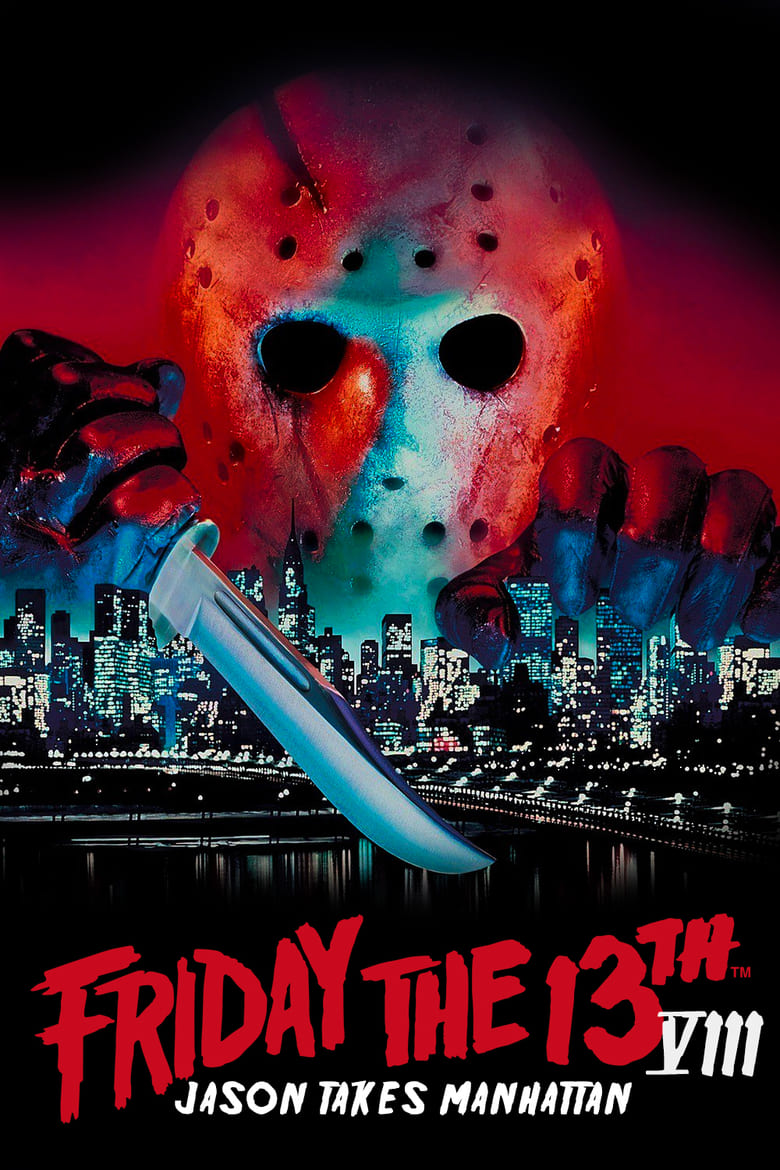
Friday the 13th Part VIII: Jason Takes Manhattan
“New York has a new problem.”
Jason ships out aboard a teen-filled "love boat" bound for New York, which he soon transforms into the ultimate voyage of the damned.
About Friday the 13th Part VIII: Jason Takes Manhattan
What Friday the 13th Part VIII: Jason Takes Manhattan gets right
You don’t start this one with a cosy campfire story — you start with a prank. A teenager on a houseboat toys with a hockey mask and a prop knife, and the movie is off. That small, knowing gag gives the film its rhythm: menace disguised as mischief, a familiar object becoming a promise.
Rob Hedden directs a compact, leanly paced 96-minute entry that refuses to treat Jason as a local mystery. Kane Hodder’s hulking presence gets uprooted from the lake when damaged cables shock the drowned legend back to life, and the series’ usual rules — bodies in the woods — are cheerfully ignored. It’s a slasher at heart: a graduating class, a chaperoned trip, a handful of unmistakable victims, and two leads — Rennie Wickham and Sean Robertson — who inherit the film’s emotional stakes. Underneath the splatter, the movie keeps coming back to a few simple ideas: freedom, family and how fear can trace back to something that happened long before the credits roll.
The idea that sets Friday the 13th Part VIII: Jason Takes Manhattan in motion
The engine here is straightforward: small-group dynamics and secrets on a moving vessel collapse into a dangerous situation. There’s a video student who records a compromising moment involving a teacher, and petty cruelties — pushing someone overboard, rejected advances — ripple outward.
Those private betrayals matter because they make the ship a place where nobody is entirely innocent and where trust frays fast. It lets Jason’s return feel less like a supernatural one-note and more like an interruption of a week that was already on the edge.
The movie signals early that basic violence won’t stop meaningfully surprising anyone. A prom queen is killed with a shard of mirror after a shower; a would-be fighter finds out that punching a myth doesn’t work the way you think. The set-pieces are blunt but they land.
All of that funnels into a pared-down final geography: Rennie and Sean climbing a ladder as Jason staggers after them — an image that makes the film’s simpler logic clear. It’s a series of confrontations boiled down to movement and survival.
Why Jason Voorhees matters
Jason isn’t just a walking weapon here; he’s a force that rewrites locations. The film gives us the moment of his return — shocked awake by damaged cables — and then treats him like the inevitable outcome of a bad day where boundaries have already been broken.
That hockey-mask prank at the start is a neat piece of business: the mask is a token people can joke about, but the joke flips back on them. It’s a reminder that Jason’s presence in the story is both literal and symbolic — the past showing up to claim attention.
Within the ship’s micro-society, Jason is the ultimate equaliser. He doesn’t make moral distinctions between a jealous student, a would-be rock star or a petty bully. The film leans on that blunt fairness: he is less about motive than consequence.
There’s also a quieter thread running under the pounding: family. The movie keeps nudging at relationships — guardianship, blame, inherited fear — which makes Jason more than a monstrous set-piece. He becomes a measuring point for why people behave the way they do.
Friday the 13th Part VIII: Jason Takes Manhattan has more on its mind than the plot suggests
Strip away the murders and you’re left with a few blunt human concerns. The film keeps nudging at freedom — a class of teenagers away from home — and the costs that come with that unsupervised liberty.
Loss and mortality are unavoidable here. The movie stages sudden, public ends: a teacher’s secret exposures, a car exploding, a boxer’s attempt to fight something that can’t be fought in conventional terms. Those losses land because the story occasionally insists on personal backstory, not just shock value.
Family is sneaked into the edges of the narrative. One character’s behaviour toward Rennie is revealed to be the origin of her aquaphobia, and that push-and-pull between guardian and child gives the film a small moral knot to untie. And then there’s growing up: Rennie’s final beat — a last vision putting a childhood image of Jason to rest — is literal and thematic. The movie turns an old fear into a problem that must be faced rather than a fate to accept.
Friday the 13th Part VIII: Jason Takes Manhattan could not belong to any other decade
Released in 1989, this instalment sits right at the decade’s end and carries with it a late-80s appetite for pushing franchise ideas into stranger places.
That willingness to relocate a well-known figure and see how he fares outside his old backyard feels very of its time: the era’s momentum nudges familiar properties into new, often riskier set-ups.
Seen in this light, the film is a kind of decade-closing huff: it’s big enough to leave the lake, eager enough to test Jason in unfamiliar territory, and in doing so it wears the label ‘1980s movie’ without apology.
If you like your slashers with a sense of movement — geographically and narratively — this one is quintessentially late-80s.
What has aged — and what hasn't
Some things survive the years intact. Rennie’s arc — her terror tied to a childhood incident and then finally confronted — still gives the film a human note that modern viewers can latch on to. Resolving a psychological fear rather than just out-running a killer gives the finale teeth.
Other beats are harder to defend. Kidnapping by a pair described simply as drug addicts reads today as blunt shorthand rather than nuanced threat; the choice sits uncomfortably beside the film’s more thoughtful gestures about trauma and blame.
The opening prank with the hockey mask still works as a tiny, effective stunt: it establishes tone quickly and smartly. Conversely, moments that use extreme spectacle to shock can feel like reminders that some late-80s horror favoured escalation over subtlety.
All told, enough of the emotional wiring — family, fear, an ordeal that forces growing up — remains intact to make a modern viewing interesting, even when parts of the execution feel dated.
Why Friday the 13th Part VIII: Jason Takes Manhattan still matters
There are a few images and decisions from this film that linger. The way Jason is literally yanked back into motion — by damaged cables beneath the water — gives his return a mechanical, almost accidental quality that’s oddly memorable.
The film doesn’t pretend all the deaths are subtle. It piles them up — a speargun, a shard of mirror, a strangling on a dance floor — and then stages a catastrophe on the ship when an electrified corpse sets a fire that floods the vessel. It’s the sort of cranky ingenuity that sticks in the brain.
What helps elevate it above throwaway entries is a smattering of character moments: Rennie’s aquaphobia anchored in a childhood shove, the teachers who try and fail to keep order, and the few survivors rowing away as the Lazarus sinks. Those moments give the chaos weight. Finally, the sewer finale — toxic waste, a melting face and a last vision that allows Rennie to stop being haunted — is messy, strange and oddly fitting. It isn’t tidy. It is, however, specific enough to make the film worth remembering.
Does Friday the 13th Part VIII: Jason Takes Manhattan still hold up?
Yes — but with a big asterisk. If you’re watching for a coherent, polished horror classic, this isn’t it. If you’re watching for a late-80s slasher that keeps surprising you with where it will turn next, it absolutely has value.
The film packs practical ideas into a tidy 96 minutes: a revived legend, a high-school voyage that detonates into disaster, and a lead who has to face a fear anchored in her own family history. Those beats — freedom, loss, mortality — are the movie’s currency, and they buy more than cheap shocks.
Kane Hodder’s Jason is the fixed point around which the rest spins, and the script gives Rennie and Sean enough to make us care. The finale — toxic waste, melting skin and the image of a childhood fear finally seen and dismissed — is surprisingly decisive for a franchise instalment that could easily have coasted.
Bottom line: watch it if you like slashers that take risks with setting and theme. It’s messy, occasionally reckless, sometimes crude — and in that peculiar combination it still has a pulse. Let it wash over you; it was always going to be a bit of a swim.