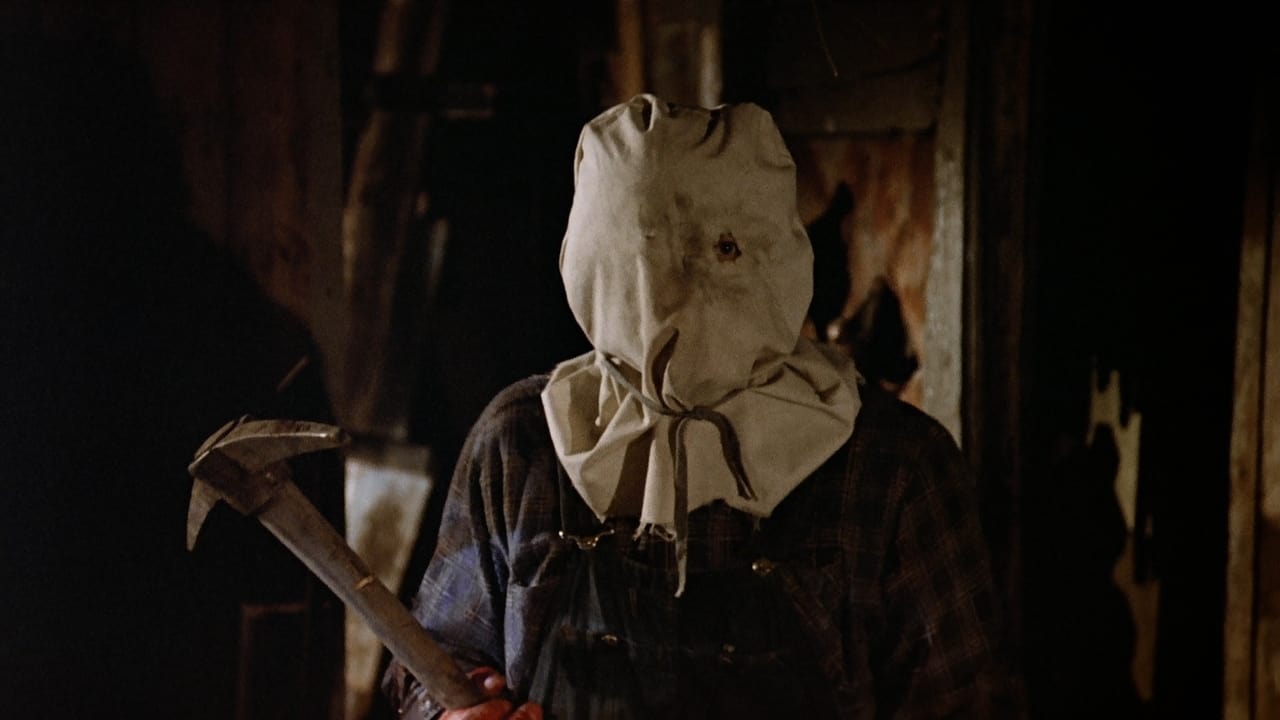

Friday the 13th Part 2
“The body count continues...”
Five years after the horrible bloodbath at Camp Crystal Lake, new counselors roam the area, not sensing the ominous lurking presence that proves that the grisly legend is real.
About Friday the 13th Part 2
Why Friday the 13th Part 2 is still worth talking about
There’s a moment in the early minutes that still makes people wince: a private, domestic action — opening the fridge — turning into something unbearably loud and wrong. That abrupt, intimate horror is the sort of choice that keeps Friday the 13th Part 2 talking long after its 83-minute runtime has finished.
Steve Miner directs a sequel that doesn’t bloat itself. Released in 1981, it picks up after Alice Hardy’s escape and quickly hands a new lead the keys: Amy Steel’s Ginny Field, one of the counsellor-trainees at the story’s new Crystal Lake school. What makes the movie stick isn’t just the killings. It’s the way it ties violence back to family — literal and fractured — and then refuses to hand the audience a neat ending. It’s short, sharp and a little nasty, and that combination still sparks conversation.
The idea that sets Friday the 13th Part 2 in motion
The film wastes no time reminding you that the original bloodletting didn’t close the book: Alice Hardy is still reassembling herself after what happened at Camp Crystal Lake. That lingering trauma is the soft knot the sequel pulls on to set everything else in motion.
To restart the action, a school for camp counsellors has been opened on the lake’s shore and the story drops a fresh group of trainees into the old, condemned territory. Around a campfire they’re told the old legend again — including the suggestion that maybe Jason survived — and what is playful storytelling turns very quickly into a rehearsal for real danger.
Miner keeps the simple mechanics tight: misdirection, small-town warnings and a string of late-night dangers that split the group apart. That discipline makes the eventual reveal — and Ginny’s desperate plan when she discovers what’s in the shack — land harder.
Why Ginny Field matters
Ginny Field is the film’s practical fulcrum. She’s introduced as Paul’s assistant and one of the trainees at the counsellor school, part of a group that includes lovers, jokers and people who make bad decisions at the worst possible moments.
What gives Ginny bite is what she does when all the easy options are gone: she improvises. Faced with evidence in that shack she uses Pamela Voorhees herself — or at least the idea of Pamela — as a weapon, putting on the sweater and trying to convince Jason she is his mother.
That gambit ties Ginny to the movie’s quieter theme of family. She isn’t just fighting to survive; she’s navigating someone else’s warped family history and exploiting the one thing that might stop him, however briefly.
Friday the 13th Part 2 has more on its mind than the plot suggests
At face value this is a slasher: a string of intrusions, small scenes of normal life cut short. Underneath, the movie keeps looping back to mortality — not as philosophy but as immediate consequence. People don’t just get scared; they die, and the film treats that as both sudden and ordinary.
Loss hangs over the action in multiple ways. There’s the loss of safety, the loss of the idea that a place can be closed and sealed against violence, and the more intimate losses that drive character choices. Those absences press in on the survivors and shape how they respond. ‘Mortality and lifespan’ feels oddly literal here: the story concerns itself with what remains after death, who remembers, and who is left to pick up the pieces. And threaded through all of that is family — the origin point for the film’s most disturbing acts and for Ginny’s countermove.
Friday the 13th Part 2 could not belong to any other decade
Released in 1981, this is very much an early‑80s horror object: economical, direct and interested in extending a nightmare rather than re-inventing it. That sense of continuation — moving the story along without gilding it — is a distinctive trait of the period.
The film literally stretches the original set-up forward; by 1984 Paul Holt has opened a school for counsellors on the shore of Crystal Lake, a choice that keeps the lakeside mythology alive and gives the sequel a ready-made place to stage its scenes.
Call it franchise-mindedness, or simple thrift. Either way, the movie’s appetite for sequels and ongoing stories is very much of its time: an early-80s cinema that likes the idea of a single, resolvable fright being turned into an ongoing problem.
Why Friday the 13th Part 2 still matters
There are images in this film that cling. One is the domestic shock of Alice finding Pamela’s severed head in her fridge — a private horror that lands harder because it’s so ordinary. Another is the altar in the shack: a grotesque shrine which brings the past — Pamela, Alice, the drowned boy — into a single, stomach‑tightening tableau.
Then there’s the narrow, unforgiving logic of the kills: a dog carcass that hints at what’s coming, a deputy who follows someone into the woods and doesn’t come back, lovers ambushed mid‑tryst. These are the sort of beats that lodge in memory because they cut the evening’s safety into small, recognisable pieces.
Ginny’s confrontation with Jason — using Pamela’s sweater as a psychological bluff — is a moment people still talk about. It almost works, and the fact that it fails when Jason sees Pamela’s head is exactly the cruel mechanic that gives the film its teeth.
Finally, the ending’s refusal to tidy everything away — an ambulance, a missing rescuer, a villain who disappears from his own shrine — leaves an aftertaste. It’s not just a jump‑scare; it’s an unresolved note that keeps the story alive in the viewer’s head.
Does Friday the 13th Part 2 still hold up?
Yes — with a small asterisk. If you want a lean, single‑idea slasher that’s more interested in extending grief than in smoothing edges, this is a solid example. It runs 83 minutes, gets to its point quickly and doesn’t waste time pretending the story can be neat.
The film’s strength is its focus: it keeps returning to mortality and loss, and it asks what survives when family is twisted into something vengeful. Ginny Field’s resourcefulness — and the way the film lets a psychological ploy play for real stakes — gives the whole thing a darker, slightly smarter spine than a purely mechanical massacre.
There are moments designed to shock — Alice’s fridge, the altar in the shack, the sudden ambushes — and they still sting because the movie pairs them with small human threads: a trainee group, a deputy who follows a lead, a rescuer who vanishes. That combination matters. So should you watch it? If you’re curious about early-80s slashers that don’t overstay their welcome and you don’t need everything wrapped up, yes. Friday the 13th Part 2 isn’t polite company, but it leaves a nasty, memorable bite — which, for this sort of film, is the point.