
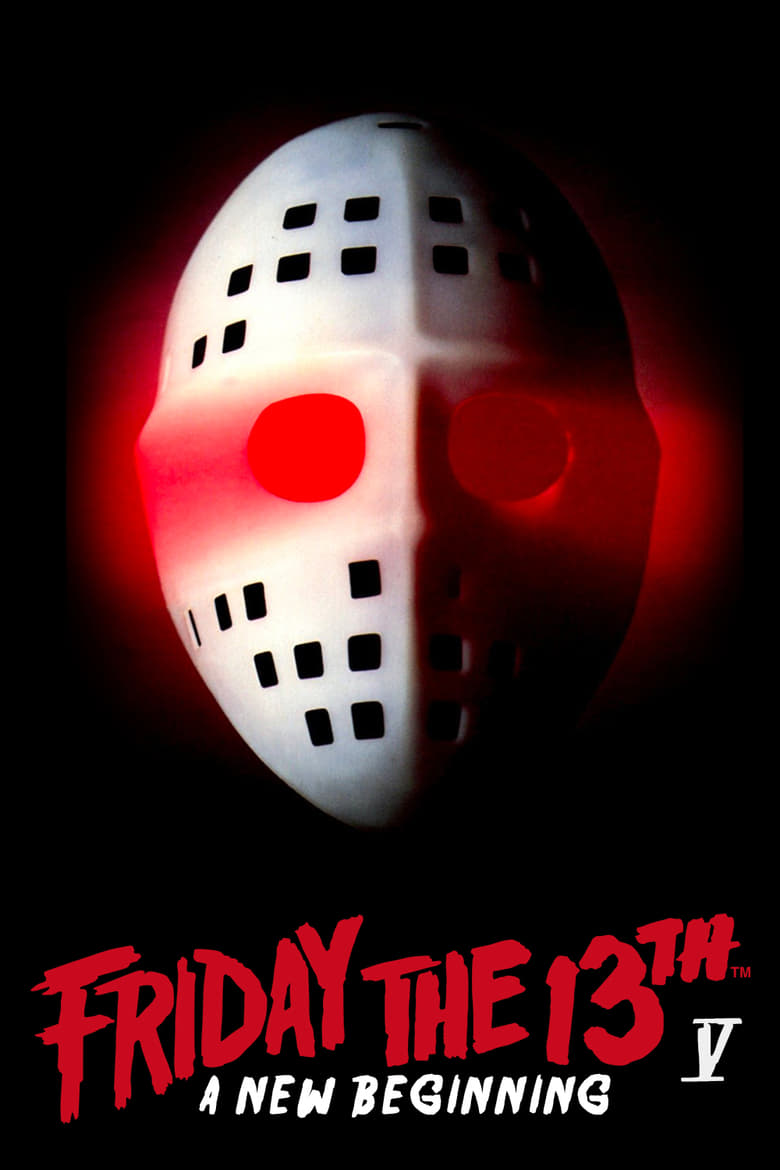
Friday the 13th: A New Beginning
“If Jason still haunts you... You're not alone.”
Homicidal maniac Jason returns from the grave to cause more bloody mayhem. Young Tommy may have escaped from Crystal Lake, but he’s still haunted by the gruesome events that happened there. When gory murders start happening at the secluded halfway house for troubled teens where he now lives, it seems like his nightmarish nemesis, Jason, is back for more sadistic slaughters.
About Friday the 13th: A New Beginning
Why Friday the 13th: A New Beginning still stands out
You open this one expecting the usual lakeside terror — and instead you get Tommy Jarvis waking up from the kind of nightmares that won’t let a character be ordinary. Five years on from the Jason business, he’s been bounced between psychiatric hospitals; the movie plants him in a halfway house where the past is a presence you can almost feel in the wallpaper.
Danny Steinmann keeps the runtime economical — 88 minutes — which gives the film a propulsive, no-flab quality. It’s a tight little machine: a familiar horror premise retooled into a domestic, almost claustrophobic setting, and that makes Pam Roberts, the practical assistant at the facility, an unexpectedly central figure to how the story plays out. The cast tosses up recognisable names — John Shepherd as the teenage Tommy, Corey Feldman briefly as a younger Tommy, Shavar Ross as the earnest Reggie — but the film’s personality comes from its setup more than its star wattage. It’s a slasher that treats community and vulnerability as part of the tension, and that’s why it still gets talked about.
The idea that sets Friday the 13th: A New Beginning in motion
Put simply: a traumatised teen who once faced a mass murderer is trying — and failing — to sleep. Tommy Jarvis’s recurring nightmares land him in the Pinehurst Halfway House, where Dr. Matt Letter and his staff keep a watchful eye.
The halfway house isn’t a blank slate for scares; it’s populated. There’s a circle of younger residents — lovers Eddie and Tina, the stutterer Jake, punk Violet, the serious Robin, the gluttonous Joey and Reggie, whose grandfather George cooks for the place — and that group dynamic raises the stakes whenever someone wanders off.
Matt explicitly forbids the teens from leaving the grounds, which gives the film a built-in tension: the outside world is a threat they’re not allowed to test, and that prohibition feels deliberate in scenes where rules are broken and bad choices are made.
Once murders start — car-breakdown greasers, a diner couple, and the slow, escalating killings around the institute — suspicion circles Tommy even as the local sheriff begins to wonder if Jason Voorhees has somehow returned. The setup keeps you second-guessing whether the town is haunted by a resurrected legend or by the consequences of grief and revenge.
Why Pam Roberts matters
Pam Roberts is the practical arm of the halfway house: the assistant who accompanies Reggie to visit his returned brother, brings Tommy along, and behaves like someone who’d rather be useful than indulgent. That steadiness becomes a quiet spine for the movie.
Her choices move the plot without feeling engineered. When Pam volunteers to go with Reggie to check on Demon, she’s not performing heroics for their benefit so much as doing the job of someone who’s sensible and involved — and that makes her presence sharper when danger arrives.
Pam also operates within the film’s family concerns. The halfway house is, in its own way, a surrogate family, and Pam is one of those adults who tries to keep a fragile unit together. She’s the sort of character who lets the movie show its softer side without losing the horror thread.
Put differently: Pam matters because she’s the bridge between the traumatised Tommy and the rest of the group. When the slaughter begins around them, it’s Pam’s practical momentum — searching, sheltering, trying to protect — that colours how the audience reads the danger.
Friday the 13th: A New Beginning has more on its mind than the plot suggests
Beneath the machetes and chases, the film is very interested in family — but not always in the warm, traditional way. It’s about broken families and the people who try to hold them together: institutional carers, grandparents who cook, kids who look for belonging.
Loss threads through the movie. The halfway house exists because something has been taken — childhood, safety, normality — and the killings amplify that absence, turning grief into a force that warps behaviour and judgment.
Courage here isn’t just gore-fuelled bravado. It’s the quieter kind: adults and teens trying to keep each other safe, making practical choices to protect the vulnerable. Those smaller acts count for a lot in a film where the safe places become unsafe. Parental protection appears as a driving motive too. When revenge is revealed as a motive, it reframes some of the killings as personal — not supernatural — and forces the audience to reckon with how far grief can push an ordinary person.
Friday the 13th: A New Beginning could not belong to any other decade
This is, unavoidably, a mid-80s film: it was released in 1985, and it wears that placement in the slasher cycle on its sleeve. By that point the genre had moved beyond a single lakeside shock and was experimenting with settings, motives and the psychology of its survivors.
What marks it as of its time is that it channels the decade’s appetite for compact, fast-moving horror. At 88 minutes it doesn’t linger on exposition; it gets into the action and lets character quirks — the kids, the halfway-house rules, the meddling neighbour — do the world-building.
The movie’s rhythms and choices feel like a product of 1980s horror storytelling: familiar beats repurposed, a focus on a group of young people as the engine of the narrative, and a willingness to fold in domestic anxieties around safety and community.
In short, the film is an 80s slasher that recognises the decade had moved from introducing a killer to asking what happens to the people left behind.
What has aged — and what hasn't
The film’s core — Tommy Jarvis wrestling with recurring nightmares and the idea that the past won’t stay buried — still reads. That psychological knot is simple, and simple often survives time better than fashions or effects tricks.
The halfway house full of distinct young characters also holds up. The dynamic between the residents, and the way the place acts like a fragile, improvised family, gives the movie emotional stakes that don’t rely on trendy design choices.
Themes of home and safety — a place meant to shelter people becoming a site of threat — remain effective. The contrast between rules (Matt forbids leaving the premises) and the teens’ missteps still provides believable tension for modern viewers.
Where the film shows its age is not in the premise but in the inevitability of certain slasher beats. The hallucination motif — Tommy facing a final, solitary vision and choosing to make it disappear — is a tidy emotional close, but modern audiences may expect a more complex reckoning. That said, the core moment of a traumatised character confronting his demons still lands.
Why Friday the 13th: A New Beginning still matters
People who grew up with this entry tend to remember it for the way it rearranges the puzzle pieces. It keeps the familiar iconography of the series but relocates the action into a community that feels lived-in: carers, cooks, neighbours and a noisy, argumentative group of kids.
The halfway house ensemble — lovers, loners, kids with quirks — gives the film something to come back to. It’s not just set-pieces; it’s the texture of who shares the space and what that sharing costs when violence arrives.
The movie also matters because of its twist on motive. The revelation that the hockey-masked killer isn’t necessarily supernatural but driven by a personal need for revenge reframes the narrative as one about grief turned violent. That grounding in a human motive is one reason the story still prompts discussion. Finally, the ending — Tommy’s hospital hallucination and the image of him appearing with a mask — leaves an impression. It’s a darker, ambiguous final note that keeps viewers talking long after the credits roll.
Does Friday the 13th: A New Beginning still hold up?
So, does Friday the 13th: A New Beginning still hold up? Yes — although watching a film from 1985 honestly means accepting that not every moment will land exactly as it once did.
The film still has something recognisable to say about family, loss and courage, and its characters stop those ideas from feeling abstract.
Friday the 13th: A New Beginning remains worth revisiting because characters such as Pam Roberts, Tommy Jarvis, Tommy Jarvis at 12, Reggie Winter and Dr. Matt Letter still feel like people rather than labels once the film gets underneath the stereotypes.