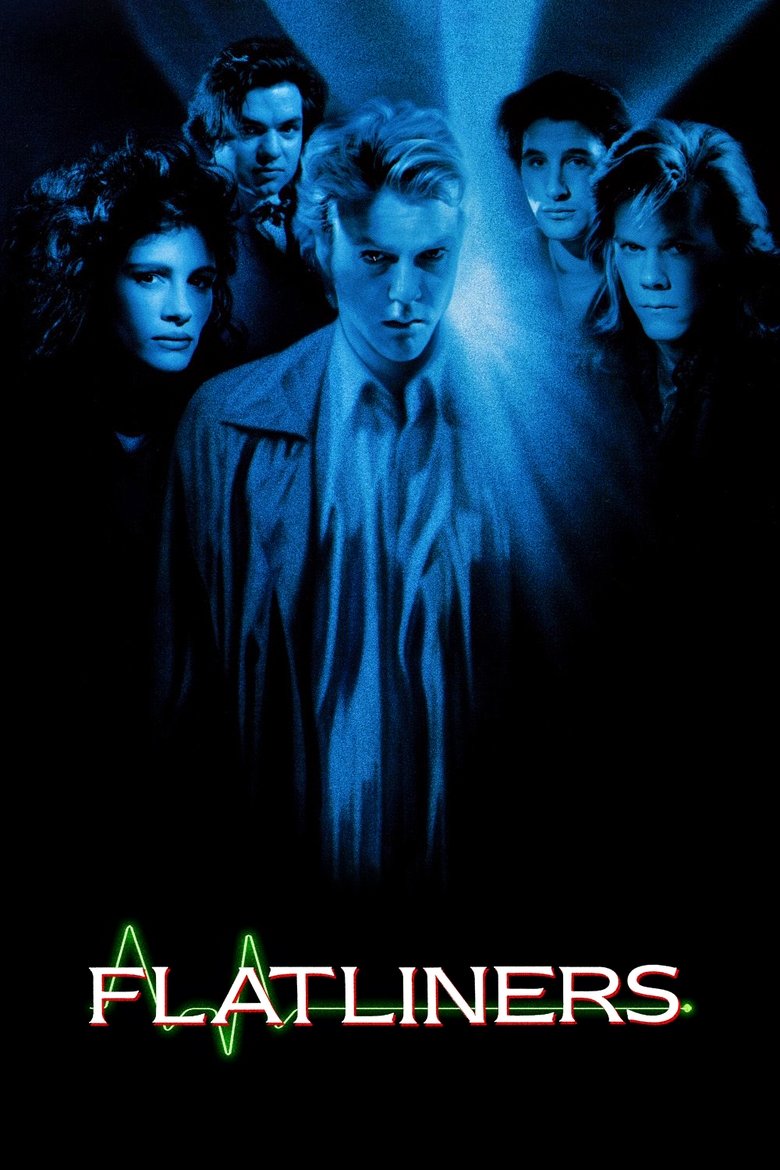
Flatliners
“Some lines shouldn't be crossed.”
Five medical students experiment with "near death" experiences, until the dark consequences of past tragedies begin to jeopardize their lives.
About Flatliners
What makes Flatliners worth revisiting
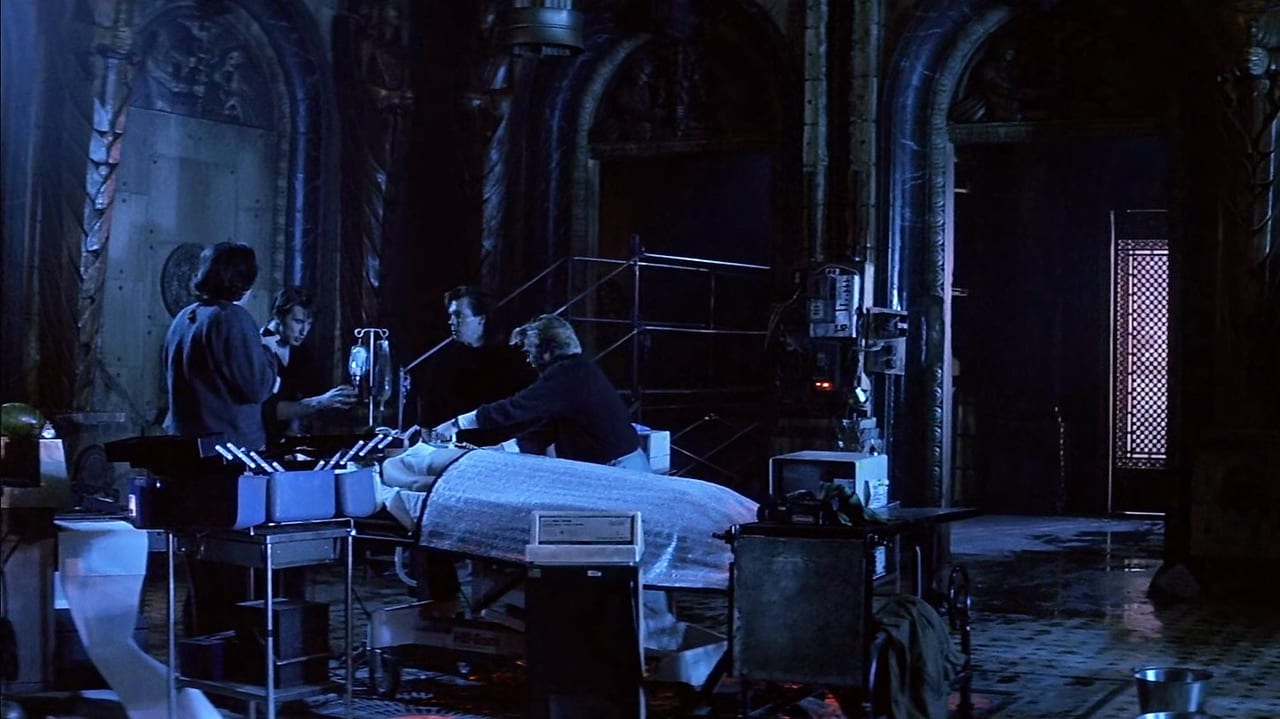
Talk of Flatliners usually starts with a single image: medical students switching the defibrillator pad from saving lives to testing what happens when you stop one. That daft, dangerous curiosity is Nelson Wright’s idea — he convinces his classmates to help him find out what lies beyond death — and from that dare the film pulls a surprising number of threads: guilt, memory, friendship and consequences.
Joel Schumacher directs with a steady sense that genre lines are negotiable; this is part sci‑fi experiment, part psychological horror, part interpersonal drama. It’s the kind of picture that keeps a foot in each register rather than settling into one comfortable tone, and that tonal restlessness is exactly why people still bring it up. Finally, it’s the characters who carry the film. Kiefer Sutherland’s Nelson kicks the whole thing off, but the story depends on the group — the way they follow one another into the same reckless act, and the way those experiments reverberate back into their private lives. That mix of bravado and personal fallout is what still makes Flatliners worth a revisit.
The idea that sets Flatliners in motion
The premise is elegant and dangerous in equal measure: Nelson persuades his fellow medical students to deliberately ‘flatline’ so they can briefly visit whatever comes after life, then be revived. The procedure is a stunt with a scientific sheen — short, controlled, theatre‑like — but the film makes you feel instantly that it’s a stupid, human thing to try.
They don’t all see the same things. When David takes his turn on Halloween he’s confronted by Winnie Hicks, a girl he bullied at school; Joe’s vision links back to a promiscuous past and the consequences of that behaviour. Those glimpses may feel private and irreproducible at first, but they quickly start to leak into waking life.
Crucially, the experiment isn’t merely spectacle: the fallout affects relationships. Joe’s troubled private life collapses when his fiancée discovers evidence of his behaviour and leaves, and even the secrets people carry about their parents surface — Rachel's guilt around her father’s death is shifted by a revelation that reframes what happened to him.
And the most raw encounter of all is Nelson’s: the boy he tormented as a child appears in his ‘afterlife’ vision, which opens the movie’s central problem — these aren’t harmless phantoms, they’re unfinished business turned violent, and the group’s curiosity has turned into a reckoning.
Why Nelson Wright matters
Nelson Wright is the kind of character who makes trouble not out of malice but out of a dare-to-know impulse. Kiefer Sutherland plays the student who convinces his colleagues to take the experiment; whether you admire him or think he’s irresponsible, he’s the engine of the story.
He’s memorable because the consequences of his curiosity are personal. After his flatline he reports that he can’t explain what he saw, which is a neat way of saying something true and disturbing happened — and that ambiguity becomes a burden he carries alone for a while.
That burden turns into guilt and atonement. Nelson apologises for dragging his friends into the experiment, and the plot’s late escalation — when he flatlines again and the others race to save him — turns what began as a one‑man stunt into a test of friendship. The film asks whether the group can hold together when the stakes stop being theoretical.
When the friends are close to giving up on reviving him it is forgiveness — from the boy Nelson harmed — that ultimately unravels the cycle. That moment reframes Nelson from a daredevil to someone confronting the cost of a childhood mistake, and it’s why his arc anchors the film emotionally.
Flatliners has more on its mind than the plot suggests
At face value Flatliners is a thriller about a reckless experiment. Underneath, it’s a film quietly obsessed with mortality — not death as spectacle, but how the thought of death focuses everything you’ve done and left undone.
Linked to that is lifespan: the students’ choice to stop their hearts briefly forces each of them to look back at how they’ve lived. The visions aren’t random; they undo a private history — old cruelties, secret betrayals, the things you hoped no one would remember.
Friendship is the other big engine. The experiment is communal and the consequences are communal; the friends must either help each other face the past or be crushed by it. Their loyalty — and their failings — turn the supernatural conceit into a study of how people repair damage to one another. And loss keeps surfacing in domestic ways: parents, suicides and abandoned promises. The film mixes supernatural belief with very human courage — the courage to tell the truth, to apologise and to stay when it would be easier to run away.
Flatliners could not belong to any other decade
Flatliners landed in 1990, right at the cusp of a new decade, and that timing matters. It wears the decade’s appetite for cross‑genre experiments on its sleeve: a medical-science premise braided with psychological horror and melodrama felt instantly modern then, and still reads as a product of a moment when filmmakers were comfortable mixing tones.
The film’s focus on youth testing boundaries — students staging a stunt to peer at death — taps into a 1990s fascination with transgressive curiosity, where the question was less ‘can we?’ and more ‘should we?’. That moral wobble feels of its era without descending into gimmickry.
Most importantly, placing the story at the start of the decade lets it operate as a transitional piece: it’s not trying to be nostalgically 80s or overtly 90s, but it carries the new decade’s willingness to ask bigger, messier questions about consequences and responsibility.
What has aged — and what hasn't
What holds up is the central relationship dynamic: the film’s insistence that these are friends who drag one another into something reckless, and then have to repair the damage. That idea — loyalty mixed with exasperation — still lands because it’s fundamentally human and not a period trick.
Some individual plot beats also survive modern viewing. Joe’s unravel led by his private recordings and the collapse of his engagement still reads as a sharp character consequence; it’s a tidy, believable cause-and-effect that helps explain why his hauntings stop once his domestic life collapses.
Where the movie dates is more in tone than in story: certain flavours of genre-sleaze and shorthand for ‘promiscuous past’ can feel of their moment. But those are surface choices; the film’s moral questions about accountability and making amends remain clear and relatable.
In short: the film’s heart — friends forced to face the consequences of a shared mistake — still works, even if some of the trimmings feel tied to 1990.
Why Flatliners still matters
Flatliners lingers because its central conceit is both a great party trick and a moral puzzle: deliberately stopping your heart to see what’s next feels ridiculous and heroic at once. That tension — between spectacle and private reckoning — is why the film keeps being mentioned in conversations about movies that mix genre with ethical consequences.
The visions themselves stick in the memory. Nelson’s encounter with the boy he once tormented, Joe’s eroticised flashbacks and David’s meeting with Winnie are not throwaway shocks; they’re personalised punishments that force each character to confront what they did and who they were. Those sequences give the film its emotional weight.
The other reason people remember it is how the story turns the stunt into a communal test. When Nelson flatlines again and his friends rush to save him, the film stops being about curiosity and becomes about whether friendship can heal the damage curiosity made. That final stretch — the race to revive him, the forgiveness he receives — is what transforms the film into something more than a horror novelty. So Flatliners matters not because it reinvented cinema, but because it used a striking premise to talk about guilt, memory and repair. It’s a film that rewards remembering what it actually put on screen: a dare, the fallout, and the stubborn work of putting things right.
Does Flatliners still hold up?
Yes — with a caveat. If you come for the conceit, Flatliners still delivers: the image of Nelson convincing classmates to flatline, the one‑minute experiment, and the way those glimpses reverberate are compelling enough to carry 115 minutes of storytelling. It’s a lean runtime that keeps the plot moving toward personal reckonings rather than allowing the premise to become a never‑ending gimmick.
Where it may falter for some modern viewers is in its framing choices around certain characters and the shorthand the film sometimes uses to explain past behaviour. But the central questions that drive the picture — mortality, how we account for our past, and whether friends can help one another face what they’ve done — remain potent and readable today.
Joel Schumacher’s direction places the story at a point where genre and melodrama meet, and that mixture still works: the film is as much about friendship as it is about ghosts. When Nelson is on the verge of dying and the group refuses to give up on reviving him, Flatliners becomes a small, fierce argument for repair over escape.
So should you watch it? If you want a film that pairs a clever premise with genuinely human consequences, yes. It’s not flawless, but it is stubbornly interested in the question it raises — and that interest is the thing that keeps Flatliners from becoming merely a curious footnote.