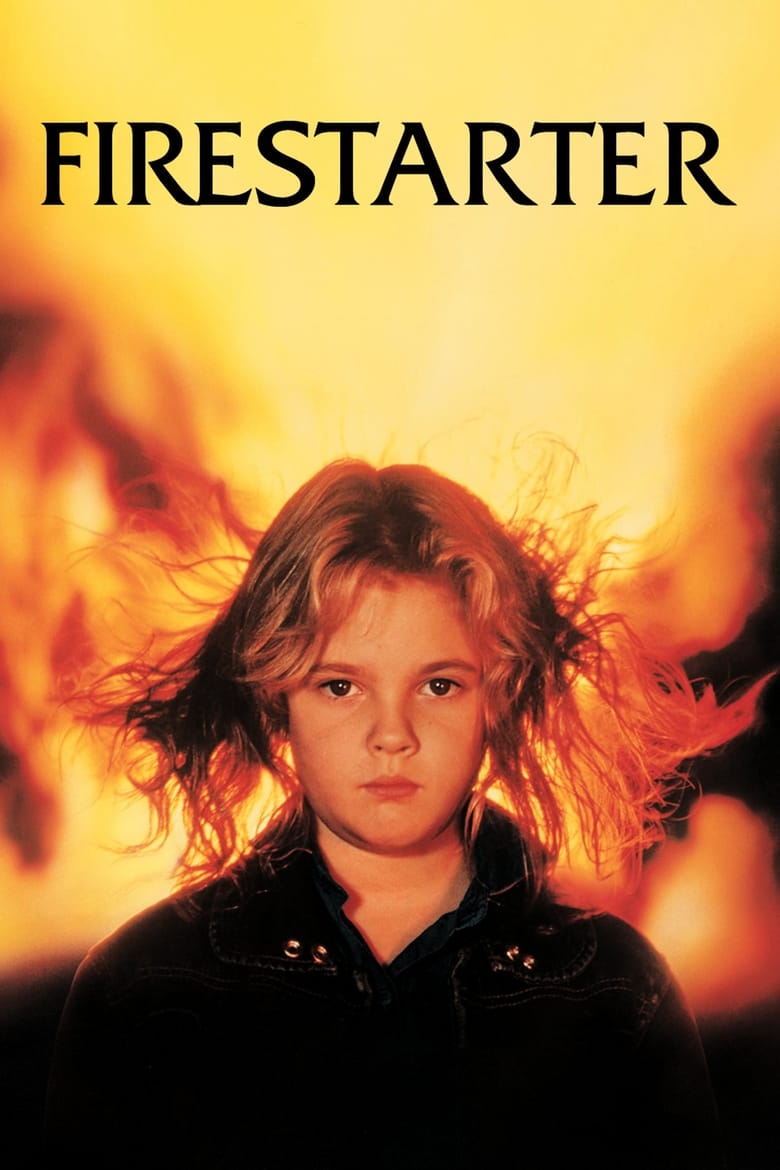
Firestarter
“She has the power to set objects on fire with just one glance!”
Charlene "Charlie" McGee has the amazing ability to start fires with just a glance. Can her psychic power and the love of her father save her from the threatening government agency which wants to destroy her?
About Firestarter
Why Firestarter still works
Firestarter starts with a deceptively simple science-class premise: as students, Andy McGee and Vicky Tomlinson take part in an experiment that leaves them with psychic abilities. That tiny seed — an accidental consequence of a drug called LOT-6 — is the film’s persistent itch. It turns a family home into a battlefield and ordinary choices into urgent ones.
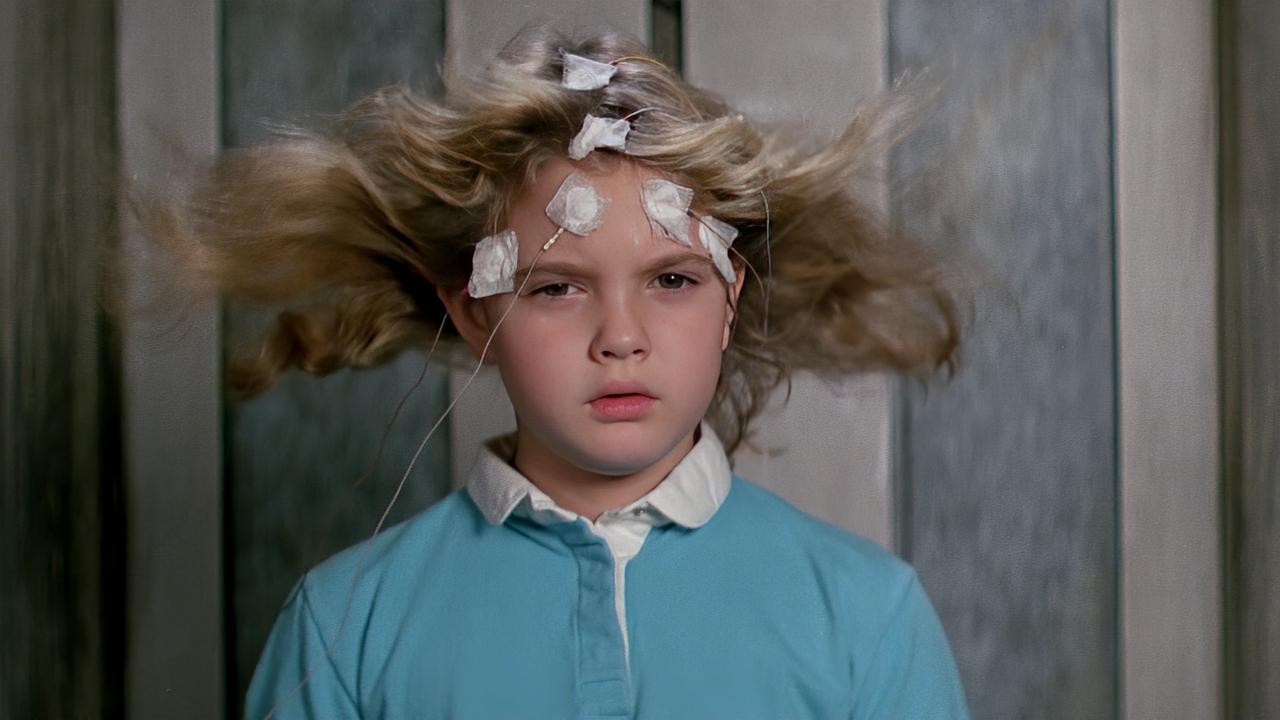
What keeps the film moving is the collision between the private and the political. Andrew McGee and his wife suddenly have powers they didn’t ask for; their eight-year-old, Charlie, inherits something even more dangerous: the ability to summon heat and flames and a frightening knack for seeing the near future. Those abilities make them targets, and the movie becomes a chase where every step toward safety risks revealing them further. Mark L. Lester directs with an eye on pace and tone: this is an action-thriller that wants to frighten you and make you care. David Keith’s Andrew is the parent at the centre of it all and Drew Barrymore’s Charlie is the small, volatile heart — the pair anchor a story that mixes family drama with outright menace.
The idea that sets Firestarter in motion
The film’s engine is simple: a family with unusual powers tries to stop being hunted and make their case public. At one point they hole up in a secluded cabin, preparing to tell the world what happened to them and why the government should not be allowed to seize their child.
But that plan collapses. Capture follows and father and daughter are separated — a gutting move that raises the stakes from ‘stay hidden’ to ‘get back together’. When a parent and child are torn apart, the plot does the sensible thing and keeps putting them on the path to reunion.
That setup works because it keeps the emotional question straightforward: can a father protect his daughter from an authority determined to weaponise her? The story doesn’t overcomplicate matters; it feeds the drama by repeatedly forcing the family into situations where trust, secrecy and courage are tested.
The payoff — after escape attempts and betrayals — sends them back into public life, with Charlie eventually heading to New York to make their story known. It’s a tidy throughline: hide, lose, fight to reunite, and then try to be heard.
Why Andrew McGee matters
Andrew McGee is the story’s human hinge. We meet him as a man whose ordinary life is shattered — he returns home to find his wife murdered and his daughter taken — and everything he does after that is about repair and protection. That’s what gives his actions a gravity you can follow even when the plot turns cinematic and extreme.
His importance comes from the choices he faces. He’s a parent up against a bureaucratic machine that sees his daughter as an asset. The film keeps returning to family as its compass: when Charlie is torn away, Andrew becomes someone who’ll lie, run, fight or gamble everything to get her back.
The separation after capture amplifies his role. The promise that he and Charlie repeatedly make — to find each other, to hold on — means Andy isn’t just a vehicle for action scenes; he’s the emotional reason the audience keeps watching.
And when the story forces Andy to bluff and strategise, it underlines his central job: buy time, protect Charlie, and never let the people who reduced them to test subjects win.
Firestarter has more on its mind than the plot suggests
On the surface it’s a chase movie about a child with dangerous powers. Below that, Firestarter is a film about what happens when private life collides with institutional ambition. Themes of family and parental protection sit cheek by jowl with questions about power — who gets to hold it and who gets to control it.
The source of the trouble is straightforward and punitive: a college experiment leaves Andy and Vicky with psychic abilities and their daughter with something far more volatile. That origin turns the personal into political: this isn’t natural talent so much as collateral damage from a system that thinks it can engineer human beings.
The movie also cares about freedom and authority. Andy’s attempts to resist — even faking submission to drugs to lower the enemy’s guard — show the film preferring cunning and love over compliance. When Charlie’s powers rise to the point that she can level a facility, the narrative is explicit: the family will not be turned into an armament without a fight. Finally, there’s home and safety. The Manders’ farm and the attempt to go public from a remote cabin are both gestures toward reclaiming ordinary life. Firestarter’s tension comes from repeatedly asking whether a family can ever be ordinary again once their privacy has been violated.
The effects work that gives Firestarter its physical personality
A strange thing about Firestarter: it anchors its weirdness in plain human terms. The film’s physical personality flows from the fact that the characters’ powers are rooted in an experiment gone wrong — the LOT-6 episode that left Andy and Vicky altered.
Because the powers are presented as consequences of that experiment, the movie treats psychic phenomena as a tangible reality that forces ordinary people into extraordinary responses. That gives the film a tactile feel: this is not abstract metaphysics, but something that breaks up normal life.
You notice how much the story relies on the bodily cost of powers — the strain on Andy, the escalation of Charlie’s abilities — rather than keeping everything off-screen as a vague threat. The source (the drug LOT-6) keeps the material feeling grounded and specific.
All of which means the movie’s strange moments sit beside domestic ones and feel part of the same world, not a different genre glued on top.
Firestarter could not belong to any other decade
Released in 1984, Firestarter wears its decade plainly in its combination of genre instincts: action, thriller, science fiction and horror. Those rubrics let it hop from family drama to set-piece threat without much fuss — that fluidity felt natural in the cinema of the time.
The 1980s had a curious appetite for stories about experimentation, institutional overreach and ordinary people pushed into extraordinary situations. Firestarter sits comfortably in that lane because it trades on the fear that technology or government know-how can reach into the home and steal safety.
It’s therefore an 80s movie not because of a look or a soundtrack, but because it plugs into a set of anxieties common to the period: the belief that progress can have a human cost and that authority is not always benign.
That placement in 1984 helps explain why the film mixes emotional beats with pulpy thrills — it isn’t coy about its genre ingredients, which is very much in the decade’s spirit.
What has aged — and what hasn't
Some of the film’s core elements hold up because they’re human and immediate. The murder and abduction that kick the story off still feel like clear, brutal stakes: a family’s privacy is violated and the survival of a child becomes a moral problem that can’t be papered over.
Themes of family and the scramble to keep home and safety intact are evergreen. The emotional throughline — a father trying to protect his daughter from an institution that sees her as an asset — is easy to follow and still emotionally persuasive.
Where the movie shows its age is less about theme and more about the fact it’s a product of its mechanics and storytelling shortcuts. But the core idea — that ordinary life can be ruptured by forces that treat people as experiments — reads fairly well to a modern viewer. In short: the emotional logic of protection and loss still lands. The specifics around how the plot moves might feel dated in spots, but the family element keeps the film watchable now in a way that cheap genre tricks wouldn’t.
Why Firestarter still matters
People remember Firestarter because its central image is so simple and unsettling: a young girl who can make fire, and the adults who try to exploit or stop her. That quiet monstrousness — a child as both vulnerable and devastating — sticks in the head.
The film’s sequence of survival beats helps too. Andy finds Charlie, they live on the run, neighbours take them in, and that repeated cycle of refuge and exposure keeps tension high and gives the story memorable set pieces: the Manders’ farm, the secluded cabin, the eventual assault on the facility.
The cast of figures around the family — the head of the agency, the undercover ‘orderly’ who isn’t what he seems, the farmers who offer shelter — give the film a gallery of threats and allies that helps the central relationship remain the emotional anchor.
Finally, the way the plot ties protection to action — Andy bluffing to lower guards, Charlie’s powers accelerating until she breaks free and makes the authorities pay — is the kind of concise narrative logic that leaves a lasting image: a family refusing to be turned into someone else’s weapon.
Does Firestarter still hold up?
Yes — with a caveat. If you’re after modern, polished effects or a twisty, ambiguous thriller, this isn’t the film for you. But if you want a lean 1984 genre picture that trusts its central relationship, Firestarter still has muscle. The basic moral engine is plain: a family harmed by an experiment will go to extreme lengths to protect their child.
David Keith’s Andrew is the parent who keeps the story honest — he finds his wife murdered, rescues Charlie and then spends the film trying to keep her safe, even when that means bluffing, running and ultimately sacrificing. Charlie’s powers and the way they escalate are the narrative’s blunt instrument; the story uses them to show what happens when private life becomes an object of state interest.
Mark L. Lester’s direction keeps the momentum tight across its 114 minutes, and the blend of action, thriller, science fiction and horror means the film rarely settles for one tone. When the facility falls and Charlie walks away, the movie honours the promise that family matters more than the people who tried to own them.
So should you watch it? If you care about a solid, idea-driven genre picture with a clear emotional stake — yes. Watch for the tough choices a father makes and the way a little girl’s terrible gift forces everyone around her to reveal who they are.