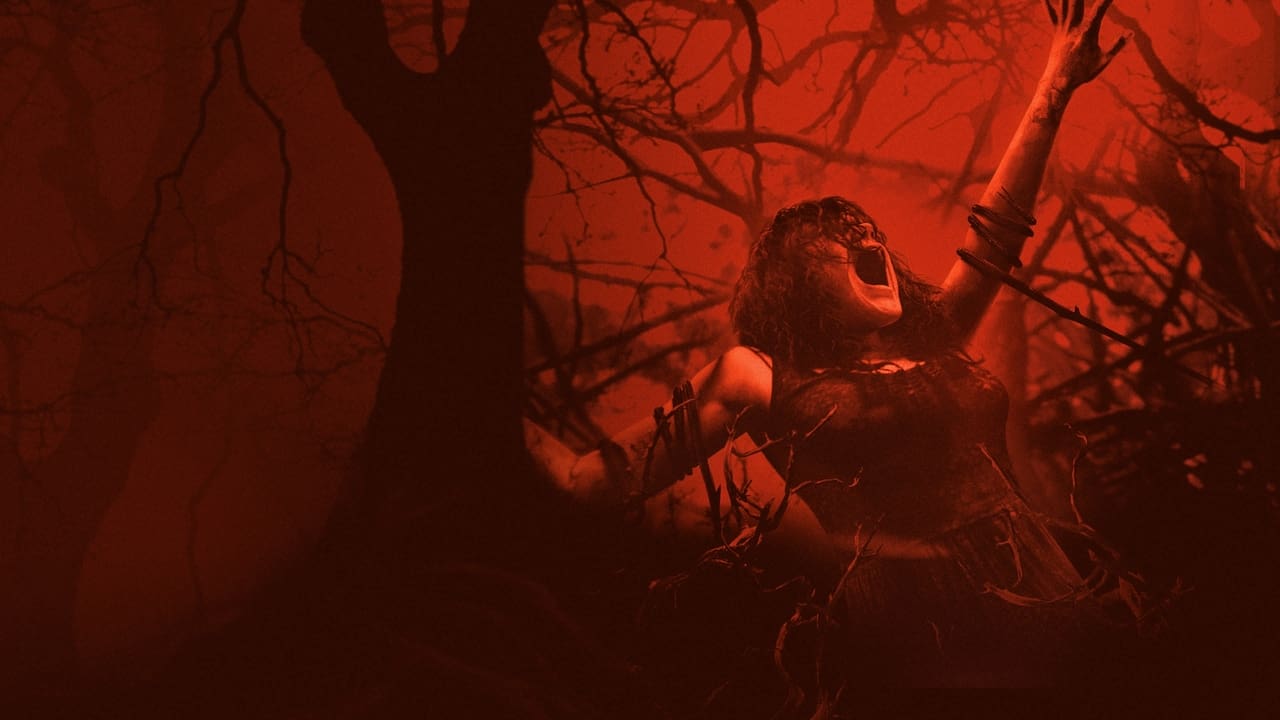
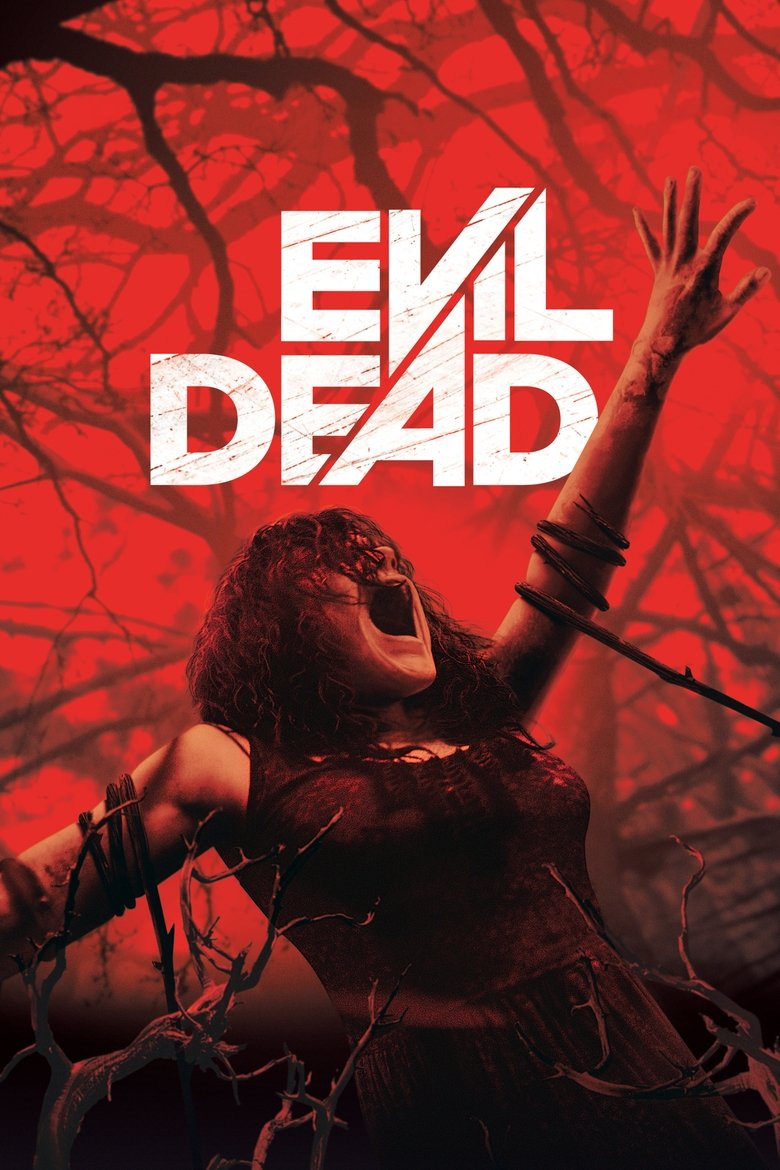
Evil Dead
“The most terrifying film you will ever experience.”
Mia, a drug addict, is determined to kick the habit. To that end, she asks her brother, David, his girlfriend, Natalie and their friends Olivia and Eric to accompany her to their family's remote forest cabin to help her through withdrawal. Eric finds a mysterious Book of the Dead at the cabin and reads aloud from it, awakening an ancient demon. All hell breaks loose when the malevolent entity possesses Mia.
About Evil Dead
Why Evil Dead still works
The movie lunges straight for the throat. An old woman in a cellar speaks from a strange book and that small, specific horror — someone held captive while an incantation is read — does the heavy lifting. It’s a bright, nasty primer: supernatural threat plus human vulnerability.
From there Fede Álvarez keeps things tight and mean — a compact ninety-one-minute ride that trades patience for pressure. The story plants a family into that pressure cooker: David brings his estranged half-sister Mia to the cabin, joined by friends and a dog, and whatever was sleeping under the floorboards wakes up fast. The film also remembers to wink at the past. Bruce Campbell’s Ash Williams shows up in shadow during the credits, a small reminder that this is part of a longer, blood-soaked conversation — but the main engine belongs to a new, smaller set of people and the terrible choices they make.
The idea that sets Evil Dead in motion
At its simplest the film is an old cabin, a forbidden book and the chain reaction that follows when a friend reads one of its lines aloud. That reading wakes something that turns ordinary injuries and anxieties into outright possessions.
What keeps the engine moving is how those possessions are counted as a kind of tally. When a wound or a body becomes claimed, it isn’t just gore for gore’s sake — the story treats each lost person as a step toward something much worse.
So the stakes are tidy and immediate: stop the spread, stop the tally, or everything escalates. The film leans on grisly solutions — live burial, dismemberment, burning — and the awful choices people make when they believe those are the only options left.
And when the impossible happens — when Mia is buried and then brought back with a homemade defibrillator — the set-up flips. Resurrection becomes a double-edged favour: saving someone can hand the enemy another rope to pull.
Why Ash Williams matters
Ash arrives not to steal the movie but to remind you where this family of films started. Bruce Campbell’s Ash Williams is presented quietly — a cameo in shadow during the credits — and that choice keeps the focus where it belongs: on the new characters who endure the mess.
The film is ultimately about family in a bruised, practical way. David has brought his estranged half-sister Mia to the cabin as a place to try and get clean, and the presence of a familiar franchise face at the end functions like a postcard rather than a takeover.
There’s a rhythm to that postcard: the older series’ horror-comic bravado sits beside a darker, more intimate story about siblings and the people trying to protect them. Including Ash is a nod for fans; it doesn’t have to carry the emotional load.
And that’s why Ash matters here — not because he changes the plot, but because his cameo clarifies the movie’s ambition: it wants to be part of the Evil Dead family while still making room for Davids and Mias who have their own terrible choices to live with.
Evil Dead has more on its mind than the plot suggests
On the surface it’s gore and possession. Under the surface it’s a film habitually worried about endings. Mortality and lifespan aren’t academic notes here — they’re the engines of every desperate decision the characters make.
Family sits at the centre: this is a story about a brother trying to keep his sister alive, and about parents who make brutal choices out of protection. The opening image of a terrified young woman begging for her mother and then being killed by her father is a harsh shorthand for how fear contorts care.
Loss threads through every scene. When someone is taken by the force at work in the house, the movie treats that loss as both supernatural event and very human bereavement — which is why burial, dismemberment or burning feel like options born of grief as much as strategy. There’s also a running note about belief. The characters alternate between denial, practical savagery and a grim acceptance of ritual: when the book’s rules are read aloud, people stop treating the threat as metaphor and start treating it as literal.
Evil Dead could not belong to any other decade
Coming out in 2013 places this Evil Dead squarely in the 2010s — a time when filmmakers were comfortable rebooting familiar canvases and sharpening the sting. Its runtime and momentum reflect a decade that favoured brisk, high-concept horror runs.
That timing matters because the film doesn’t attempt a nostalgic pastiche; it’s made in the present of its release and shaped by it. Saying it’s ‘Evil Dead 2013’ is shorthand for a remake that wants to feel immediate rather than museum-like.
The 2010s also meant audiences were primed for horror that married personal stakes to visceral spectacle: this film trades on that appetite without turning the personal into a footnote.
So the film wears its date like a label — not a weakness but a declaration of intent: it’s trying to speak to viewers who expect both heart and a hard shove.
What has aged — and what hasn't
What still hits is the small, human centre: David’s attempt to help his half-sister and the blunt family dynamics at play. Those moments keep the film honest; they give the horror a reason beyond set pieces.
Some sequences that lean into resurrection and bodily reclamation — burying Mia, then bringing her back with a homemade defibrillator — can feel like risky storytelling today. That specific choice is still provocative: it raises questions about how far we’ll go to save someone and what that rescue actually costs.
The notion of family as a battleground for desperate choices ages well because it’s universal. The film’s willingness to make the painful options explicit — to show parents and siblings forced into brutal acts — still reads as a strong dramatic spine.
Where it may jar is in the way it treats certain transgressive images: scenes that were designed to shock remain shocking, and that intensity will land differently depending on your tolerance. The emotional core, though, generally keeps its hold.
Why Evil Dead still matters
There are images from this film that stick — a cellar incantation, a book called the Naturom Demonto, vines that assault and possess, and a chain of possessions that adds up to something worse. Those visual and narrative beats are gruesome in a way that lodges in the memory.
The film also drills its hooks into familiar family territory: David arrives at his family holiday home to try and help Mia through addiction, and that domestic aim keeps the horror personal rather than purely fantastical. When grief and supernatural threat collide, the consequences feel earned.
It’s a run that counts losses: friends and lovers become victims of possession, a wound becomes a threat, and the tally of souls matters. That mechanism — the Taker of Souls needing five claims to become an Abomination — gives the carnage a counting-house logic that turns panic into dread. And then there’s the ending theatre: David’s sacrifice, the birth of the Abomination, Mia fighting back with a chainsaw and surviving that final fallow moment — plus the post-credits glimpse of Ash saying “Groovy.” Together these beats hand the film a clear identity: it’s vicious, familial and still in conversation with the original series.
Does Evil Dead still hold up?
Yes — if you want horror that pairs a human argument with absolute nastiness. Fede Álvarez’s ninety-one-minute film makes clear what it’s willing to do: it will make you watch people you care about make terrible, necessary choices and it won’t flinch from the consequences.
The movie’s themes — mortality, family, loss and parental protection — give the shocks a reason to exist. When Mia is buried and then revived, that isn’t just a stunt: it’s the pivot on which the film explores how far someone will go to keep a loved one breathing.
If you’re sensitive to relentless intensity, some sequences will still feel too raw. But the tight runtime, the moral pressure on the characters and the willingness to let sacrifice matter all combine to produce a horror picture that remains effective on its own terms.
Should you watch it now? If you want horror that’s as interested in the people beneath the gore as it is in the gore itself, then yes. It’s messy and uncompromising — and that final shadowed “Groovy” means it remembers its roots even as it drags you back into the cellar.