
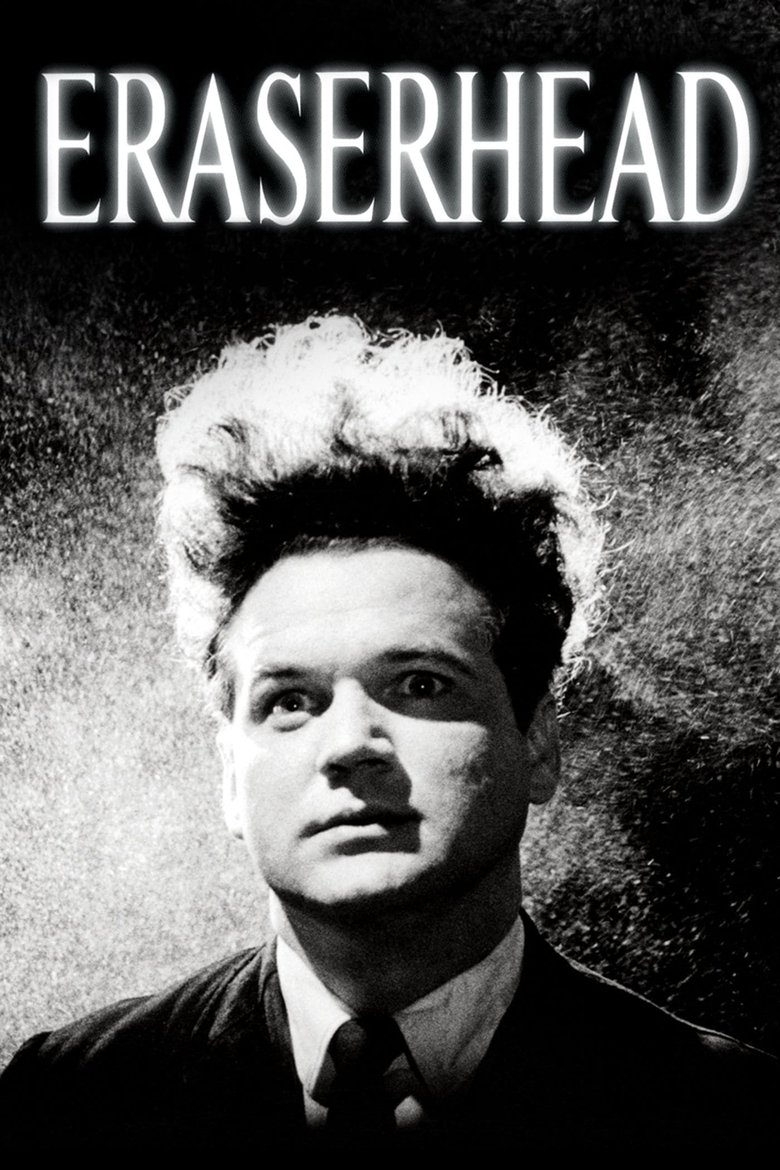
Eraserhead
“Where your nightmares end...”
First-time father Henry Spencer tries to survive his industrial environment, his angry girlfriend, and the unbearable screams of his newly born mutant child.
About Eraserhead
Why Eraserhead is still worth talking about
There are films you describe with a sentence and there are films you describe with an image. Eraserhead lives in the image column: Henry’s face hovering against a planet, small and oddly wrong, and then — inexplicably — a tiny sperm-like thing emerging from his mouth. That opening is the movie’s contract with the viewer: expectations will be rearranged.
It’s a short film in duration — 89 minutes — but enormous in imagination. David Lynch’s 1977 feature feels like a private broadcast from someone who decided domestic anxieties should be projected through nightmares. Jack Nance plays Henry Spencer, the man stuck in all of it, while an unsettling supporting cast fill out the house rules: Mary, her parents, a grandmother, the girl across the hall, and a Lady who lives in a radiator. Call it surreal, call it body horror, call it experimental — Eraserhead is all of those labels and refuses to be reduced to any one. What keeps people talking isn’t just the grotesque props or the jokes that go wrong; it’s the way family and home are treated as things you can’t trust, and how that suspicion is made peculiarly, devastatingly intimate.
The idea that sets Eraserhead in motion
Eraserhead doesn’t bother with a tidy premise. Instead it gives you a handful of unnerving rules and lets the rest tumble out. One of those rules: Henry and Mary move into a single, cramped room and are co-opted into caring for a swaddled bundle that looks wrong — a tiny face that echoes the earlier uncanny creature.
Family obligations are presented as obligations by other people, too. A dinner with Mary’s relatives turns into a ritual test: at one point Henry is asked to carve a Cornish game hen that behaves like a living thing, writhing and bleeding as he cuts it. The table manners are less about etiquette and more about being measured against someone else’s expectations.
Pressure becomes physical. After dinner Henry is cornered by Mary’s mother in a way that suggests coercion rather than warmth, and he begins to show bodily symptoms — small, uncontrollable giveaways of the strain he’s under.
The house rules escalate to a horrific, intimate choice: when Henry finally uses a pair of scissors to unwrap the child, he discovers the bandages were the only thing holding it together. The revelation and the action that follows are the kind of gut-level business that stop the film from being merely weird and make it painfully specific.
Why Henry Spencer matters
Henry is the film’s barometer. He’s not a hero in the usual sense; he’s a man who gets handed roles and told to act them out. Jack Nance plays the part — the casting is part of the point, because Henry is ordinary enough to be anyone’s neighbour yet specific enough to be believable in his embarrassment and bewilderment.
We see him at key moments of small humiliation: he’s stopped in the corridor by the girl across the hall and told about a family dinner he’s expected to attend, and later he finds himself awkwardly conversing with Mary’s mother. Those scenes do a lot of work. They turn social obligation into a pressure that’s bodily: a nosebleed here, a look of panic there.
Henry’s public self and private state are constantly misaligned. At dinner he’s meant to perform normality — carve the bird, keep conversation moving — while privately the film keeps nudging at the fact that he’s out of his depth. That mismatch is what makes him memorable. He’s a stand-in for anyone who’s ever been made to feel small by domestic expectations.
And yet the character also functions as the viewer’s anchor. As the world of the film folds and warps — planets, levers, singing women in radiators — Henry remains the single human we have to follow. His confusion becomes our navigation tool.
Eraserhead has more on its mind than the plot suggests
At one level Eraserhead is a sequence of weird events. Look a little closer and it’s preoccupied with family — not as a cosy ideal but as a set of demands and expectations that can feel invasive. The film keeps returning to the idea of being judged by others in intimate settings, and the dinner scene is the clearest example: the family’s rituals test Henry in private ways.
Home, too, is unsettled in the film. The room Henry inhabits is not a sanctuary but a place that accumulates dirt and decay; it’s more a holding cell for responsibilities than a refuge. That flips the usual cinematic promise of home as shelter into something that can be hostile.
This combination — family that weighs and home that repels — gives the film its emotional logic. The surreal images are not random embellishments; they dramatise what it feels like to be trapped by other people’s definitions of you. So the film’s nastier bits, its body horror and grotesqueries, are best read as metaphors for obligation and fear. They aren’t illustrations of shock for shock’s sake; they’re the movie’s way of making private pressures visible.
Eraserhead could not belong to any other decade
Eraserhead arrived in 1977, and it carries the decade’s willingness to let movies be strange and uncompromising. The 1970s were a period when independent filmmakers felt they could break from studio formulas and try out private visions, and Lynch’s film is a pure example of that impulse.
It sits alongside other 1970s work that treated genre boundaries like suggestions rather than rules. Eraserhead borrows from horror, drama and experimental film and glues them together until the seams show; that patchwork sensibility felt contemporary in 1977 and helps explain the film’s distinct personality.
That decade’s tolerance for patience and oddness is baked into the film’s rhythm. At a time when mainstream pictures rarely asked an audience to sit with discomfort for long stretches, Eraserhead asked the opposite.
Seen this way, the film feels of its moment without being a museum piece. Its strangeness is part of a 1970s tradition that made room for personal, difficult cinema.
What has aged — and what hasn't
There’s still a sharpness to how Eraserhead represents domestic discomfort. When Henry walks home through that industrial landscape, clutching groceries, the mood is immediate: you get the sense of someone going back into a life that’s already compromised. That image still reads clearly to a modern viewer.
Scenes where Henry is politely pushed into family rituals — stopped by the girl across the hall, made to attend dinner, then asked to perform at the table — retain their awkward cruelty. Social pressure, especially in close quarters, is a feeling that doesn’t date.
What feels more conditional is the film’s patience for oddity. Modern viewers accustomed to faster, more explanatory storytelling may find parts of Eraserhead indulgent. But the moments when it narrows down to family and the claustrophobia of the flat remain effective: the domestic stakes still hit.
In short, if you’re watching for the film’s exploration of family and the uneasy idea of home as an unsafe place, those elements continue to land. If you come expecting conventional pacing or clear answers, you might be less impressed.
Why Eraserhead still matters
Certain images from Eraserhead lodge in the mind like splinters: Henry’s face superimposed over a planet, a tiny sperm-like creature, and that inscrutable man manipulating levers inside the planet. They’re the sort of details you can hum back to yourself hours after viewing.
But the sticking power isn’t only visual. The film gave us domestic scenes that refuse to feel cosy — an apartment full of dirt and dead plants, a dinner where a bird writhes when carved, a child that cries and refuses food until the parents fracture. Those moments are visceral and specific; they translate into emotional residue that’s hard to shake.
There are also moments of strange tenderness mixed with the grotesque: Henry’s head ending up amid eraser shavings, then being embraced in a white void by the Lady in the Radiator. The film can be vicious and oddly consolatory at once, which is part of why it keeps drawing conversation. All of this makes Eraserhead a film remembered for its daring and its unwillingness to comfort. It’s a movie that still invites debate because it gives you images and scenarios that demand interpretation, rather than handing you tidy meanings.
Does Eraserhead still hold up?
Yes — if you’re willing to let it work on you rather than explain itself. Eraserhead is relentless in its logic: oddities recur, images echo, and the personal pressure of family and home keeps the surreal bits tethered to human experience. That makes it more than a collage of grotesqueries.
Jack Nance’s Henry is the film’s human hinge, and watching him perform the small humiliations — being stopped in the hall, attending that fateful dinner, returning to a one-room apartment full of decay — gives the movie an anchor. Those moments of enforced normality make the horror feel intimate rather than theatrical.
There are stretches that ask for patience: Lynch’s 1977 picture favours mood and accumulation over tidy plotting. But the set pieces — the writhing game hen at the table, the infant that will not be comforted, the visions of a lady stomping creatures in a radiator — still have the power to disturb and to provoke thought about what family and safety demand from us.
If you’re curious, see it as an invitation to sit with discomfort for under ninety minutes. Eraserhead won’t hand you answers, but it will make you notice the ordinary things you take for granted at home — and then make you question whether they’re really there to keep you safe.