
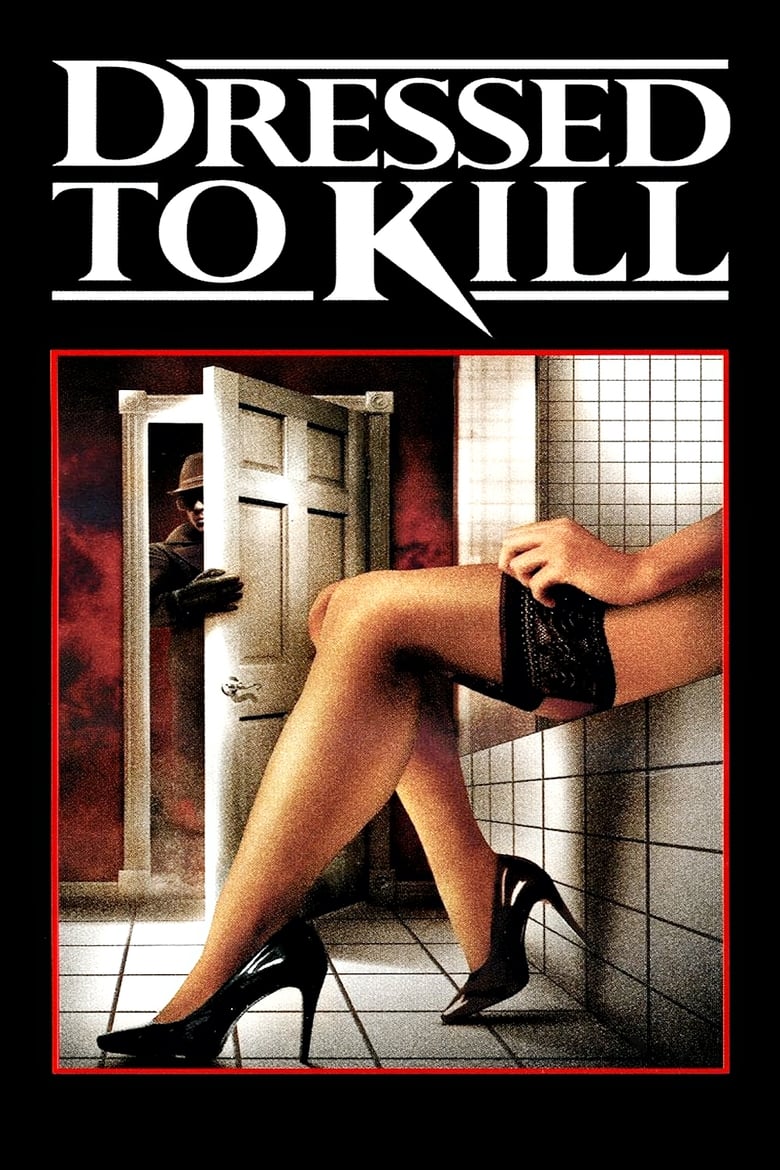
Dressed to Kill
“The latest fashion in murder.”
After witnessing a mysterious woman brutally slay a homemaker, prostitute Liz Blake finds herself trapped in a dangerous situation. While the police thinks she is the murderer, the real killer is intent on silencing her only witness.
About Dressed to Kill
What makes Dressed to Kill worth revisiting
There’s an immediate, slightly uncomfortable intimacy to Dressed to Kill: Kate Miller turns up at her psychiatrist’s office to talk, and what begins as a domestic therapy scene quickly tightens into something darker. That pressure—private confession sliding into public danger—gives the film a constant forward motion.
Brian De Palma directs with a taste for tension rather than exposition, and he keeps things economical: the film runs for about 105 minutes, which is just enough time to wind the characters up and let the plot snap. Michael Caine is the doctor at the centre of it all, while Angie Dickinson plays the woman whose day out turns catastrophic and Nancy Allen plays the figure who gets pulled into the investigation.
Combine a premise built on bedside power dynamics with a procedural that treats suspicion like an infectious thing, and you get a thriller that still feels designed to make an audience uneasy in the best possible way.
The idea that sets Dressed to Kill in motion
It begins like a small domestic drama: a woman’s therapy visit, a thwarted flirtation and then a day that takes a different shape when she goes out alone. The story’s engine is straightforward—an ordinary outing turns into an extraordinary crime and someone who should be a witness becomes the focus of suspicion.
That witness, Liz Blake, discovers the body and, crucially, sees the killer reflected in an elevator mirror. Instead of being protected by that information, she finds herself treated as the prime suspect, which is the first push the film gives the audience away from comfortable certainties.
The police aren’t convinced by Liz’s account, so she pairs up with Kate’s teenage son Peter. He’s an inventor with a streak of DIY ingenuity: his homemade listening devices and time-lapse cameras become the unlikely tools that drive their hunt for the truth.
The setup works because it keeps the action personal—this isn’t a detached detective story. The people closest to the victim are the ones forced to act, and that immediacy keeps the stakes small and unbearably human.
Why Dr. Robert Elliott matters
Dr. Robert Elliott sits at the awkward centre of the film: he is the professional the audience meets in a private room, the person other characters trust with intimate details. Michael Caine plays that doctor, which matters because the film’s momentum depends on the idea that someone in a position of care and authority might also be part of the problem.
The narrative sets up Elliott as an axis for the drama—Kate comes to him, confesses, then goes out into the world and is killed. That link—therapist to patient to victim—keeps Elliott improbably close to the action even when he isn’t physically present.
What makes him memorable within the structure of the movie isn’t just a single violent moment; it’s that his role as a figure you’re expected to trust gets tested and then used to complicate who the audience should believe.
Dressed to Kill has more on its mind than the plot suggests
Two ideas pulse beneath the surface: authority and fear. The film keeps returning to the problem of who gets to be believed, and to what happens when the people who hold power—medical, legal, or social—are also the ones who might be hiding something.
Fear in Dressed to Kill is often domestic rather than cosmic. A small domestic panic—Kate forgetting her wedding ring and going back for it—becomes the hinge that turns private anxiety into mortal danger. That shift from personal worry to life-and-death consequence is where the movie’s tension lives.
When authority wobbles, the audience’s loyalty is constantly tested. The film is less interested in moralising than in showing how brittle trust can be once the scaffolding of supposed expertise creaks.
Dressed to Kill could not belong to any other decade
Released in 1980, Dressed to Kill arrives right at the moment the decade begins to take shape onscreen: the film’s appetite for mixing noirish investigation with erotic tension feels of a piece with the era’s willingness to blur genre lines.
That placement matters because the movie uses a compact cinematic hour-and-a-half to do the heavy lifting—psychological set-up, a crime, an amateur investigation—without sprawling. It’s a kind of economical intensity that was finding its voice at the start of the 1980s.
Calling it ‘of its time’ isn’t an insult here; it’s recognition that the movie plugs into a moment when thrillers were getting more interested in private life and the fractures inside it.
What has aged — and what hasn't
Some core mechanics still read well: the story’s reliance on small inventions—Peter’s homemade listening devices and time-lapse cameras—gives the investigation a tangible, hands-on logic that keeps the mystery feeling immediate rather than circuit-board distant.
The film’s fear beats remain effective because the danger is often rooted in ordinary actions. Kate’s decision to return for a wedding ring transforms a private embarrassment into a catastrophic moment, and that kind of escalation still lands.
Other things jar more. The way the police treat Liz—doubting her because of her profession—feels like a plot point built from recognisable social attitudes of the time. Watching it now, that scepticism is harder to miss and reads differently than it might have in 1980.
And some of the story’s practical solutions—spraying a stalker with homemade Mace on the subway, for example—work as plot set-pieces, though they carry a slightly different weight for a modern viewer who notices how the mechanics of pursuit and protection have changed.
Why Dressed to Kill still matters
The film keeps coming back into conversation because it starts small and keeps tightening. A therapy session becomes the first turn in a sequence that runs through a museum flirtation, an elevator murder and a woman who becomes both witness and suspect. Those beats are the kind of compact, shocking pivots that lodge themselves in memory.
There are also plot beats that demand attention: a taunting answering‑machine message from a character called Bobbi, the way amateur detectives use gadgets to follow the story, and the moment the killer is unmasked in a confrontation that literally strips away disguise.
Crucially, the film offers an explicit explanation: a doctor’s split between wanting to become a woman and not being able to complete that change is presented as the narrative engine behind the violence. That narrative choice is central to how the story resolves its mystery and is a major part of why discussions about the film keep returning to its handling of identity and secrecy.
Put simply: Dressed to Kill lingers because it ties voyeurism, professional authority and private fear into a compact package where each twist directly reorders what the audience thinks it knows.
Does Dressed to Kill still hold up?
Yes — with caveats. Dressed to Kill is a tight, 105-minute demonstration of how to build suspense from small domestic choices: a therapy appointment, a cancelled plan because a son is finishing a science-fair project, a brief flirtation in a museum. Those are the simple decisions that the film turns into full-blown danger.
It’s still interesting to watch how authority and fear work together here: a psychiatrist who hears intimate confessions, police who doubt a woman’s testimony, and amateur sleuthing that relies on ingenuity rather than glamour. Those dynamics give the story its momentum and remain watchable.
At the same time, the film’s resolution—its explanation for why the violence happens and how identity plays into that—will sit awkwardly with some modern viewers because it ties together gender, secrecy and pathology in a way that’s of its moment. That isn’t buried in subtext; it’s the film’s stated rationale.
If you’re prepared to engage with its dated ideas while appreciating the craft of a brisk psychological thriller, Dressed to Kill still cuts. Watch it for the set-pieces and the tension; watch it with your attention on the assumptions the story asks you to accept.