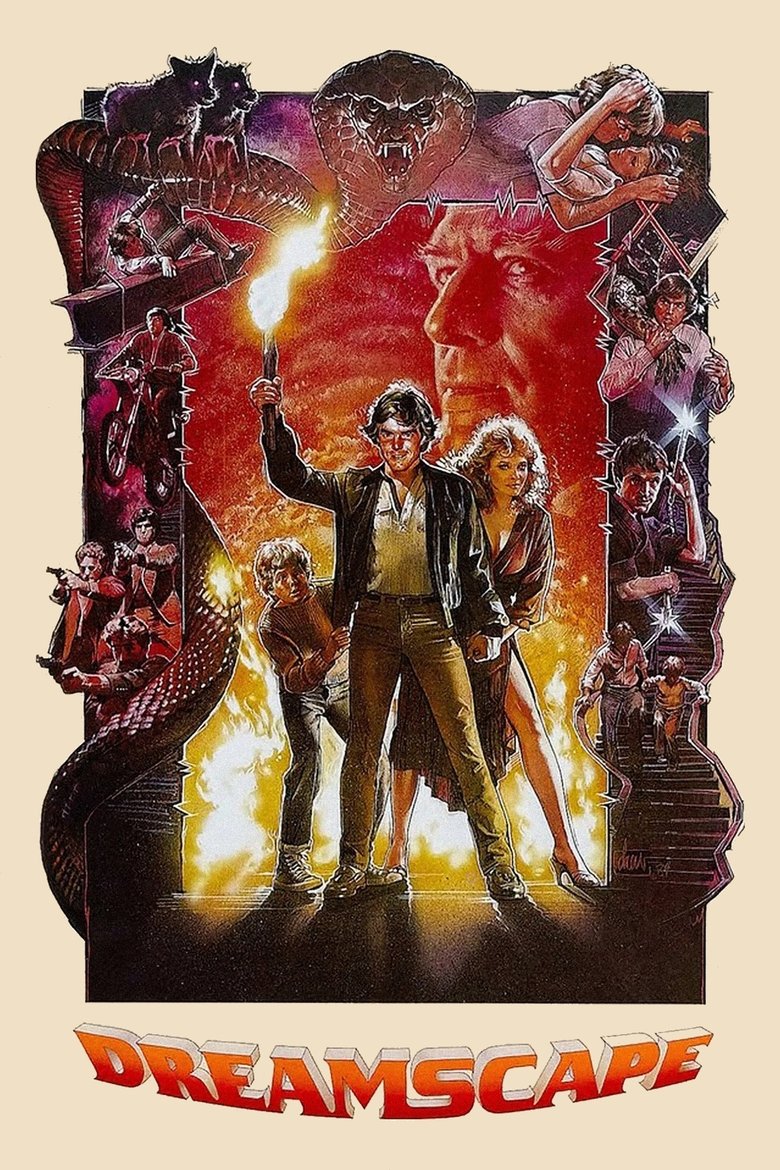
Dreamscape
“Close your eyes and the adventure begins.”
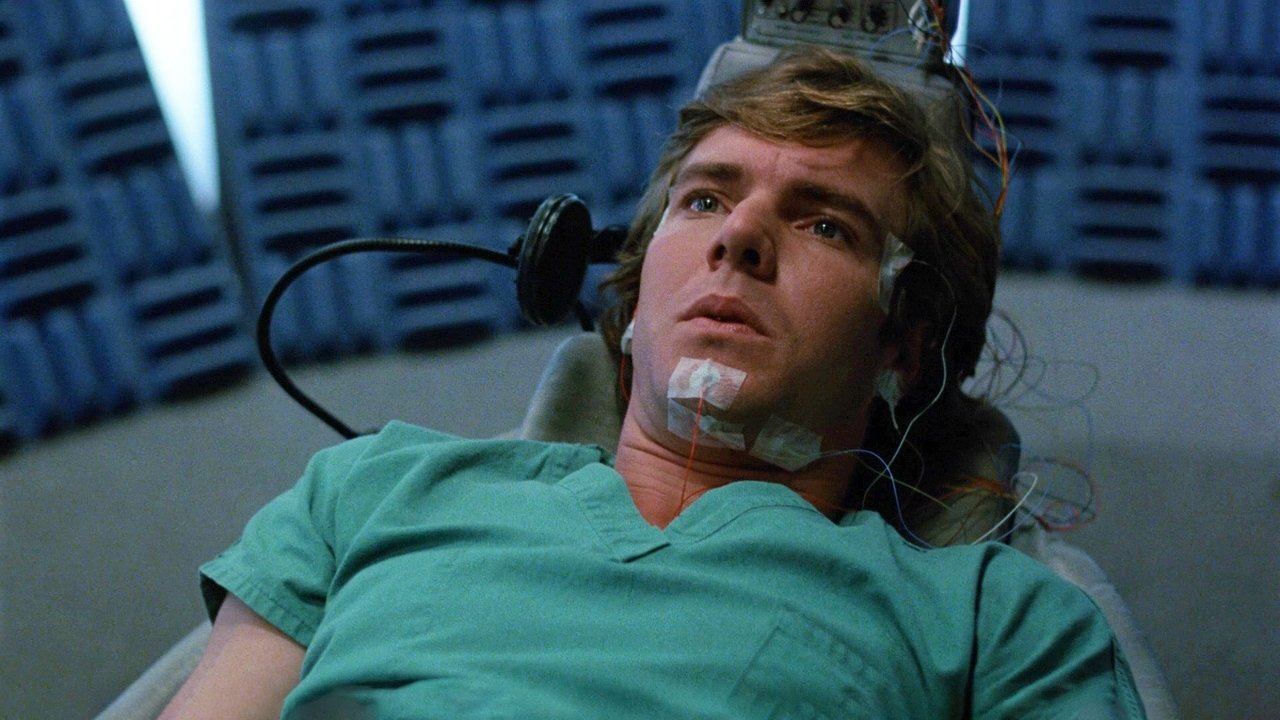
In order to diagnose the psychic traumas suffered by his patients, Dr. Paul Novotny gets young Alex Gardner to enter their dreams.
About Dreamscape
Why Dreamscape still works
There’s a distinct pleasure in a movie that lays its cards on the table: this one’s about a man who can enter other people’s minds and, for the most part, uses it to get what he wants. Alex Gardner is that man — gambling and womanising his way around problems until the plot insists he do the decent thing.
Joseph Ruben doesn’t dilly-dally. The film is a brisk 95-minute thriller that folds horror and science fiction into the same set of rules: scientists have worked out how to link into somebody’s REM sleep and walk around in their subconscious. That clever, slightly terrifying hook gives the film someplace specific to hang its weird ideas on. Once the premise is clear, Dreamscape fills its cast with characters who raise the stakes — from Max von Sydow’s scientist to Christopher Plummer’s menacing government figure, Kate Capshaw’s fellow researcher, and David Patrick Kelly’s terrifyingly unstable psychic — so the film never feels like a party trick. It’s a compact, determined movie that knows how to move from a gambling den to a nightmare wasteland without getting lost.
Why Alex Gardner matters
Alex Gardner is the sort of lead who begins as a slippery opportunist — a psychic who treats his gift as a means to bankroll his pleasures. That baseline makes his choices interesting because you’re never sure if he’s about to con someone or actually try to help them.
The film uses that slipperiness to give the character room to change. He’s not written as a saint; he’s a working man with unusual skills, and the story puts him in positions where selfish instincts collide with responsibility.
Family is woven into his arc in a striking, physical way. At one key point Alex takes on the shape of a murdered father to stop a violent psychic — a choice that forces him into a parental role he never asked for.
That push-and-pull is why he sticks in the mind after the credits. He begins as a useful rogue and ends up performing a kind of guardianship he never signed up for — which is more interesting than a straight-laced hero, precisely because it feels earned from the character the film establishes early on.
Dreamscape has more on its mind than the plot suggests
On the surface it’s a clever premise and a tidy thriller. Underneath, Dreamscape keeps drifting into questions about who gets to use power and why — and what happens when the institutions that claim to protect us see a private talent as a public tool.
Freedom is a recurring note. The idea of entering someone’s sleep is, by definition, an invasion; the film asks whether the technology should exist and, if it does, who controls it. That conflict between individual liberty and institutional authority quietly steers several plot decisions.
Family works as the emotional counterweight. Dreams here aren’t just clever set-pieces; they’re spaces where personal loyalties, grief and protection play out. Parental protection, in particular, turns up repeatedly: nightmares aren’t abstract fears but things people feel responsible to shield others from.
Put together, those ideas stop Dreamscape from being merely a catalogue of neat dream sequences. It becomes a film about control — over minds, over power structures and over the private parts of a person that nightmares expose.
Dreamscape could not belong to any other decade
Released in 1984, Dreamscape sits neatly inside a moment when genre films liked to mix high-concept speculation with down-and-dirty stakes. It’s a film that trusts a slightly wild premise and lets the idea drive the action.
That willingness to marry speculative science — a technique for linking REM sleep — to political and personal threats feels very of its time. The decade produced a lot of movies that trusted a single inventive idea to carry a story, and Dreamscape is one of them.
Because it moves quickly and likes clear, grabby set-ups, the film feels like a product of 1980s storytelling instincts: lean, bold and unafraid to get a bit silly to land a bigger point. Seen alongside other 1980s movies, Dreamscape isn’t retro for the sake of it: it exemplifies a period appetite for mash-ups — science fiction with horror and thriller — told at a clip that keeps the audience engaged.
Why Dreamscape still matters
There are two tangible reasons people remember Dreamscape: its central conceit and the moments that follow from it. The movie gives us a believable, if alarming, technology — a way for psychics to project into someone’s subconscious during REM sleep — and then watches what people do with that power.
It also keeps a few bold image-beats that stick in the head. A young boy’s nightmare about a snake-man, a mentally unstable psychic who embodies violent fantasy, and an actual assassination attempt staged inside a president’s dream — these are the kinds of sequences that get retold at parties.
The film does something slightly cheeky with its rules, too. Alex manages to enter someone else’s dream without the equipment other psychics need, which makes him unusually mobile inside the story and gives the film permission to make personal choices matter in a world of institutional plans.
Finally, there’s the way the movie ties private fears to public consequences. When the technique is pressed into service as a political weapon — with the plan to use dreams to kill — the personal and the national collapse into the same space. That collapse is what keeps Dreamscape in conversation: it’s not just the novelty of dreamwalking but the price that novelty demands.
Does Dreamscape still hold up?
Yes — if your idea of a good watch is a compact, idea-first thriller with a streak of horror. At 95 minutes, Dreamscape doesn’t outstay its welcome: it sets up a psychic who’s more interested in his own comforts than heroism and then nudges him into the uncomfortable work of protecting others.
The movie works because its stakes feel both intimate and absurd. A technique meant for treating nightmares becomes a weapon in political hands, and that slide from therapy to assassination keeps things tense. The personal stuff — a young boy’s nightmare, a murdered father’s image — gives the big, national peril a human face.
If you enjoy films that ask questions about authority and freedom without turning them into lectures, Dreamscape is satisfying. It’s concise, it has memorable sequences (some of them gruesome), and it uses its premise to examine what loyalty and protection mean when the battlefield is someone’s sleep.
So yes: watch it. Not for slick modern effects or slow-burn subtlety, but for a lean, imaginative 1984 film that treats dreams as places where ordinary choices suddenly have extraordinary consequences.