
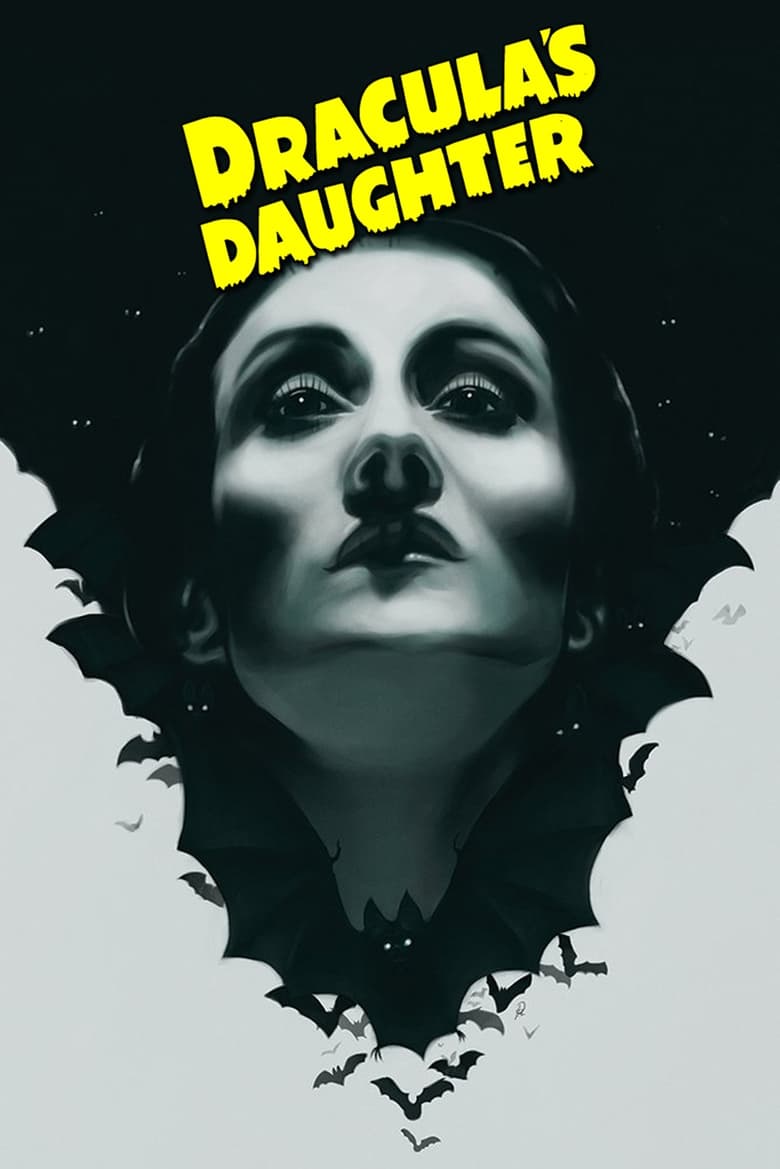
Dracula's Daughter
“She gives you that WEIRD FEELING.”
A countess from Transylvania seeks a psychiatrist’s help to cure her vampiric cravings.
About Dracula's Daughter
Countess Marya Zaleska is still the reason this movie works
If you remember one image from Dracula's Daughter, it's not a gothic castle or a howl in the night — it's the Countess. Gloria Holden's Marya Zaleska arrives like an argument you can't ignore: she steals her father's corpse, burns it on a pyre and then, stubbornly, tries to stop being what she is.
That stubbornness is the film's personality. The picture wastes no time establishing the odd new problem at its heart: Van Helsing has dispatched Dracula, the local police find the bodies, and the mechanics of the monstrous are already being dealt with by Scotland Yard. The story doesn't reopen the Dracula book so much as pick at the stitches left behind. At 71 minutes, Lambert Hillyer's 1936 vampire picture is small and economical, a horror movie that makes its case in short, determined bursts — and it does so by letting its central figure wrestle with mortality, desire and fear rather than relying on spectacle alone.
The idea that sets Dracula's Daughter in motion
This film opens after the obvious climax of the Dracula story: Van Helsing has finished the job and the local police find Dracula and Renfield dead in Carfax Abbey. That aftermath becomes the new starting point.
The Countess isn't content with simply inheriting her father's darkness. She steals his corpse from the jail, then carries out a ritual burning of the body — a private attempt to break what ails her. It's a strange, desperate bid for normality rather than a revenge plot.
Her next move is to look for help in unusual places. A chance meeting at a society party brings her into contact with Dr Jeffrey Garth, a psychiatrist and a former pupil of Van Helsing, and she asks him to help resist the influence she feels from beyond the grave.
Garth responds with a clinical prescription: confront the cravings rather than flee them. That pragmatic advice — willpower plus science — is the film's engine. It's a compact premise that lets the story move quickly from moral question to immediate consequence.
Why Countess Marya Zaleska matters
Countess Marya Zaleska is the sort of antagonist who refuses to be a simple villain. Gloria Holden plays her, and the film keeps returning to the Countess's attempt to be free of vampirism as the clearest way to define her.
She isn't merely prowling for victims; she actively sabotages her father's remains in the hope of breaking the family curse. That ritual burning is an act of repudiation as much as it is superstition — she wants an end to her condition, not a victory over people.
The Countess also operates through seduction and influence: she mesmerises victims and uses a jeweled ring as part of her means. But the film gives her more than predatory gestures; it gives her a project — to cure herself — and that single-mindedness makes her memorable.
When she stops fighting and decides a cure is impossible, the story becomes almost tragically simple: the Countess wants company in immortality, and that desire moves the plot toward its darker choices.
Dracula's Daughter has more on its mind than the plot suggests
On the surface it's a vampire picture: people get bitten, go under hypnotic sway and die. But the film keeps turning to the same three concerns — mortality, fear and lifespan — and lets them quietly reframe the horror.
The Countess's central problem is lifespan writ large: she has an unnaturally extended existence and seeks to escape it. That makes the plot less about hunting a monster and more about a creature negotiating the cost of never ageing.
Fear functions in two directions. There's the ordinary fear of being attacked, of course, but there's also an existential fear — the Countess's terror of what she has become and her dread of immortality as a sentence, not a gift. When the movie asks whether one can defeat what one is born into, it invites viewers to think about regret and the strange loneliness of outliving a natural life-span. For a short, economical horror picture, it carries a surprisingly thoughtful idea about time.
Dracula's Daughter could not belong to any other decade
Released in 1936, Dracula's Daughter wears its decade quietly rather than loudly. It sits within the 1930s horror tradition in which monsters are treated as both supernatural threats and psychological problems.
That era's films often trimmed the Gothic fat and concentrated on mood and moral puzzles; this picture follows the same discipline, keeping runtime short and the focus tight.
There's a practical economy here — short running time, swift plotting — that feels very of its moment. The 1930s gave studios compact, idea-driven horror pictures, and this film is a tidy example.
Seen this way, the movie is less a relic of style than a product of a period when horror was willing to fold social and psychological questions into the scares.
What has aged — and what hasn't
A modern viewer will find the film oddly lean. It doesn’t aim for overwhelming spectacle; it prefers a quieter tension. That economy helps the themes of fear and mortality breathe — the idea of an exhausted immortality still reads.
Some plot beats feel straightforward to contemporary eyes: the Countess burns Dracula's body hoping to break her curse, then eventually accepts that her cravings may be incurable. Those steps make the character's choices easy to follow, which is helpful in a short runtime.
Where the picture is less comfortable is in certain plot conveniences — the Countess's eventual decision to stop resisting, or the way events funnel around a small group of characters — but those are storytelling shortcuts rather than fundamental flaws.
If you approach it as a compact, genre-specific piece about fear and lifespan rather than a modern psychological drama, it still has a jagged emotional clarity: a vampire who wants an end, and the human price that desire exacts.
Why Dracula's Daughter still matters
People return to Dracula's Daughter because it flips a familiar setup: instead of reanimating Dracula's terror, it studies the next generation and asks what immortality costs. The film opens on the immediate aftermath of Dracula's destruction and then follows what the survivors leave behind.
The Countess's theft and ritual burning of her father's body is the kind of image that lodges in memory — a character trying to excise a family past rather than simply hide from it. That act colours everything that follows.
There's also a tidy moral line the movie draws: a scientist comes forward — Dr Jeffrey Garth — with the blunt suggestion that confronting cravings might work. His involvement turns the story into a collision between will, science and appetite. Finally, the film does not shy from darker consequences. Victims are hypnotised and die, the Countess surrenders to her nature, and the narrative forces its characters into choices that feel irrevocable. For those who grew up with this sort of 1930s horror, that uncompromising finality is part of its lasting appeal.
Does Dracula's Daughter still hold up?
Yes — but with a rider. Dracula's Daughter is not a bombastic remake of Dracula; it's a compact exploration of what comes after the vanquishing of a monster. That makes it interesting in a way bigger spectacle rarely is: it asks about consequences.
The film’s tight running time (71 minutes) and direct plotting keep it watchable today. You get the setup — Dracula's corpse found in Whitby, Van Helsing explaining the legal aftermath at Scotland Yard, the Countess's ritual burning — and then a short, intense investigation into will and appetite.
It will feel old-fashioned in places: some characters exist mainly to move the plot, and the Countess's surrender to her urges is narrated as much as lived. Yet those choices underline the themes rather than derail them. The story of a creature who tries to end her own curse, who then seeks to make a companion of a human, still makes for an unsettling, intelligent horror premise.
So watch it for the Countess and the oddly modern question she brings: what if immortality is the trap, not the prize? For seventy-one minutes, the film treats that question with enough seriousness to remain worth your time.