
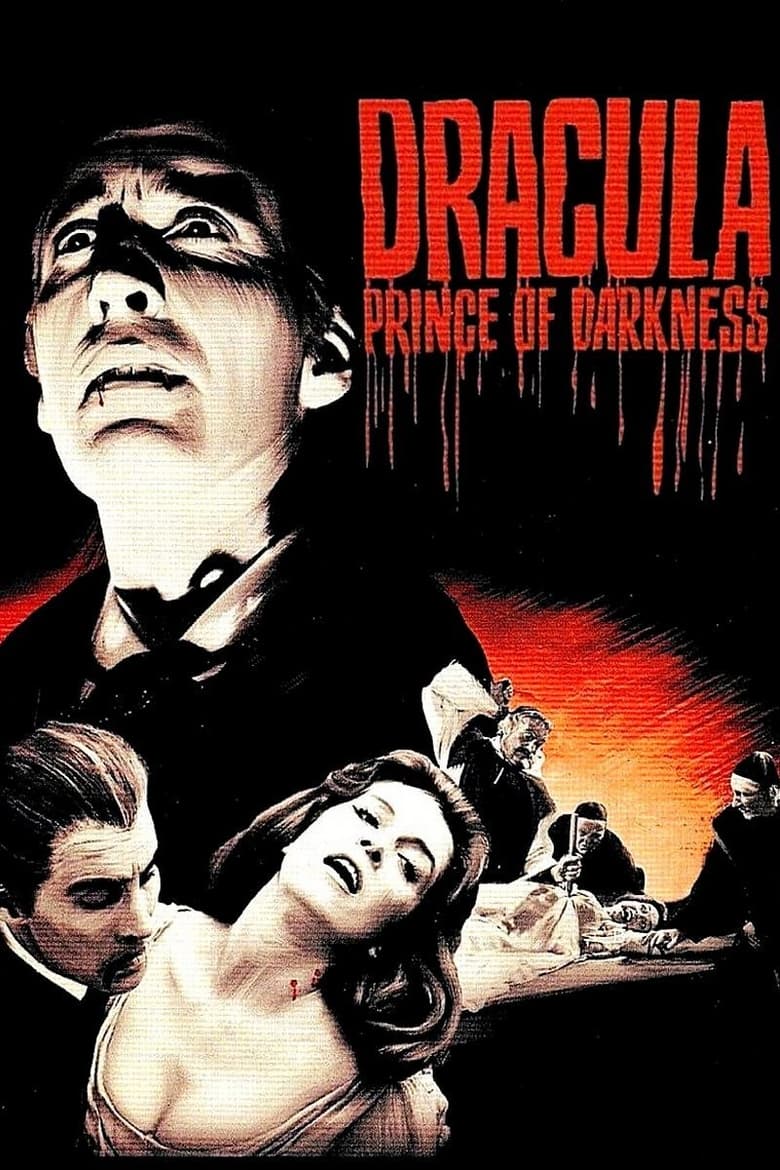
Dracula: Prince of Darkness
“DEAD for Ten Years DRACULA, Prince of Darkness, LIVES AGAIN!”
Whilst vacationing in the Carpathian Mountain, two couples stumble across the remains of Count Dracula's castle. The Count's trusted servant kills one of the men, suspending the body over the Count's ashes so that the blood drips from the corpse and saturates the blackened remains. The ritual is completed, the Count revived and his attentions focus on the dead man's wife who is to become his partner; devoted to an existence of depravity and evil.
About Dracula: Prince of Darkness
Why Dracula: Prince of Darkness still works
The film opens not with exposition so much as memory: a prologue that replayed Dracula’s destruction by Van Helsing’s sunlight, leaving only the idea of the Count’s evil hanging in the air. That choice sets the tone — this is a sequel that leans on dread as much as explanation.
Terence Fisher runs the show with efficient theatre-like economy. At a brisk ninety minutes, the movie has no room for faff; it gets to the castle, gets its teeth in, and keeps moving. And with Christopher Lee back as Count Dracula, the problem is immediate and unmistakable: the presence of the vampire matters here as a disruptive force, not merely as a set piece.
The idea that sets Dracula: Prince of Darkness in motion
It begins, helpfully, with a priest who refuses to let old fears be handled carelessly: Father Sandor stops the disposal of a corpse suspected of vampirism, reminding everyone that these things linger in people’s heads as much as in graveyards.
That attitude — a clash between superstition and a desire for order — is immediately tested when four English tourists ignore Sandor’s warning and head for Karlsbad.
Night falls, the coach driver deserts them, and the Kents find themselves shepherded to a nearby castle where they discover a dining table set as if for their arrival. Small domestic details like that — unpacked bags, ready beds — are what make the castle unsettling.
The practical move that starts everything else is cruelly simple: one of the servants, Klove, kills Alan and uses his blood with Dracula’s ashes to bring the Count back. Once Dracula is revived, the film tightens into a very direct contest of rescue, resistance and escape.
Why Count Dracula matters
Count Dracula in this story is less an origin mystery and more a returned verdict. The film reminds us — via that prologue — that he was once defeated, but the idea of him never really goes away, and that’s exactly the space the film wants to play in.
Christopher Lee’s casting is a simple, practical thing: the Count’s arrival needs to register instantly. The movie doesn’t spend long explaining who Dracula is; it just shows the consequences when he’s let back into the world.
There’s also a useful domestic angle that keeps the Count from being a mere roaming menace. Klove explains that Dracula ordered the castle be kept ready for strangers, which turns the house into a kind of trap disguised as hospitality.
And because family is threaded through the plot — the Kents travel together, get separated, and watch one another be taken — Dracula’s threat lands on people you care about, not nameless victims. That tight focus makes his return feel personal rather than merely theatrical.
Dracula: Prince of Darkness has more on its mind than the plot suggests
At the overt level it’s a vampire tale. Underneath, the film keeps returning to a handful of ideas: freedom, fear and family. Those themes are simple, but they give the story shape.
Freedom toggles between the desire to travel and the reality of being trapped. The Kents set out as tourists; by night they are prisoners of circumstances they didn’t expect.
Fear is treated as contagious and institutional. Father Sandor calls out the priest who perpetuates the panic over vampirism, which suggests the movie is as interested in how panic spreads as it is in the supernatural cause. Family is the film’s emotional anchor. The missing brother, the wives, the pairings — when Dracula threatens, he isn’t attacking an abstract population; he’s tearing into domestic bonds, and that makes the stakes immediate.
Dracula: Prince of Darkness could not belong to any other decade
Released in 1966, the film sits squarely in the mid-60s period when British studios like Hammer were refining a particular brand of horror: economical, theatrical and audience-aware.
There’s a confidence here that comes from making genre films for an audience who knew what to expect — the movie doesn’t redefine the vampire but restates it, crisply and without apology.
That mid-decade clarity means the film reads like a concise genre exercise: it knows its rules and gets straight to the business of upsetting them.
So while it’s a product of 1966, its commitment to clear, brisk storytelling is what actually ties it to the decade rather than any surface decoration.
What has aged — and what hasn't
The story’s core — a small group of ordinary people who stumble into an ancient danger — still plays. Opening with Father Sandor stopping a gruesome disposal keeps the film grounded in parish-level concerns rather than grand mythology, and that is still effective.
The film’s simplicity helps it survive. The sequence where the coach driver deserts the party, leaving them vulnerable, still jolts because it’s a neat, believable escalation of peril rather than spectacle.
Some elements feel quaint: the ways characters call on crucifixes, stakes and lamps as counters to vampirism are of their moment. Still, those moments work within the movie’s own rules — Sandor sterilizing a bite and putting crucifixes in coffins is sensible within this logic, and it gives the rescue scenes traction.
All told, the movie ages like a compact thriller rather than a blockbuster: it’s strongest when it keeps the conflict local and personal, and less persuasive when it asks you to accept big, convenient plot moves without fuss.
Why Dracula: Prince of Darkness still matters
People remember this film because of its economy: that coachmanless carriage, the table already set, a servant who revives Dracula with a grisly ritual — these are images that lodge because they do narrative work without fuss.
The structure — tourists who split up, an undead Helen attacking her sister-in-law, and the monks at the abbey refusing entry to the undead coffins — gives several memorable set pieces that stick in the mind exactly because they’re immediate and physical.
There’s also the moral clarity the film offers: when the Count returns, the community is forced to make small but decisive choices — sterilize a bite, drive a stake, shoot ice — which keeps the drama squarely on human responses rather than on mysterious metaphysics. And the endgame — Dracula plunging through ice into water — is satisfyingly conclusive in a way many modern horror films avoid; here the problem is solved with a series of practical actions, and that tidy closure is part of why older viewers keep coming back.
Does Dracula: Prince of Darkness still hold up?
Yes — with a small rider. If you want a long, revisionist take on Dracula, this isn’t it. If you want a tight, purposeful vampire picture that keeps the threat close to a family and a handful of defenders, it remains effective.
Terence Fisher directs with no theatrics, which is the point: the film is 90 minutes of concise problem-solving, and it earns the small solutions — a crucifix that works, a stake driven home, an abbey that refuses entry — so those moments feel earned.
Christopher Lee’s Dracula is the unavoidable centre, but the movie’s emotional commitments lie in the Kents and Father Sandor; their decisions and the film’s tidy moral operations are what make the film worth revisiting.
If you sit down expecting subtle psychological horror you’ll be disappointed. If you want a compact, well-made piece of 1966 Hammer horror that treats fear as a contagion and family as the thing worth defending, then this one still bites.