Dracula
“Who will his bride be tonight?”
After Jonathan Harker attacks Dracula at his castle, the vampire travels to a nearby city, where he preys on the family of Harker's fiancée. The only one who may be able to protect them is Dr. van Helsing, Harker's friend and fellow-student of vampires, who is determined to destroy Dracula, whatever the cost.
About Dracula
Why Dracula still stands out
The movie wastes no time getting to the point. A young librarian arrives at a remote castle, a frightened woman begs for help, and the visitor quietly discovers that he’s walked into a far older, far nastier game than he expected.
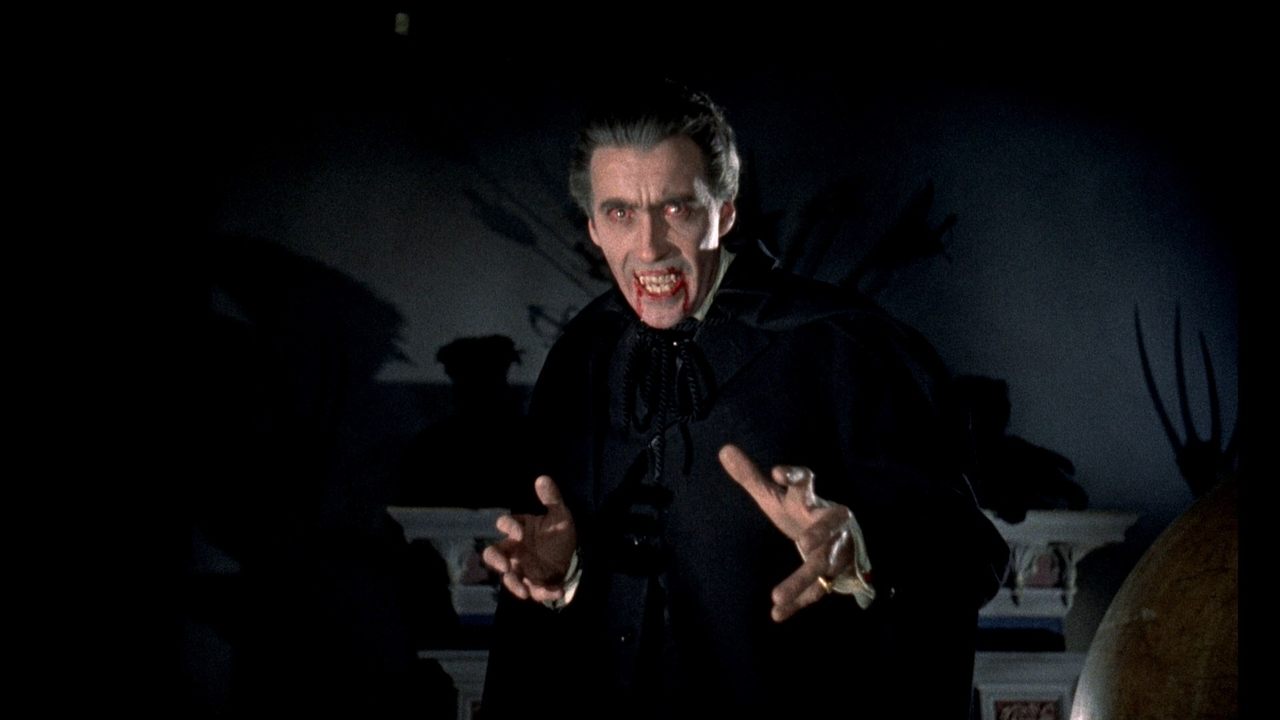
Terence Fisher directs, Christopher Lee plays the Count and Peter Cushing turns up as the doctor who won’t stop when things go wrong. It’s a compact picture — the sort that gets a lot done in a little time — and that economy gives the story a hard, focused feel. Beneath the immediate fright are quieter tensions: mortality, the weirdness of lifespan when the living brush against the undead, and the lengths people will go to protect their own. That gives Fisher’s Dracula a specific, human centre rather than a parade of gothic spectacle.
The idea that sets Dracula in motion
At the heart of the story is a practical, almost medical panic: Lucy is ill, and Mina turns to Van Helsing to try to save her. The measures prescribed — garlic, watchful care — point to a world that wants to treat the problem before it becomes something worse.
Those small precautions fail. Lucy is found dead, yet a new, uncanny life returns to her grave; three days after burial she lures a child out into a graveyard. The threat has slipped its leash and now moves among the living.
Van Helsing pursues a lead, then a mistake exposes Mina. In trying to protect her, the people around Mina make desperate, blood‑sized choices — including a transfusion that temporarily buys hope but ends with Dracula escaping with his coffin and Mina herself.
It’s a setup that works because the danger stays close to home: it’s not an abstract curse but something that bites at the edges of family life and parental duty.
Why Abraham Van Helsing matters
Peter Cushing plays a Van Helsing who is all purpose and procedure. He arrives where the problem is worst and immediately starts doing the job: reading journals, unearthing graves, making the grim decisions other people can’t.
The film gives him blunt, decisive moments. He opens a crypt and finds his friend transformed into the thing he feared — then he acts. There’s no elegant moral debate; there’s necessary work to be done.
That practicality is part of why the character sticks. Van Helsing is a sort of family sentinel: he delivers bad news, insists on hard remedies and will, if he must, sacrifice comfort for the sake of those still alive.
Because family ties run through the plot, Van Helsing’s willingness to do the dirty, final things — even when they look ruthless — reads as protection rather than cruelty. He matters because he keeps the story anchored to what people will endure for one another.
Dracula has more on its mind than the plot suggests
Yes, it’s a vampire movie. But the film is quietly obsessed with mortality — not just death in the abstract, but the way a long life (or an unnatural un-death) warps the lives of ordinary people around it.
The contrast between centuries-old undead and the short, fragile span of the living shows up again and again: in stolen portraits, in graves disturbed, in a ruined engagement reduced to longing and loss.
Parental protection is another steady undercurrent. Characters make choices to shield children or loved ones — sometimes useful, sometimes tragically mistaken — and those choices push the story forward. Taken together, family and lifespan give the chase a human face. The monster matters because it threatens the people we care about, and so every small domestic detail becomes a battleground.
Dracula could not belong to any other decade
This Dracula wears its year — 1958 — like a practical coat. It doesn’t dilly-dally: the story moves briskly, trims the fat and keeps an eye on straightforward moral problems rather than indulging in baroque excess.
That tightness feels very of its moment: a late‑50s picture that treats horror as a no-nonsense threat to ordinary family life rather than pure escapist spectacle.
The film’s concerns — lifespan, the defence of the household, the failure of communal courage at an inn — sit comfortably within the kinds of stories movies of the period were willing to tell.
In short: the film’s shape and focus are recognisably 1950s. It prefers clarity and pressure over wink and flourish, and that gives it a distinct personality.
What has aged — and what hasn't
What still holds up is the film’s moral urgency. The diary that reveals Jonathan as a hunter, the desperate attempts to protect Lucy and Mina, the villagers who won’t help — those are story mechanics that still feel immediate when you watch now.
The movie’s simplicity also helps. Scenes such as the crypt descent, the discovery of a turned friend and the small, horrific domestic moments — a neck bared on a terrace, a child lured to a graveyard — keep the stakes personal rather than abstract.
Some elements feel of their time: the plot moves by decisions that nowadays might be questioned more overtly, and a few narrative shortcuts rely on characters behaving predictably. But the emotional centre — family at risk, a doctor willing to do the ugly work — remains clear.
And when the film chooses to finish the story in a single, decisive confrontation, that final, physical undoing of the monster still reads as satisfying and earned.
Why Dracula still matters
People remember this film because it reduces a vast myth to very human terms: a librarian arrives; a diary reveals a plan; a friend is lost and then, heartbreakingly, found as something else. Those beats stick.
Van Helsing’s methods — from handing over incriminating journals to digging up graves — give viewers a string of images that are both ghastly and oddly reassuring: something is being done about the threat.
The film also keeps the horror close. Dracula doesn’t only menace strangers; he bites into families, lures children and steals a woman from her bed. That domestic invasion is the sort of thing that stays in the memory. Finally, the chase to the castle and the film’s decisive ending — the destructive morning after and the small human recoveries that follow — tidy the story in a way that leaves an emotional mark rather than a loose, unresolved dread.
Does Dracula still hold up?
Yes — if what you want is a compact, purposeful vampire film that treats horror as an intrusion on ordinary life. Terence Fisher’s 1958 picture runs tight and true, and it keeps the focus where it belongs: on people trying to save those they love.
Peter Cushing’s Van Helsing and Christopher Lee’s Count anchor the conflict, but the story’s smallest choices — a transfusion, a torn curtain, a grave opened at dawn — are what make the ending feel earned.
The themes of mortality, long life versus short life, and parental protection are woven through the plot rather than tacked on, so the film still speaks to modern viewers who appreciate horror with a human cost.
If you’re deciding whether to watch it: expect efficient storytelling, uncompromising choices and a finale that settles the score. It may not be the last word on Dracula, but it’s a satisfying, sharp bite that still draws blood.