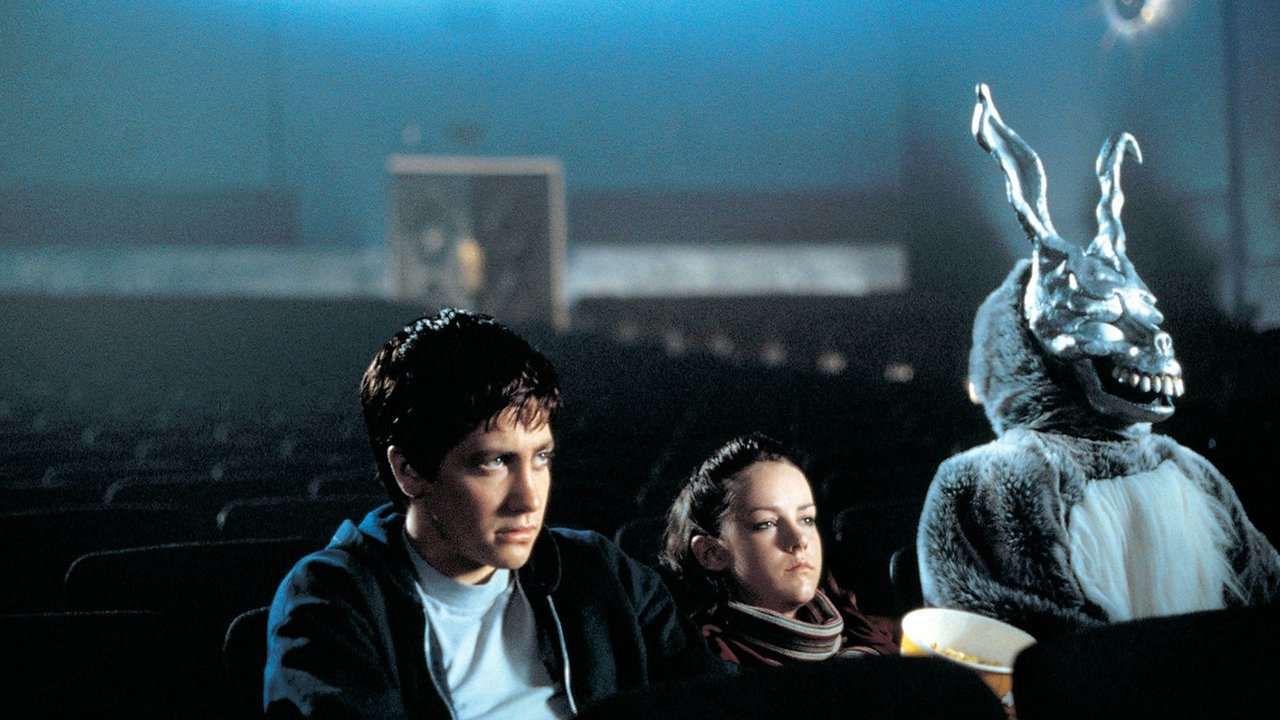

Donnie Darko
“28 days, 6 hours, 42 minutes, 12 seconds... that is when the world will end.”
After narrowly escaping a bizarre accident, a troubled teenager is plagued by visions of a large bunny rabbit that manipulates him to commit a series of crimes.
About Donnie Darko
What makes Donnie Darko worth revisiting
It starts like a night you half remember from your teens: one odd decision, the wrong place at the wrong time, and a question you can't shake. Donnie Darko opens with a sleepwalking episode that immediately announces this isn't a straight teenage drama — something else is tugging at the edges of ordinary life.
That ‘something else’ takes the form of Frank: a terrifying presence in a rabbit suit who hands Donnie a countdown. The film uses that absurd, unnerving image to let a weird set of rules settle in — school corridors, parental rows and motivational pep talks all suddenly feel vulnerable to the ridiculous and the uncanny. Richard Kelly directs the whole thing with an appetite for tonal whiplash — one minute it's domestic, the next it's impossible — and he wraps it in a compact 113 minutes that keeps you off-balance. The cast fills the town: Jake Gyllenhaal as the central teenager, Patrick Swayze as the local speaker Jim Cunningham, Mary McDonnell and Maggie Gyllenhaal anchoring the family, and a supporting crowd that make the suburb feel lived-in and oddly combustible.
The idea that sets Donnie Darko in motion
The film gives you one startling premise and then treats the rest as if it were perfectly normal: Donnie sleepwalks into the night, meets Frank in a monstrous rabbit suit and learns the world will end within a month. That absurdity is the spark — it makes everything that follows feel like a rehearsal for catastrophe.
Around that central oddity, the story keeps its feet planted in recognisably teenage territory. Donnie starts a relationship with Gretchen, a newcomer whose past has clearly scarred her; their connection is one of the film’s few honest refuges.
But refuge is fragile here. The same impulses that bring Donnie and Gretchen together also drag him into actions that unsettle the town. The movie balances moments of intimacy with increasingly violent intrusions, so the premise matters because it turns ordinary adolescent choices into high-stakes bets.
By folding domestic concern and surreal menace into the same fabric, the setup lets Donnie's personal confusion stand in for something larger: a teenager trying to find solid ground while the rules keep slipping away.
Why Jim Cunningham matters
Jim Cunningham isn't the film's villain in a cartoon sense, but he's a presence that reveals how the town wants to soothe itself. As the motivational speaker whose 'attitude' lessons get taught in school, Cunningham represents a tidy, packaged answer to messy teenage discomfort.
Those lessons land in the gym teacher's classroom and immediately clash with Donnie's skepticism. When Donnie rebels, it isn't merely teenager-versus-authority — it's an argument about whether easy answers should replace honest difficulty in a family or community.
What Cunningham brings to the story is the idea that adults often prefer simple rhetoric over messy truth. That friction — between neat solutions and complicated reality — ricochets through Donnie's household and the school, exposing tensions beneath ordinary routines.
So Cunningham matters because he catalyses conflict without needing grand melodrama. The town buys his message. Donnie refuses it. And that small refusal makes the character a useful barometer for the film's larger anxieties about family and friendship.
Donnie Darko has more on its mind than the plot suggests
Underneath the time-bending plot beats, the film is stubbornly domestic. Family conversations, sibling rivalry and parental decisions are where Donnie’s pressures come from — the supernatural elements simply turn those pressures up to eleven.
There’s a repeated sense that home — and the safety we expect from it — can fail. The ordinary rituals of family life are constantly interrupted, which keeps the viewer tuned into what’s fragile rather than what’s spectacular.
Growing up in Donnie Darko isn’t a tidy rite of passage. It’s a messy negotiation with loss and fear: of losing loved ones, of losing certainty, of confronting mortality in ways that teenagers aren’t trained to handle. And friendship threads through that mess. Donnie’s relationships are how the film measures him; they’re the human stakes that give the science-fiction ideas emotional teeth. Strip away the paradoxes and you still have a portrait of a teenager trying — sometimes badly — to find where he belongs.
Donnie Darko could not belong to any other decade
Released in 2001, Donnie Darko arrived at a moment when filmmakers were mixing genre and teen drama with a certain confidence. Its hybrid identity — part domestic drama, part science-fiction oddity — feels very much of that period.
The movie's appetite for tonal shifts and its willingness to let a youthful protagonist sit at the centre of strange, almost metaphysical events fits the era's taste for ambitious, slightly off-kilter indie cinema.
That said, its connection to the 2000s is more about attitude than wardrobe: a readiness to let small-town life be both recognisable and weird, and to expect audiences to hold two uncomfortable things in their heads at once.
So while the film carries specific markers of its release year, what ties it to the 00s is the confidence to mix teen intimacy with speculative ideas and to treat that mixture as worth taking seriously.
What has aged — and what hasn't
A few of the film's central images still land hard: the sleepwalking opening and the very notion of finding a jet engine where a bedroom should be are the kind of startling moments that don't go soft with time. They still announce that we're in a world where the familiar can be catastrophically interrupted.
The themes of family, home and fear remain surprisingly direct. Those domestic dynamics — parents trying to make sense of a troubled child, siblings occupying different stages of life — are timeless enough that modern viewers can still connect to the stakes.
Some plot devices that once felt daring now read as peculiar but effective: the way Donnie is handed a semi-technical manual about time travel by his teacher gives the strange events a scaffolding, and that structure still helps the film avoid feeling like pure mood without flattening its mystery.
Other scenes keep their punch because they mix tenderness with shock — a first sexual encounter shaded by grief or the moment a threatening figure reveals himself as a hurt teenager. In short: the film's emotional knots are what have aged best, while the oddities continue to provoke rather than date it.
Why Donnie Darko still matters
People return to Donnie Darko because it braided a very particular knot — restless youth, suburban routine and speculative weirdness — and never untied it neatly. The film opens with a sleepwalking teen and a monstrous rabbit; it closes by returning us to that domestic rupture, which keeps the whole story feeling like one strange, coherent loop.
The movie's willingness to mix small-scale cruelty and kindness — a motivational speaker who masks deeper problems, a community flailing in the face of confusing events, a teenage romance shaded with trauma — gives it emotional complexity. Those elements make characters feel like real people clashing with the extraordinary, rather than mere pieces in a puzzle.
It also built a compact myth: visions, a book on time travel handed to Donnie, and a counterintuitive answer to how to fix things. The presence of that quasi-scientific manual steadies the story's flights without explaining them away, which is part of its appeal. Finally, there's the sequence of choices that escalate the consequences — arson that exposes a dark secret, the small acts that ripple outward — and the way the narrative brings us back to a singular, devastating image. That loop, of ordinary lives touching a strange event and being altered, is why the film keeps getting watched and talked about.
Does Donnie Darko still hold up?
Yes — but with a small, candid rider. Donnie Darko still works when you accept it as a film that mixes adolescent interior life with the surreal and trusts you to keep up. Its strength is emotional: family tensions, the search for safety, the messy business of growing up — those beats still cut through.
The plot's strange mechanics — a rabbit, a countdown, a manual about time travel — can still feel deliberately odd, but they give the film a shape. The presence of characters like Jim Cunningham, whose tidy platitudes land badly against real trouble at home and school, keeps the story grounded in recognisable social dynamics.
Watching it now you get both a period piece and something less time-bound: it's a 2001 movie in its confidence and mood, yet its core is a portrait of fragile domestic life when certainties fail. That combination is what makes it worth revisiting rather than merely remembering.
So if you're wondering whether to watch it today: go in ready for mood swings, small-town crookedness and a strange, looping logic. Donnie Darko doesn’t answer every question it raises — which is exactly why it still stays with you.