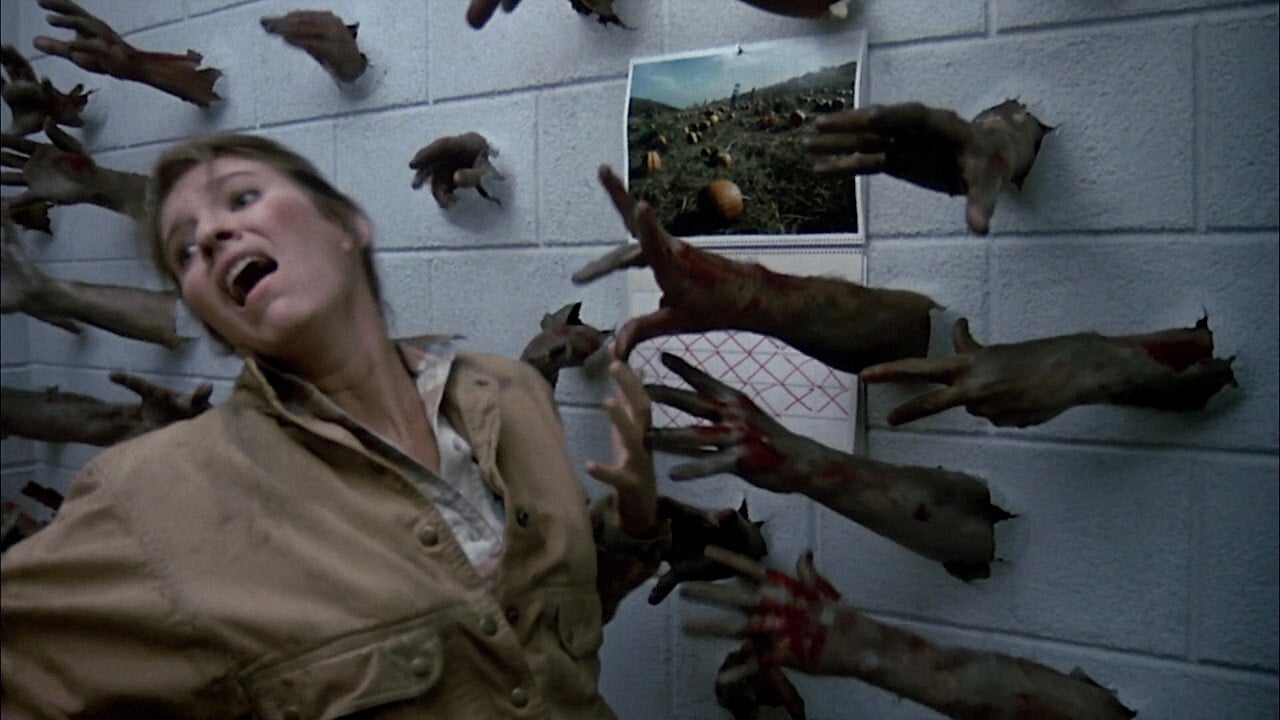

Day of the Dead
“The darkest day of horror the world has ever known!”
As the world is overrun by zombies, scientists and military personnel in an underground Florida bunker must decide on how they should deal with the undead.
About Day of the Dead
Why Day of the Dead still works
Day of the Dead is less about the roaming dead outside than the living people locked under the surface. Seven years on from Dawn of the Dead, Romero drops us into a ruined world where survivors are few and the dead are many — and then puts the survivors in a sealed-off bunker so their disagreements can swell to melodrama.
It’s a tight set-up: a handful of scientists and soldiers holed up in a missile bunker in the Everglades, trying to make sense of, or survive, the same catastrophe. That confinement turns routine power struggles into life-and-death matters — not because the zombies are clever, but because the humans are prone to panic, cruelty and stubborn belief. And at the centre of that argument is Dr Sarah Bowman. Lori Cardille’s character is the one who keeps pushing for a cure when others want to hold their ground, which means she’s not just another survivor — she’s the person in the room trying to keep logic running against chaos.
The idea that sets Day of the Dead in motion
Romero’s premise is simple and effective: civilisation has collapsed, and the people left alive have to decide how to manage the wreckage. That’s why this film centres on a small group who aren’t wandering the streets but living in a fortified research facility — soldiers to protect, scientists to try and fix what’s happened.
The personal stakes thread through that practical one. Sarah, John and Bill fly out from the bunker hoping to find fellow survivors and instead come back with grim news and a reality check: there might be nowhere left to hide.
Inside the compound those differences turn into a political problem. The soldiers, short on patience and supplies, get angrier as time passes; the scientists keep pushing for answers. It’s the kind of argument where any small incident can tip people into violence.
And small incidents don’t stay small. When tensions flare, choices are forced on people who have no good options — which is the whole engine of Romero’s setup. It’s not just about surviving the undead; it’s about surviving each other.
Why Dr. Sarah Bowman matters
Sarah Bowman isn’t the film’s only moral compass, but she’s the one who won’t accept that giving up is the only answer. We meet her as someone prepared to leave the bunker in search of survivors and, crucially, a solution — not because she’s Pollyannaish, but because she treats the collapse as something to be studied and, if possible, fixed.
That makes her different from people who’ve succumbed to belief or despair. When she flies to Fort Myers with John, Bill and Miguel, she’s doing a job and holding a hope — and the contrast between her method and the soldiers’ pragmatism is where the story finds friction.
The film also uses Sarah to test loyalty and sacrifice. She’s pulled between professional commitment and personal attachments; when Miguel begins to fall apart, she tries to help until she’s pushed away. That tension — trying to be both healer and survivor — is what keeps her interesting.
Put simply: she reads as someone with purpose in a purposeless world. In a movie full of shouting and panic, Sarah represents the stubborn, quieter insistence that maybe, just maybe, something can be done.
Day of the Dead has more on its mind than the plot suggests
Strip away the gore and you’re left with Romero’s favourite subjects: how people handle loss, how power gets grabbed, and what freedom looks like when the old rules are gone. Themes like mortality and humanity are woven into every argument, every decision to lock someone up or set them free.
The film stages those themes as direct conflicts. Authority and power — whether Rhodes’ attempts at tight control or the scientists’ quieter claim to moral expertise — are tested when supplies dwindle and communication with the outside world cuts out.
Freedom here isn’t just escaping zombies; it’s the fantasy of leaving responsibility behind. John’s suggestion that he, Sarah and Bill should take the helicopter and vanish to an island is less an escape plan than a temptation to abandon the messy work of keeping people alive. And then there’s the odd, heartbreaking example of empathy: a creature that starts to show traces of its past life. That moment — a semblance of memory, mourning even — forces the film to ask whether humanity can be measured by behaviour rather than by breath.
Day of the Dead could not belong to any other decade
Released in 1985, Day of the Dead sits squarely in the mid‑80s appetite for bigger, meaner genre pictures that still wanted to say something. It’s stitched from practical, watchable ideas rather than glossy spectacle — a film that trusts its set of characters and the nightmare they live in.
The decade gave Romero room to push the concept of apocalypse toward the political and personal. Where earlier entries in his series might have used crowds and shopping malls, this chapter tightens the world into a single compound and lets interpersonal politics take the foreground.
That narrowing feels of its moment: an era when genre films started to pair louder shocks with arguments about authority and survival. Day of the Dead wears its period in the size of its conflicts rather than in obvious visual frills.
Why Day of the Dead still matters
People come back to Day of the Dead because it gives the zombie thing a human scoreboard. The bunker setup — a handful of scientists trying to solve a pandemic while soldiers keep watch — turns the usual chase movie into a study of failing institutions and personal failure.
Characters linger. There’s the stubborn Captain Rhodes, the menaced technicians and the technicians’ quiet attempts at meaning. And then there’s Bub — a captured subject who shows tiny, unnerving echoes of his former life. Moments that mix pity with the uncanny stick in the memory.
The film’s scenes of fracture — when Rhodes declares martial law, when Logan’s methods are exposed, when the perimeter fails — are the sort of beats that horror fans remember because they’re moral and visceral at once. The shock isn’t just the zombies’ teeth, it’s the way people use despair and power against one another.
Finally, the ending matters because Romero refuses to let the film settle into a neat moral. The survivors who do get away carry with them the consequence of how the bunker failed to hold, and that unresolved feeling is part of the film’s aftertaste.
Does Day of the Dead still hold up?
Yes — but with a caveat. If you go expecting nothing but spectacle, you’ll miss the reason Romero’s bunker continues to chatter in people’s heads. The film works because it turns a sci‑fi horror problem into a human one: scientists and soldiers trapped in a failing system, trying to decide what matters and who gets to decide.
Dr Sarah Bowman’s refusal to give up on finding a cure, set against the soldiers’ impatience and Rhodes’ drift toward authoritarian moves, keeps the drama sharp. Those moral confrontations matter more now than ever; they’re the reason the film’s arguments still feel immediate.
It’s also a 100‑minute machine that doesn’t outstay its welcome. It’s lean enough to keep focus on conflict and collapse, and it leaves the audience with the unsettled question of whether escape — literal or moral — was ever possible. So watch it for the bunker politics, for the odd tenderness of a creature who remembers being human, and for the way Romero stages people making awful choices under pressure. It’s not just a splatter film; it’s an argument you can feel in your throat.