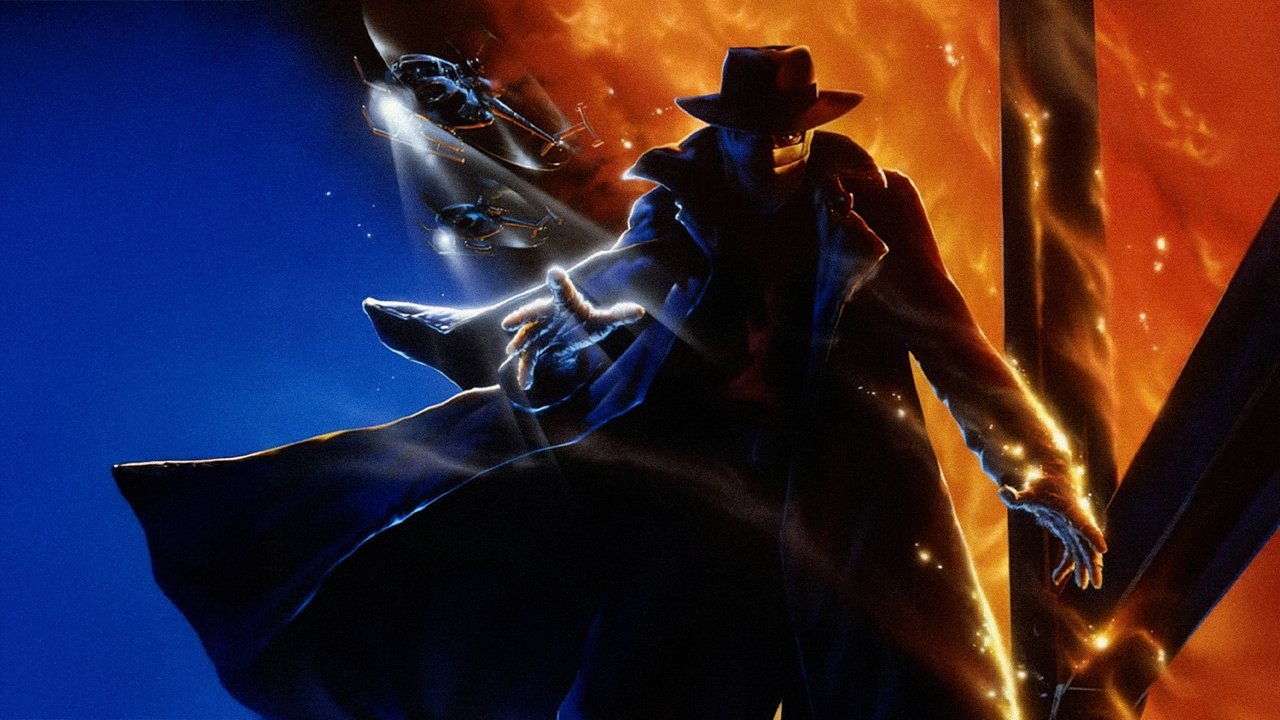

Darkman
“They destroyed everything he had, everything he was. Now, crime has a new enemy and justice has a new face.”
Dr. Peyton Westlake is on the verge of realizing a major breakthrough in synthetic skin when his laboratory is destroyed by gangsters. Having been burned beyond recognition and forever altered by an experimental medical procedure, Westlake becomes known as Darkman, assuming alternate identities in his quest for revenge and a new life with a former love.
About Darkman
Why Darkman is still worth talking about
Start with the synthetic skin. It’s a neat, tragic idea: a life-changing medical advance that simply won’t hold together for longer than an hour and a half. That built-in impermanence — a patch that falls to pieces after 99 minutes — gives the whole film a ticking humanism; everything the story fixes is provisional.
Sam Raimi delivers all of that in tight, efficient form. At just 95 minutes, Darkman rattles through its action, horror and melodrama without letting the central loss get crowded out. It’s a movie that knows what it is: a pulpy, emotional machine with a scientist at the centre who has to reckon with what happens when an invention makes you less whole, not more. And yes, it’s got a cast you remember from odd corners of other films — Liam Neeson as the wounded Dr Peyton Westlake, Frances McDormand as the woman who finds the trouble, and even Bruce Campbell turning up in disguise at the end. Those are the pieces Raimi assembles into a curious hybrid: part superhero origin, part revenge tragedy, part sci-fi parable about fragile fixes.
The idea that sets Darkman in motion
The engine of Darkman is simple and perfectly mechanical: a scientist working on synthetic skin, a document that exposes corruption, and a violent burglary that destroys both lab and life. Those few moving parts push the film into a classic tight knot of cause and consequence.
Julie Hastings finds the memorandum that proves her boss has been bribing the zoning commission. It’s exactly the sort of thing organised criminals and unscrupulous developers would want to grab — which, of course, they do. That theft is the pivot: it turns a scientific drama into a chase against very human nastiness.
After the attack Westlake is left disfigured and presumed dead. He disappears from the life he once knew and sets up shop in an abandoned building, determined to solve the one problem that will let him be himself again: the skin that won’t last. The attempt to fix his face becomes a lonely, stubborn labour.
What follows isn’t just a hunt for the men who ruined him. It’s a series of small deceptions built from masks and mimicry: Westlake uses his synthetic skins to impersonate his enemies and unsettle their alliances. It’s clever, vicious and quietly tragic — because every mask is temporary, and every victory is borrowed time.
Why Darkman matters
At its heart, Darkman is not simply a man in a costume. He is Peyton Westlake — a scientist who set out to repair other people's bodies and instead discovers how fragile his own identity can be. That tension between healing and harm is the character’s motor.
He literally becomes someone who must hide: reconstructing faces, wearing masks, performing impressions of criminals to turn them against each other. Those choices tell you two things at once — he’s resourceful, and desperate. The masks are a toolbox; they are also a confession that he can’t be seen as he is.
There’s a moment near the end when he slips on a face he has made and walks into a crowd. For a while he can pass; for a while he can belong. But that mobility is counterfeit — solid for the span of a mask, fragile the moment light or time does its work. That’s what gives the character a mournful quality.
And, because this is a Sam Raimi picture, the character’s finale has a little theatrical wink: someone else appears in the guise of Darkman, and a familiar face shows up to complete the trick. It’s a small, sly touch — the idea that identity can be borrowed, performed and even faked, right up to the last frame when he finally owns the name 'Darkman' in his head.
Darkman has more on its mind than the plot suggests
On the surface, Darkman is about revenge and a man getting even. Underneath, it’s preoccupied with questions of artificial life: what happens when a technological fix intended to restore dignity actually produces a new kind of existence. The synthetic skin is the obvious symbol — an invention meant to heal that also imposes its own limits.
Freedom is threaded through the story in an odd way. Westlake's freedom is shrunk and reshaped; he gains the mobility to masquerade and move unseen, but he loses the simple freedom of being recognized and loved as himself. The film keeps asking which form of freedom is more valuable: to be free from pain or to be free to be seen as you once were.
Loss haunts every choice. The scientist who wanted to repair burns ends up living with an unfixable absence: the loss of his old life, the loss of uncomplicated trust, the loss of a face he can’t reliably keep. That grief is quieter than the action, but it’s what makes his violent choices feel like something more than cartoonish revenge. Mortality sits alongside all of it. The synthetic skin’s 99-minute limit is a small, brutal reminder that repair is temporary; nothing here is meant to last forever. That recurring fragility turns the film’s thrills into small tragedies and keeps the stakes unexpectedly human.
Darkman could not belong to any other decade
Released in 1990, Darkman arrives at the exact hinge of two decades: it carries late-80s genre energy but points directly at the 1990s’ appetite for genre-mixing. It’s part comic-book origin, part horror-thriller, part straight-up action picture — a restless recipe that feels very of its moment.
That mixture matters. Early-90s audiences were happy to accept films that blended ideas — science and melodrama, practical thrills and psychological wounds — without asking them to fit neatly into one category. Darkman takes advantage of that wiggle room and uses it to keep the pace taut.
The film’s timing also gives it an odd freedom from the era’s later blockbuster gloss. It’s compact and economical at 95 minutes: a lean, punchy experience that shows genre ambition without overstaying its welcome.
All of which makes it feel like a 1990 film in the best sense: unafraid to mash tones together, brisk in its storytelling and comfortable wearing its pulp influences where they’re visible.
Why Darkman still matters
People remember Darkman because its central gimmick is also a human problem: an invention meant to heal that ends up breaking down, forcing its creator into exile and deception. The synthetic skin’s flaw is a simple concept, but it gives the film a moral and emotional knot that’s hard to forget.
There’s also the deliciously grubby centre of the plot — a stolen memorandum that exposes bribery and corruption. That document turns the film into more than a personal vendetta; it connects the scientist’s private ruin to very public greed, and that intersection keeps the stakes grounded.
Then there’s the showmanship: the way Westlake uses masks to impersonate and unsettle the criminals who wronged him. That bit of clever nastiness — turning the thugs against each other — is the film’s gleeful trick, and it’s one of the reasons people remember the movie as both smart and vicious.
Finally, the ending lingers. Westlake refuses the easy return to his old life; even when someone else stands in as his public face, he chooses the road of exile and a self-bestowed identity. That stubborn, melancholy refusal to go back is the emotional note that keeps Darkman echoing in the memory.
Does Darkman still hold up?
Short answer: yes. If you enjoy compact, slightly oddball genre pictures that put a human problem at the centre of their pulp mechanics, Darkman still delivers. It’s a Sam Raimi movie that remembers how to move — brisk, blunt and emotionally pointed inside its set pieces.
What keeps it watchable is the central dilemma. A scientist who built a salvation that won’t last, a woman who finds a document that triggers violence, and a man who decides revenge is preferable to returning to his old life — those elements form a satisfying, self-contained arc. The themes of artificial life, freedom and loss aren’t window dressing; they’re why the action matters.
It’s also compact enough that its flaws, if you care to call them that, don’t have time to sour the film. At 95 minutes it gets in, does the business, and gets out; there’s an economy to the storytelling that’s perversely modern in its refusal to linger on anything gratuitous. So yes, give it a go. Darkman is a film where the spectacle always has a bruise underneath — and that bruise is worth paying attention to.