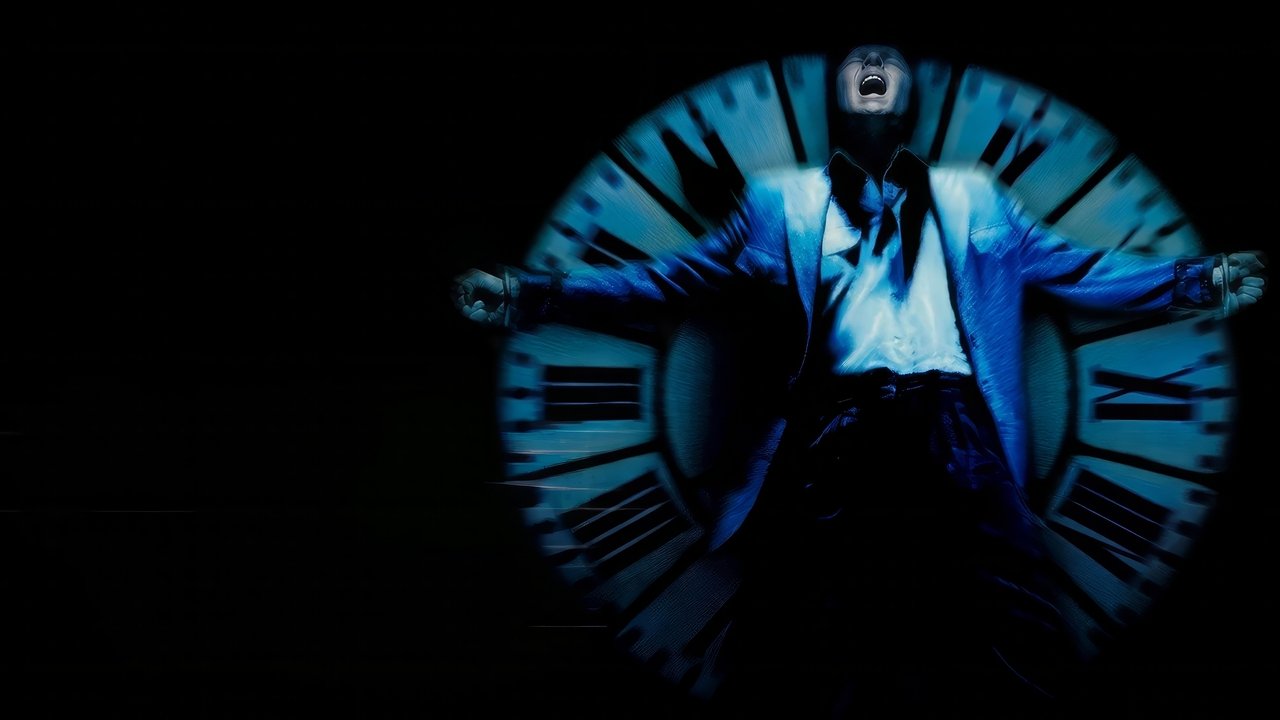
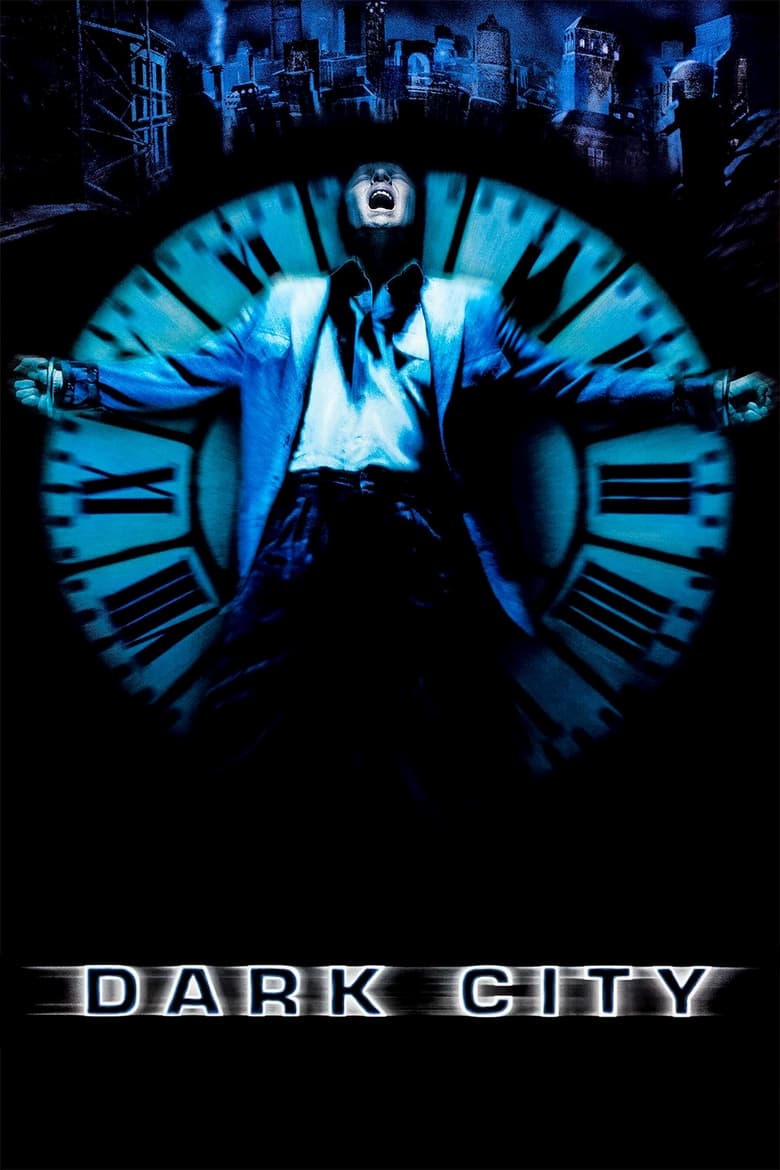
Dark City
“They built the city to see what makes us tick. Last night, one of us went off.”
A man struggles with memories of his past, including a wife he cannot remember, in a nightmarish world with no sun and run by beings with telekinetic powers who seek the souls of humans.
About Dark City
Why Dark City is still worth talking about
Start at the bathtub. John Murdoch wakes with no past and a phone call that starts everything: Dr Daniel Schreber warns him to run. That single hook — a man who doesn’t know who he is and who someone else claims to know better — makes the film feel immediate and strange from its first frame.
Alex Proyas directs and the film wastes no time. Over a lean hundred minutes, Murdoch moves through a city that never sees daylight, populated by pale men in trenchcoats, a puzzled inspector, and the woman he’s told is his wife. The set-up is sharp and tidy enough to carry you into something stranger beneath its surface. It helps that the cast give the characters names you remember: Rufus Sewell as Murdoch, William Hurt as Inspector Frank Bumstead, Kiefer Sutherland as Dr Schreber and Jennifer Connelly as Emma. They’re the people who anchor a story that’s equal parts neo-noir, science fiction and thriller — a compact, determined film that still finds ways to surprise.
The idea that sets Dark City in motion
At its core Dark City runs on one tidy piece of fiction: people’s memories can be taken, altered and re-inserted. That mechanic gives every small discovery an urgent meaning — find a memory and you might find a life.
Murdoch’s initial escape is prompted by a phone call from Dr Schreber, who tells him to flee the hotel because men are after him. It’s a practical push, but also a plot short-cut: suddenly everything around Murdoch is suspect and the city itself becomes a puzzle.
Those pale men, the Strangers, don’t merely hunt — they change people. Assisted by Schreber, they inject selected citizens with new memories, resetting identities as if tuning a machine. The threat is intimate because it works on what makes us recognisable to ourselves.
There’s an extra sting: the Strangers even copy Murdoch’s intended memories into one of their own, Mr Hand, hoping that by wearing his past they can predict him. So the chase is not just physical; it’s a contest over who gets to own a life.
Why John Murdoch matters
Rufus Sewell’s John Murdoch is memorable because he carries two straightforward urges: to know himself and to find the people who belong to that self. The film wastes no time removing his bearings — he wakes in a hotel bathtub with amnesia — and pushes him into decisions that reveal what kind of person he might be.
That search makes the film personal. Murdoch isn’t a blank cipher so much as someone whose past has been turned into a problem to be solved. Each clue to his life — a name, a photograph, a whisper about Shell Beach — becomes a small victory in a city that prefers to erase victories.
Family is the useful emotional engine here. The promise of a wife, a shared home and a remembered past gives Murdoch a direction that feels human even when everything else feels fabricated. When the film returns him to the idea of home, it makes the stakes plain: he isn’t just solving a mystery, he’s trying to rebuild a life.
In the end, Murdoch’s decision to reintroduce himself and walk toward a new life with the woman once called Emma closes the loop on what he’s been chasing. He matters because his journey shows the film’s belief that personhood is worth fighting for — and worth refusing to hand over to strangers.
Dark City has more on its mind than the plot suggests
Strip away the noir trappings and the film keeps circling a small set of ideas: memory, freedom and what it means to be human. The Strangers’ experiments are literalised attacks on identity — memories become manipulable, individuality a test subject for survival.
The Strangers bring Murdoch to their home beneath the city and force Schreber to imprint him with their collective memory because they treat individuality as a problem to be analysed. That neat inversion — humans as specimens — is where the film stops being a chase and starts asking moral questions.
Murdoch’s exchange with a dying Mr Hand crystallises the movie’s case: the Strangers looked in the wrong place for answers. They searched minds where what really matters is the messy, stubborn reality of lived connection. Humanity, in the film’s terms, is not an algorithm; it’s the accumulation of ties that persist even when memory is unreliable. Mortality and courage thread through those ideas. People in the film don’t simply want memories; they want a home, safety and the chance to keep what makes them themselves. That’s why the final choice to create a real Shell Beach—rather than accept a manufactured peace—feels like more than a twist. It’s a claim.
Dark City could not belong to any other decade
Dark City arrived in 1998, and the film wears that year lightly: it doesn’t trade on fashion so much as on an appetite of the era for moody, idea-driven science fiction. That late-90s curiosity about identity and technology gives the film a certain seriousness without making it arch.
Part of what ties it to the decade is the patience to commit to a single speculative conceit — memory as a repeatable procedure — and then to see where human stories emerge inside it. Schreber’s decision to inject Murdoch with decades of training about the Strangers and their machines is the sort of narrative compression that feels right for a period when filmmakers liked their genre with an intellectual bite.
Being from 1998 also helps the movie feel deliberate. It isn’t a throwaway spectacle; it’s a compact story that trusts its audience to follow a central puzzle and to care about what the characters lose and try to reclaim.
So while the film is clearly of its moment, it’s not nostalgia on autopilot. Its late-90s personality is more about tone and confidence than about surface trimmings — a decade’s worth of appetite for serious, shadowy sci-fi is the engine here.
What has aged — and what hasn't
What remains strongest is the small domestic core: family, the idea of home and the risk characters take to protect both. Those are timeless hooks. When a film asks you to care about someone rebuilding a life, it will usually find a way in — and Dark City does exactly that.
Similarly, the philosophical bite of the Strangers’ experiment — bringing Murdoch to their home and trying to treat identity as a lab problem — still lands. The image of people being reconfigured to test a theory about individuality feels uncomfortably relevant and keeps the story from feeling like an old trick.
There’s also something satisfying about the film giving its answers back to human choices. Murdoch’s parting line to a dying Mr Hand, that the Strangers looked in the wrong place for humanity, remains an effective summation: the movie ultimately trusts connection over analysis.
And the film’s final return to the idea of a real Shell Beach — Murdoch returning to reintroduce himself and begin again — still works because the ending honours the personal stakes it spent the film establishing. It’s a payoff that’s emotional, not just conceptual.
Why Dark City still matters
People keep circling back because Dark City gives you a puzzle that’s also a proper human story. It starts with a clear, arresting image — a man waking up in a bathtub with no past — and refuses to let the mechanics swallow the people. That mix is the movie’s long game.
It does genre without letting the genre swallow it: pale men in trenchcoats arrive, the Strangers rearrange the city at midnight and inject citizens with new memories, and a detective suspects Murdoch while still sensing the city’s strangeness. All of that feeds a mood, but the mood serves the characters and their losses rather than showboating on ideas alone.
The film’s larger set-pieces — discovering that the city is a deep-space habitat, the Strangers’ insistence that they can analyse individuality by experimenting on humans — stick in the mind because they are tethered to Murdoch’s aim: to find Shell Beach, to find Emma. When he finally creates a real Shell Beach and brings sunlight back, the spectacle earns its emotional weight. Finally, the ending matters. When Emma returns as Anna and Murdoch chooses to reintroduce himself and walk toward a new life, the film affirms the human risk at its centre. That’s the reason viewers who grew up with it still come back: it asks clever questions but answers them with a belief in people recovering what’s been taken.
Does Dark City still hold up?
Yes — and not because it’s a period curiosity but because its questions are human. The film begins with a simple, dramatic beat — John Murdoch waking with no memory — and spends its hundred minutes asking what that absence costs and what it’s worth to reclaim.
You’ll still be engaged by the chase (the Strangers, their ability to tune reality and the city that never sees daylight) and by the quieter stakes: a man accused of murder, an inspector who suspects the city is wrong, a woman called Emma who may not be what she seems. Those threads knit together into something that prefers people to puzzle pieces.
Crucially, the movie’s final gestures — the Strangers’ attempt to force Murdoch into their experiment, his awakening to his own power, the creation of a real Shell Beach and the return of sunlight — give the story a conclusion that is emotionally earned rather than merely clever.
If you’re weighing whether to watch in 2026, think of Dark City as a compact, thoughtful genre film. It asks about memory and freedom, it keeps you guessing, and it chooses human reconnection over sterile answers. That’s a combination that still pays off.