Cube
“Don't look for a reason... Look for a way out.”
A group of strangers find themselves trapped in a maze-like prison. It soon becomes clear that each of them possesses the peculiar skills necessary to escape, if they don't wind up dead first.
About Cube
Why Cube still works
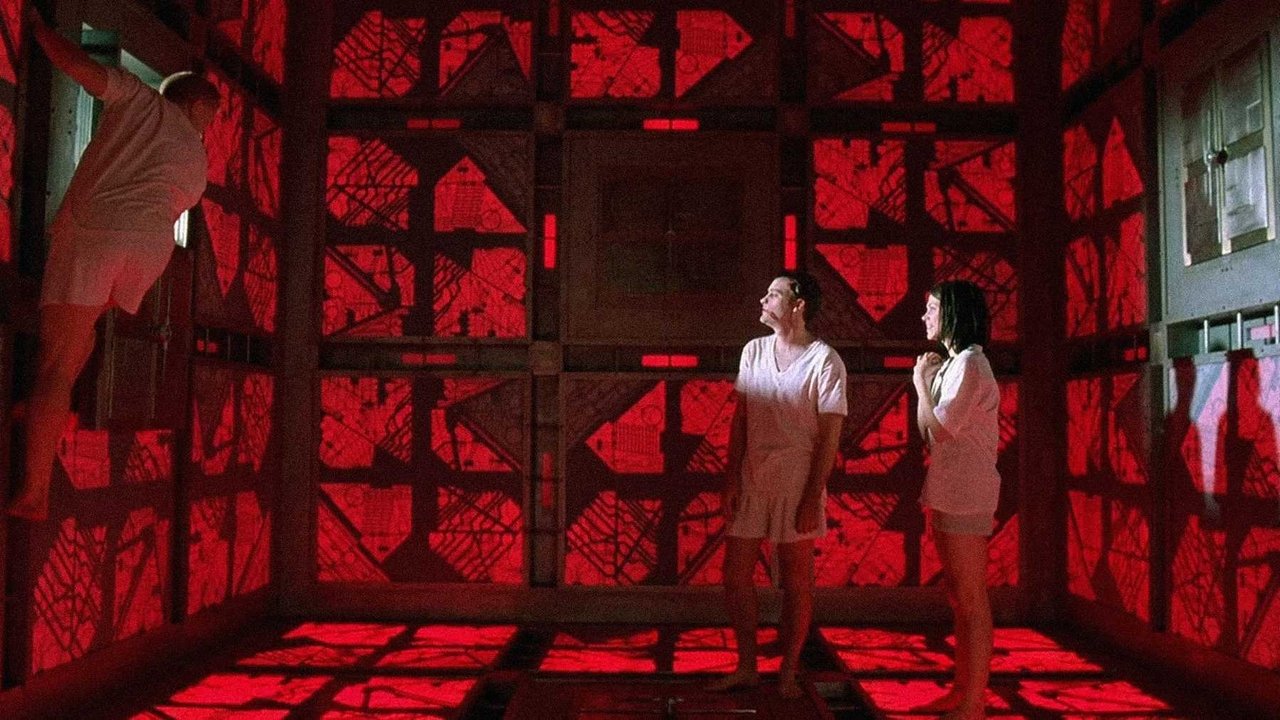
You know that moment in horror when a door opens and you think, for about two seconds, “That’s fine”? Cube opens with a man called Alderson waking up in a grid of identical rooms connected by hatches — and very quickly reminds you why complacency is lethal. The movie wastes no time: someone steps through, a hidden wire snaps, and the game’s rules are established by consequence rather than explanation.
Part of its grit comes from having a director with a clear plan and no patience for padding. Vincenzo Natali keeps things compact — the running time is a neat 90 minutes — and trusts the set-up enough to let tension do the heavy lifting. A handful of people meet in the maze: three men and two women, and the film doesn’t linger on backstory when the next room could kill you. And then there’s Kazan. Andrew Miller’s character arrives as a wildcard — a mentally disabled man pressed into the group’s logic — who turns out to matter in a way the rest of them cannot predict. In a film that is equal parts human behaviour and cold mechanics, that surprise gives Cube its particular teeth.
The idea that sets Cube in motion
At its simplest, Cube is a tight conceit: people trapped in interconnected rooms where the wrong choice means death. That straightforward premise is what allows the film to be both immediate and implacable — you don’t need long explanations when the physical stakes are this clear.
But the film’s neatness is deceptive. As the group moves, the rules begin to look less stable. A violent confrontation leaves the survivors reeling; a corpse found in another room forces them to confront the possibility they haven’t been travelling in circles at all.
That discovery — that the rooms themselves are shifting — turns the challenge from 'find the exit' into something crueler: predict movement inside an engine that has already demonstrated it will kill to keep working. The violence among the trapped people is no longer just panic; it becomes a grim arithmetic enacted under pressure.
And the machine keeps going. The story carries you to an endpoint where movement itself delivers judgement: the bridge shifts, and a human plan comes up against a mechanism with rules of its own.
Why Kazan matters
Kazan arrives as an awkward liability: the group brings him along at Dr. Holloway’s insistence, and the immediate expectation is that he makes surviving harder rather than easier. He’s written as someone who complicates the dynamics — and that’s precisely why the cube’s maths meet his mind in such a dramatic way.
What makes him memorable isn’t merely that he’s different, but what that difference allows. Kazan turns out to be a savant who can factor numbers instantly — the very skill the group needs when Leaven begins to decode the plates on each hatch. That twist reframes the earlier insistence on bringing him along: he’s not a burden, he’s the rare key.
Those dynamics also expose other characters. Holloway’s defence of Kazan tells you about her; Quentin’s readiness to abandon him tells you about Quentin. In a tight cast, Kazan forces people to make moral choices under pressure, and those choices reveal as much as any interrogation scene could.
Finally, Kazan’s arc carries a strange quiet. After the violence and the scrambling logic, the character who most clearly understands the cube’s language wanders out into the light — a small, oddly solemn coda that leaves you thinking about what survival means when intelligence and innocence collide.
Cube has more on its mind than the plot suggests
At heart Cube is driven by a single engine: fear. That’s not a glib observation — fear is treated as a practical force that shapes decisions, alliances and betrayals.
The film doesn’t moralise about fear; it shows how people respond to it. Some try to systematise the danger with rules and numbers. Some lash out. Some protect others even when it costs them. The maze is a way of watching fear make different choices inevitable.
Because the threat is impersonal — rooms and traps rather than a human villain — the movie’s tension comes from how ordinary people adapt, or fail to adapt, when survival becomes a calculation. That concentration on fear keeps the film focused. You leave the cinema thinking less about the architecture of the Cube and more about what it does to people who must live inside it.
Cube could not belong to any other decade
Cube sits on the blunt end of the 1990s — it was released in 1998 — and that placement matters. The decade liked lean, high-concept films that could be made on modest budgets and that put ideas before spectacle.
Being a 1998 film also helps explain its temperament: there’s an appetite for tight, idea-driven storytelling rather than widescreen explanation. Cube’s short runtime and intense premise feel very much in keeping with the decade’s taste for economical, often gloomy science-fiction and horror hybrids.
More than nostalgia, the film’s relationship with the 1990s is practical: it uses the era’s willingness to let small movies take big philosophical swings. It’s the sort of late-decade picture that trusts a clever conceit and a handful of performers to carry the weight.
So while Cube isn’t a love letter to the 90s, it wears the period comfortably — the film’s economy of means and appetite for conceptual risk are very much of that moment.
Why Cube still matters
People remember Cube because it takes a simple image — a locked, repeating room — and makes it consequential. The sequence that opens with Alderson in a hatch and ends with a lethal wiretrap establishes a promise the film keeps: choices have immediate, usually grisly, outcomes.
Beyond the kills, there’s an intellectual hook. Leaven reads the plates on the hatches and, with help, recasts the rooms as coordinates. Worth’s admission that he once helped design the maze’s shell turns what could have been pure mystery into a darker suggestion: this is a machine built by people and kept running by people’s forgetfulness or indifference.
Then the movie complicates the technical puzzle with human failure and heroism. The group’s journey to the cube’s edge, the discovery that rooms can move, and Leaven’s eventual realisation that traps are marked by powers of primes — all give the film a satisfying knot of logic and tragedy. Kazan’s unexpected mathematical gift reframes earlier cruelty and makes the finale feel earned rather than arbitrary.
In the end the images stick: a bridge revealing bright light; the mechanism that kills through motion; a small group arguing, betraying, protecting — and a single character stepping out into sunlight. Those moments, part puzzle and part human comedy of errors, are why Cube keeps getting pulled off shelves and put in front of new viewers.
Does Cube still hold up?
Short answer: yes. Cube’s 90-minute duration and clear rules mean there’s almost no fat; it simply throws people into a machine and watches what fear makes them do. Vincenzo Natali’s direction keeps the pressure on without over-explaining the set-up, and that restraint is part of why the film remains watchable.
If you enjoy conceptual horror that trusts a small cast and a clever engine, Cube delivers. The intellectual puzzle — Leaven’s number work, Worth’s link to the maze’s construction, Kazan’s unexpected ability to crack factorisations — gives the film genuine stakes beyond gore. The rooms aren’t just scary because they can kill you; they are scary because they demand reasoning under threat.
There are rough edges: it is compact and relentless rather than expansive, and it asks you to accept a grim moral litmus test about what people will do when survival is up for grabs. But those are deliberate choices rather than accidents. The film’s tightness is its virtue. So watch it for the idea and for the way the characters’ worst and best impulses are made to collide inside a very small, very efficient machine. And when it ends, with Kazan stepping into the light, you’ll understand why a modest Canadian film about hatches and numbers still lodges in the memory.