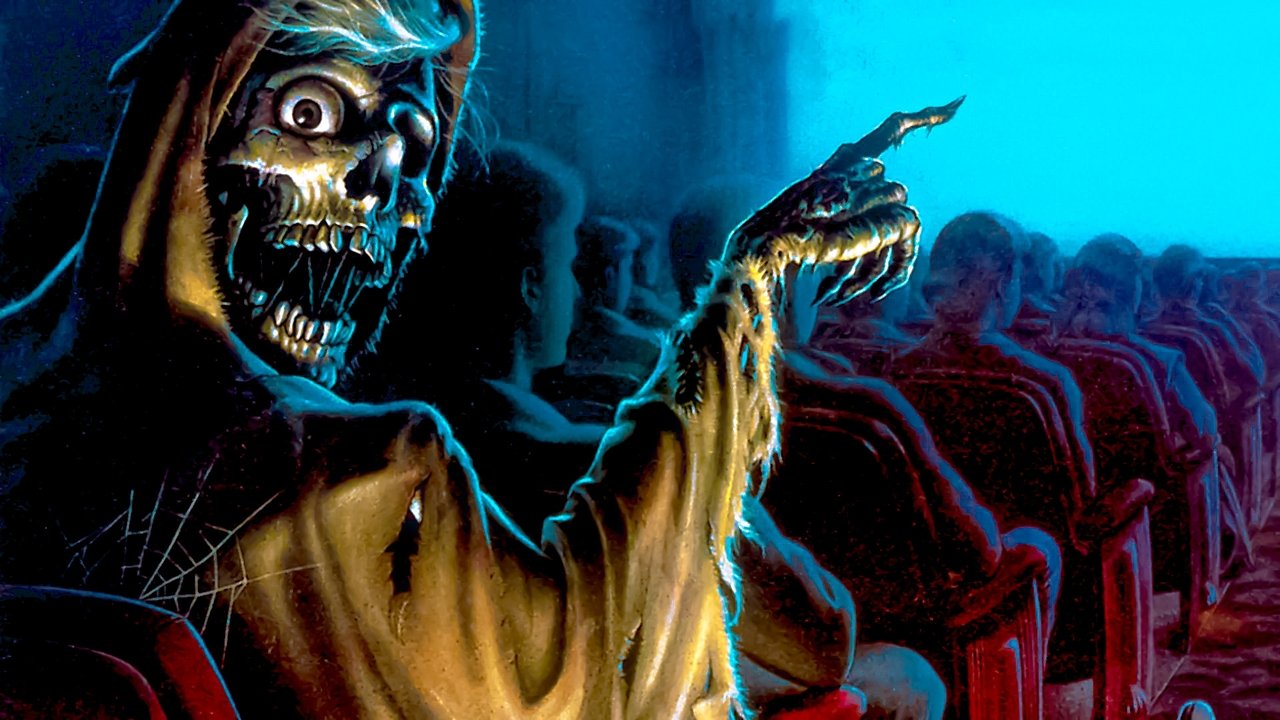
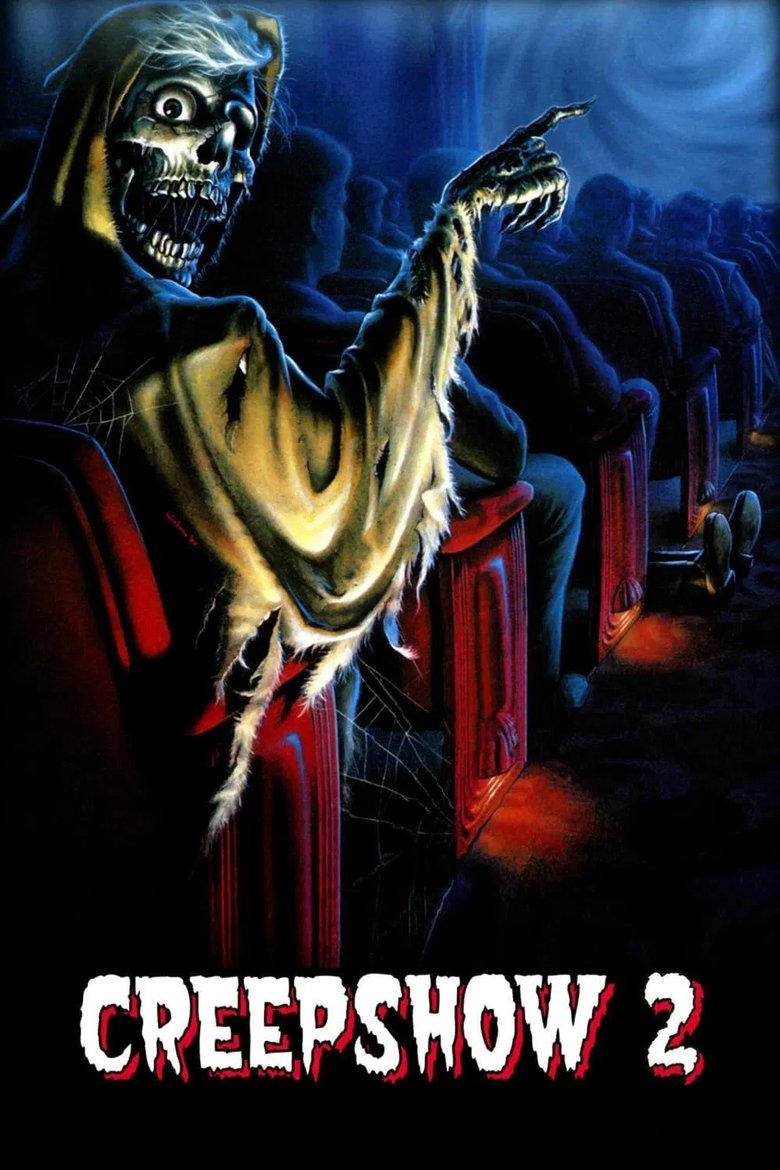
Creepshow 2
“When the curtain goes up, the terror begins.”
Three macabre tales from the latest issue of a boy's favorite comic book, dealing with a vengeful wooden Native American, a monstrous blob in a lake, and an undying hitchhiker.
About Creepshow 2
What makes Creepshow 2 worth revisiting
You know a movie has personality when it introduces itself like a travelling salesman. In Creepshow 2 a delivery truck pulls up to a newsstand in Dexter, Maine and out come the latest grisly comics — which, crucially, set the tone for everything that follows.
That delivery is also where the film finds its eyes: Billy, a boy who eagerly follows the truck on his bike and then drops into the comic’s world. The framing — animation of Billy reading and the Creep’s theatrical asides — give Michael Gornick’s 1987 anthology a jaunty rhythm that keeps three very different stories from ever overstaying their welcome.
At 89 minutes the movie doesn’t labour. It’s compact, cheeky and carried along by a hosting gaggle (the Creep is played by Tom Savini and Joe Silver in different guises) and by Billy as the kid who reads it all — a useful reminder that Creepshow 2 is built to be consumed like a handful of pulp strips rather than a single, serious statement.
The idea that sets Creepshow 2 in motion
The movie’s engine is surprisingly simple: a comic-book delivery, a kid who reads it, and the Creep as a gleeful emcee who flips from panel to panel. That cartoon frame lets the film hop across tone without having to apologise for its nastiness.
Inside that frame are three stories with a common appetite for payback. One gives life to a cigar-store Indian called Old Chief Wood'nhead, who tracks down the thugs that murdered the elderly couple who own the general store. The violence here is blunt and final: arrows, a tomahawk and a scalping settle the score in a particularly old-fashioned way.
Another prowl is more atmospheric — a black, oily blob in a lake that dissolves the careless — and the third is a nightmarish hitchhiker story of guilt and inescapable consequences. Each segment is short, sharp and designed to land a punch rather than unravel a long mystery.
All the while the Creep keeps the kiddies (and us) onside. He pops up behind the post office counter to warn that if one story didn’t do the trick, the next one will — which is a neat way of letting the anthology satisfy both the appetite for comedy and the appetite for brutality.
Why Billy matters
Billy is a handy little fulcrum. He starts outside the comic — following the delivery truck on his bike — and ends up both reading and experiencing the book’s rewards and punishments. That movement from curious kid to participant is what anchors the framing device.
A small, specific detail does a lot of work: Billy pays for a mail-order bulb that promises a meat-eating Venus flytrap and sets off for home. It’s a silly wish, but it gives him something to lose and, later, to use — which keeps him tied to the action in a film that otherwise skitters between unrelated stories.
He also keeps Creepshow 2 feeling youthful. When Billy is ambushed by neighbourhood bullies the Creep notices him from the truck — it’s the moment the comic world and the real world briefly collide, and it’s where the film’s playful cruelty turns protective.
Finally, Billy’s persistence matters. The bulb Rhino crushes wasn’t the first one he’d ordered, which lets the film repay the audience’s patience with a neat little twist: the kid’s hobby becomes the thugs’ undoing, and that tidy symmetry is exactly the kind of small moral bookkeeping this movie enjoys.
Why Domenick John's performance matters
The material gives Billy a very clear job: he’s the audience proxy who steps from the street into the comic. The film’s closing framing finds the Creep in animation preparing to drive away, but then he spots Billy still being chased by bullies — it’s a propulsive image that relies on the boy’s presence rather than any star turn.
Because the scene is mostly about what happens to Billy rather than how he presents it, Domenick John’s role functions as a connective tissue. Billy’s reactions and choices keep the framing believable: he’s the kid who orders odd things, pays for them, and gets tangled up in the film’s small-town nastiness.
In short, Billy exists to make the anthology feel seen. The Creep noticing him is the cue that the comic isn’t just entertainment — it reaches into the real world, and Billy is the hand the movie holds while it does.
Creepshow 2 has more on its mind than the plot suggests
On the surface it’s an anthology that trades in shocks, but the movie keeps nudging at a small bundle of ideas: freedom, family, home and safety. Those aren’t grand philosophical claims — they’re the simple human stakes that make each piece hurt.
Family and home, for example, are central when Old Chief Wood'nhead comes to life. The story is about a household violated and an object of protection — a general-store couple and the symbols that sit on their porch — and that domestic assault is what triggers the savage retribution.
Mortality and authority turn up in the hitchhiker tale: the narrative plays with guilt and the illusion of control, a private transgression that explodes into inevitable consequence. Power and authority — including corporate power as one of the listed concerns — hover across the segments as forces that can be abused or, sometimes, mocked by very small-scale vengeance.
Put together the themes make Creepshow 2 feel less like a string of gags and more like a comic about what people will do to protect what they love, and what happens when they try to dodge responsibility.
Creepshow 2 could not belong to any other decade
It’s a product of 1987 and wears that short, punchy runtime and genre-mixing like a badge. The film sits squarely among 1980s movies that were happy to mix comedy, horror and a touch of fantasy without fussing over tone.
Anthology horror was enjoying a particular, if niche, second wind in the era, and Creepshow 2’s approach — rapid-fire stories framed by a hosting figure — fits neatly in that moment. It’s the kind of movie that assumes the audience wants variety and a quick hit rather than a long slow burn.
That decade’s appetite for bold, self-contained genre pieces is why this film feels of its time: compact, slightly giddy and unapologetically pulp.
What has aged — and what hasn't
Some elements are oddly durable. The family-and-home stakes still read: when an elderly couple is murdered, the movie’s investment in their safety and in the outrage that follows remains straightforward and effective. Those human motivations travel across decades.
Other beats are more awkward today. The Old Chief sequence ends in a scalping and brutal tomahawk violence that plays like an old-school comic-book punishment; it lands as shock-driven catharsis, but it can feel blunt and discomforting rather than clever.
Meanwhile, small touches — Billy paying for his parcel, being ambushed by neighbourhood bullies and then leading them into a patch of carnivorous plants — still work as a tidy, cartoonish comeuppance. The kid-versus-bully story is simple and satisfying in a way that modern horror sometimes forgets.
And the hitchhiker tale — a woman racing home, convinced she’s escaped guilt only to be undone by it, dying of carbon monoxide poisoning — still carries its grim lesson. It’s the kind of moral neatness that either delights or frustrates viewers, depending on how much you like horror that ties up its lesson with a grim bow.
Why Creepshow 2 still matters
Creepshow 2 holds a place in people’s memories because of its personality. The image of the Creep dropping off the comic, the animated kids listening at his castle, and the way the film shifts from panel to panel gives it the feel of a late-night story hour for grown-ups.
Certain episodes stick. The Old Chief Wood'nhead sequence — a cigar-store Indian come to grisly life to exact revenge — is memorable for its audacity and plainness of purpose. The lake blob, an oily thing that pulls swimmers under, is the kind of simple monster that’s easy to recall in a sentence. And the hitchhiker story’s repeated line, “Thanks for the ride, lady!”, gives it a hook that lingers.
Billy’s little through-line — ordering a mail-order bulb for a meat-eating plant, getting bullied, and eventually seeing those plants do the job — provides a satisfying cap to the film’s mischief. It’s tidy: a kid’s hobby becomes the thugs’ undoing, and that comic symmetry is exactly what fans remember.
So Creepshow 2 matters because it’s compact, textured with the right number of nasty ideas, and framed in a way that makes each piece feel like a cartoonish moral fable. For those who grew up on it, that combination is hard to shake off.
Does Creepshow 2 still hold up?
Short answer: yes — if you know what you’re coming for. Creepshow 2 is an 89-minute bundle of black comedy and cartoonish horror from 1987 that trades in quick payoffs rather than slow-building dread. The framing — a delivery truck, a boy on a bike, the comic and the Creep — gives it personality and keeps the momentum brisk.
It still works when it leans into simple moral bookkeeping: Billy’s parcel, the bullies, and the meat-eating plants make for a neat comeuppance everyone can follow. The anthology pieces about revenge, a lake monster and a guilt-haunted hit-and-run all deliver the kind of tidy, sometimes savage endings the film promises.
Where modern viewers might balk is the bluntness of some violent set pieces and the way certain stories resolve their themes with theatrical finality. If you’re bothered by aggressive, old-school punishments you might find parts of it uncomfortable rather than clever.
But for a night when you want your horror to be fast, a little daft and properly vengeful — with Billy reading the whole business as if it were a comic you shouldn’t be allowed to have — Creepshow 2 still has bite. It’s not subtle, it never pretends to be, and that’s part of its stubborn appeal.