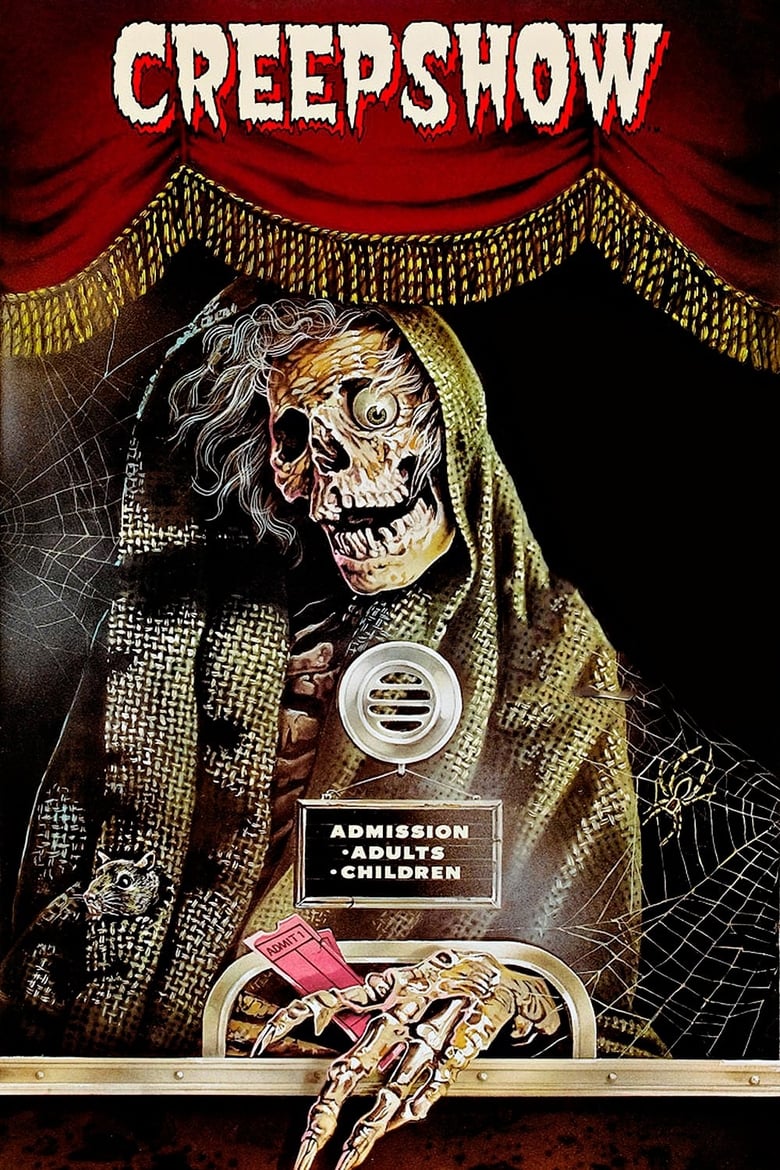
Creepshow
“The most fun you'll ever have BEING SCARED!”
Five grisly tales from a 1950s-style comic, including a murdered father rising from beyond, a bizarre meteor, a vengeful husband, a mysterious crate's occupant, and a plague of cockroaches.
About Creepshow
What makes Creepshow worth revisiting
You know the set-up before anyone says a word: a boy is caught reading a creepy comic and the grown-ups react with scandal. In Creepshow that boy is Billy Hopkins — and the domestic flap becomes the hinge that opens into five blackly comic horror tales.
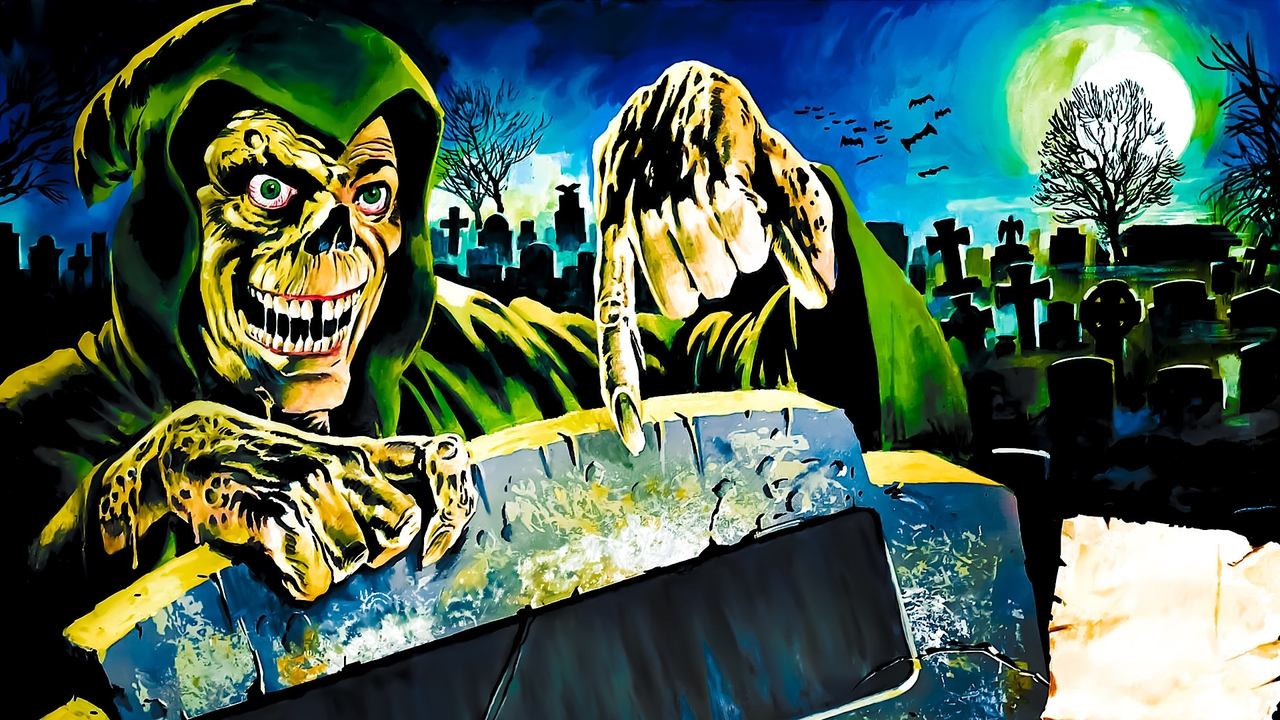
It’s a neat trick. George A. Romero takes something very small — a scrap of forbidden entertainment under a bed — and uses it to justify everything that follows. The comic’s snarling host, the Creep, literally peels the trash lid back and leads us from one grotesque little story to the next.
All of that arrives with the confidence of someone who knows the language of horror and wants to have a laugh with it. The film was released in 1982, runs for about 120 minutes, and keeps returning to the idea that ordinary family life is the best place to hide a proper nightmare.
The idea that sets Creepshow in motion
Creepshow is framed as a comic book come to life. The animated Creep flicks open a trash can and, page by page, ushers us into short stories that mostly concern ordinary people whose small cruelties or bad luck spiral into grotesque payback.
That frame gives Romero licence to hop across tones: one tale is a family reunion that turns into a funeral-service nightmare; another is a yokel’s encounter with a meteorite that turns his life into plant matter; elsewhere a college finds a mysterious crate with monstrous consequences.
The anthology device also keeps the momentum brisk. The film keeps returning to its host between episodes, then blows into a new story — a gust that tosses the comic onto the street and opens the next page.
A couple of the stories use domestic settings as the pressure-cooker: a frightened academic duo hauling out a crate, a jealous man burying his rivals by the sea, and a tycoon barricaded against things he cannot control. Small choices — leaving a crate under the stairs, burying someone near the tide line — are the dominoes. When they fall, the film is only too happy to watch the carnage.
Why Billy Hopkins matters
Billy is smaller than most of the film’s lurid spectacles, but he’s the moral fulcrum. He’s the kid who gets told off for reading the comic; that act of being punished — and the small, sulky wish for his father’s discomfort — is what lets the rest of the film exist.
He’s not the avenging hero. He’s a reader and a fantasist, the kind of child who decorates a voodoo doll with a scrap of his father’s clothing and hair. That cheap, private act — childish, petty, oddly satisfying — is the film’s quiet centre.
Because Creepshow keeps returning to the Hopkins household, Billy’s small, transgressive pleasure reframes the whole enterprise. The anthology’s shocks are loud, but it’s the private joke of a child getting back at an abusive parent that lands longest.
Creepshow has more on its mind than the plot suggests
Strip away the comic-book gags and you find the film is mostly obsessed with family. Several stories centre on relatives — a matriarchal secret, a woman who killed to escape an abusive father, the way grudges pass through generations.
Mortality sits close by. Bodies come back, people drown and the films don’t offer tidy consolations; they treat death like another nasty punchline and sometimes a deserved one. Those returns from the grave are less about gore than the idea that the past refuses to stay buried.
Corporate power also creeps in as a theme. Wealth and callousness feature in a few stories — fortunes, takeovers and the kind of executive cruelty that can drive rivals to ruin — and the film seems to enjoy watching hubris implode.
Finally, the film is interested in home and safety as fragile constructs. Panic rooms, beaches, family estates — these domestic spaces are supposed to shelter people. In Creepshow they become the places where private horrors peek through the wallpaper.
Creepshow could not belong to any other decade
This is very much an early-80s piece of work — it was released in 1982 — and it wears that date like a badge. The period loved high-concept horrors that mixed shocks with a wink, and Creepshow fits that appetite neatly.
It thrives on genre-mixing: horror braided with black comedy and a comic-book sensibility. That recipe felt fresh in 1982 and explains why the film landed where it did in the pop-culture landscape of the time.
Beyond tone, the movie’s appetite for short, sharp stories reflects an era when anthologies were a straightforward, audience-friendly way to deliver variety and bite-sized scares.
What has aged — and what hasn't
The things that still work are the human pieces. Family rows, petty cruelties, greed — those feel immediate. The Grantham story about Bedelia and her father, and the way old sins come back to bite the next generation, remains a tidy, effective tale.
The film’s take on home as a vulnerable place also holds up. When wealthy characters try to buy safety or control, Creepshow delights in showing how brittle that illusion is; it’s a pleasure to watch arrogant men realise their houses can’t save them.
Some of the smaller flourishes — the comic ads and throwaway pages — play like period curios. The fictional promotions for newspapers promising absurd prizes are odd in a way that’s part of the film’s charm rather than a flaw.
And there’s the Creep’s voice: when he mutters little barbs, or when a panel reminds a frightened character that they can’t drown their fears, the film keeps a wry, almost friendly cruelty that modern viewers can still enjoy.
Why Creepshow still matters
Memory is a strange thing. For many people Creepshow isn’t one long film so much as a clutch of unforgettable set pieces — the putrefying father emerging from his grave, the man who wakes to a house of plants, the businessman swamped by cockroaches. Those images stick.
Then there’s the framing device. The Creep, the comic and the animated turns give the whole thing the feel of a bedtime story told by someone with a wicked sense of humour. That host keeps the tone playful even when things get gruesome.
The film also gives people little private pleasures: the voodoo-doll revenge at home, the image of a tape recorder capturing a doomed man’s last breath, a crate left under the stairs. These are the small mechanics of dread that linger longer than plot summaries.
Finally, it’s a film that rewards repeat visits. You notice the throwaway advertisements, the repeatedly used props and how the framing panels nudge each segment into place. For those who grew up with it, Creepshow is both a collection of memories and a machine that makes new ones every time you watch.
Does Creepshow still hold up?
Yes — if you go for it with the right expectations. Creepshow isn’t trying to be a single, eloquent statement about humanity. It’s a comic-book in motion: quick, a touch mean, and curiously affectionate toward its characters’ pettiness.
What still lands is simple: the family moments, the small acts of cruelty and the pleasures of revenge. Billy’s private satisfaction at jabbing a voodoo doll and the way that petty wish threads through the film matters as much as any gory set piece.
The film also still finds bite in its other obsessions — mortality and the folly of power — whether that’s a rich man watching his security fail or a corpse returning with an appetite for family cake. Those beats are clear and uncompromising.
So watch it. Watch it for the Creep’s wink, for the handful of unforgettable images, and for the peculiar sensation of a film that wants to be both a prank and a moral fable. If it does one thing well, it’s that the comic stays with you — and the candle on its cover always seems to gutter out with a laugh.