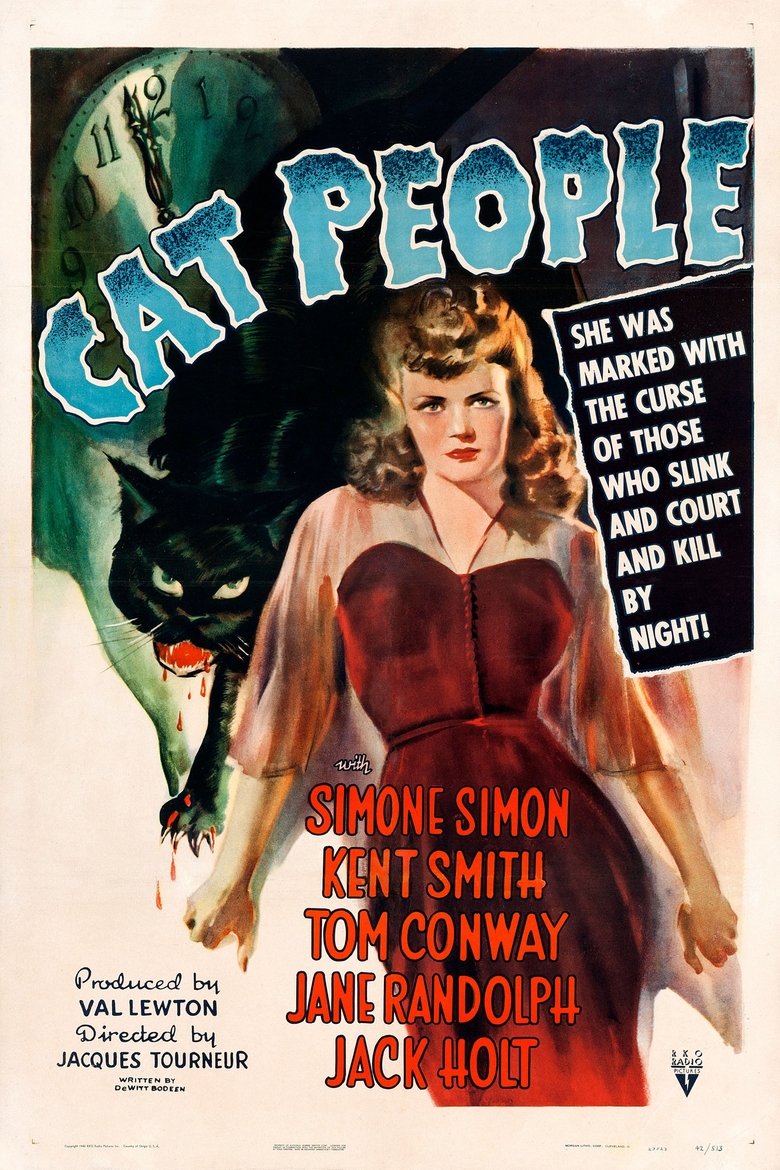
Cat People
“She knew strange, fierce pleasures that no other woman could ever feel!”
A Serbian émigré in Manhattan believes that, because of an ancient curse, any physical intimacy with the man she loves will turn her into a feline predator.
About Cat People
Why Cat People still stands out
The movie grabs you with a simple, oddly domestic image: Irena Dubrovna at the Central Park Zoo, sketching a black panther. It’s a neat piece of stage-setting — not a howling prologue but a tiny, telling scene that keeps returning in the head.
Directed by Jacques Tourneur and running under seventy-five minutes, Cat People doesn’t dawdle. It trusts the audience to assemble its unease around one person and a handful of unsettling encounters rather than sprawling explanations. Simone Simon’s Irena is the kind of character who leaves the rest of the cast orbiting her: the man who notices her, the psychiatrist who studies her, the women who might be kin. The film’s tight focus on her private danger — and the way other people react to it — is why it still makes a small, sharp impression.
The idea that sets Cat People in motion
At the heart of the story is a single, unsettling belief: Irena thinks she comes from a line of 'cat people' and will become a panther if passion takes hold. That suspicion isn’t shouted from the rooftops; it arrives in small, escalating moments.
Animals react oddly around her — a kitten hisses, creatures in a pet shop go wild — and those moments quietly insist there’s more to her than ordinary timidity. The film trusts those beats to do the heavy lifting.
There’s also a myth layered into her past: an old tale about villagers who turned to dark ways, and a violent purge that left only a few to flee. The legend works as a shadow behind Irena, something she carries rather than explains.
All of this tightens into personal stakes when relationships fray: jealousy, distance and the threat that the thing keeping her away from intimacy might also make her dangerous. The setup works because the danger is always near — in apartments, museums and the people who should be closest to her.
Why Irena Dubrovna matters
Irena is useful as a movie figure because she’s both intimate and unknowable. The opening image — a foreign-born fashion illustrator drawing a caged panther — tells you everything you need to feel protective and curious at once.
She isn’t a walking mystery for mystery’s sake; her history and the superstition she believes in shape how other people behave around her. That makes the film less about a single monstrous moment and more about the slow, social consequences of who she is thought to be.
There’s also family language threaded through her story. A stranger at a restaurant addresses her like kin, and the idea of a hidden sisterhood complicates whether she’s isolated by circumstance or by something inherited.
Put simply: Irena matters because the plot pivots on her private rules. The movie’s tension comes from trying to live with a belief that you might, at any moment, stop being the person everyone thinks they know.
Cat People has more on its mind than the plot suggests
Beneath the horror beats there are two steady concerns: family, and the safety of home. Those ideas aren’t slapped on; they’re woven into the choices characters make and the places the story goes.
Family appears not just as blood but as belonging and exclusion — the suggestion that Irena might have a hidden sisterhood reframes threats as intimate rather than foreign.
Home and safety aren’t guaranteed. Domestic spaces in the film become sites of suspense: a swimming pool, an apartment, even a wedding dinner. The film quietly asks whether the places that should protect us can turn dangerous. So, at base, Cat People isn’t only a tale of transformation. It’s a compact study of how belonging, desire and fear can undo ordinary life when the people around you are unsure what — or who — you really are.
Cat People could not belong to any other decade
Released in 1942, Cat People sits squarely in the early 1940s moment. That matters because the film takes a concentrated approach to mood and narrative — lean, purposeful and unafraid of suggestion.
Its timing gives it a certain compactness and intensity: there’s no room for side quests. Instead, the film turns inward, concentrating energy on personal anxieties rather than widescreen spectacle.
That inwardness feels of its time. The movie uses its moment not as decoration but as a reason to keep the drama close to the skin: private fears, private places, private consequences.
In short, being a 1942 picture explains why Cat People prefers implication to explanation — and why it still reads as very much an early-40s film.
What has aged — and what hasn't
What holds up: the film’s focus on family and the fickleness of what counts as safety. Those remain immediate concerns for any viewer — the idea that the people nearest you can make or break your sense of security is timeless.
Some of the specifics around Irena’s past — the old legend about villagers and a violent purge — feel like folklore, and folklore rarely dates. It continues to provide a believable backdrop for the character’s anxieties.
Other elements are more fraught. Irena never consummates her marriage out of fear, and the way others try to explain her fear — suggesting childhood trauma, for instance — reads differently to modern eyes. Those plot points open the film to contemporary questions about agency and diagnosis.
Finally, moments where Irena stalks someone or follows them home remain effective because they compress dread into human behaviour. That sort of scene still works: it’s the small, plausible invasions of privacy that make the suspense land.
Why Cat People still matters
There are tidy images the film leaves you with: a woman sketching a panther in the zoo, a man who notices her and takes her to his home, a domestic life that never quite settles. Those beats are small but memorable.
The central conceit — that Irena believes she will transform into a panther if passion takes hold — gives the story a moral and bodily tension that lingers. It’s a personal curse rather than a global one, which keeps the stakes intimate and uneasy.
The film also builds a series of set-pieces where private moments become public danger: the odd encounter at a restaurant, the stalking at a pool, a psychiatrist who tries to rationalise her fears. Those scenes make the threat feel both psychological and real. And the ending — the moment when the line between woman and animal is finally crossed and the consequences are played out in familiar places — leaves a last, hard impression. It’s that persistence of private dread in ordinary settings that keeps the picture in conversation with viewers long after the credits.
Does Cat People still hold up?
Yes — but with qualifications. Cat People is compact and focused, and it still rewards viewers who appreciate small-scale dread. The opening image at the zoo, the domestic scenes, and the pressure around Irena’s secrets are the movie’s strengths.
It’s not a film for someone looking for explicit spectacle; it’s for a viewer who enjoys a story where the terror lives in relationships and rooms rather than in showy effects. The fact that Oliver dismisses Irena’s history while she takes it seriously keeps the drama morally interesting.
The themes of family and the fragility of home are surprisingly portable: they make the film easier to relate to now than a monster-of-the-week picture would be. And at 73 minutes, it’s a tidy evening’s work — no filler, just a steady tightening of tension.
If you’re curious about a piece of 1942 that builds unease out of personal belief and ordinary spaces, Cat People still repays the attention. Watch it for Irena’s strange predicament — and for the way the film makes familiar places feel suddenly unsafe.