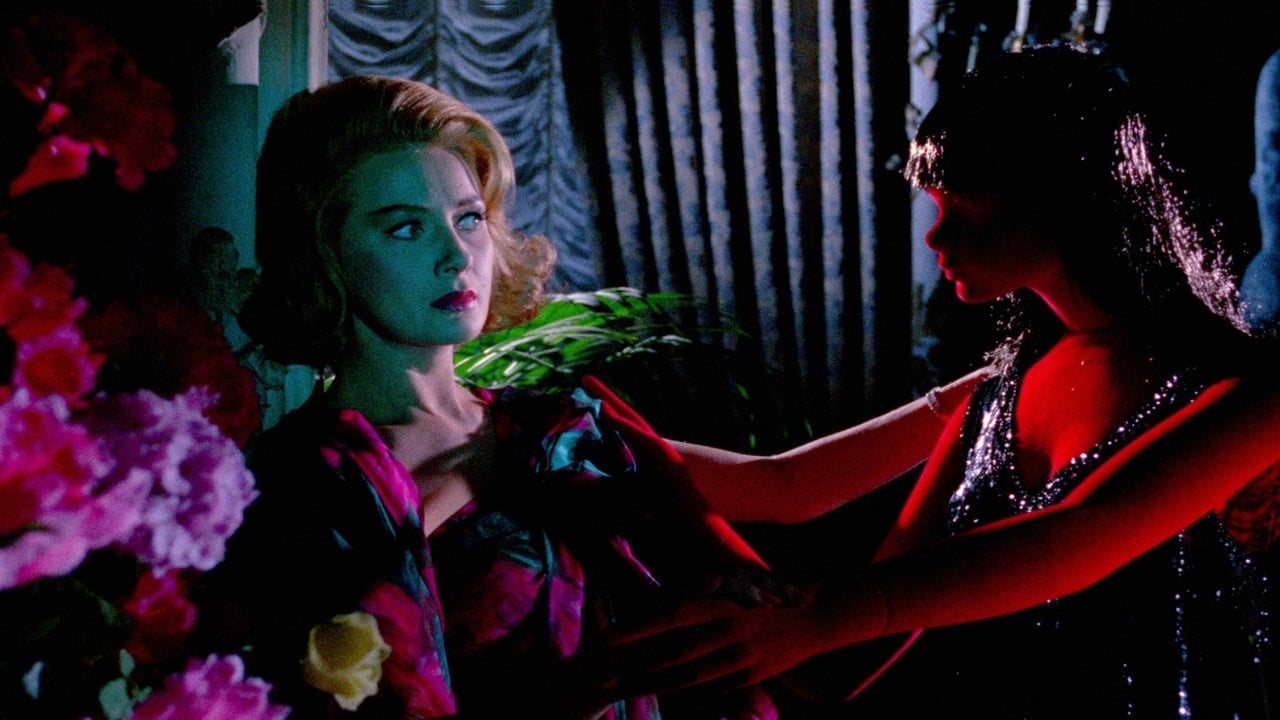

Blood and Black Lace
“A Fashion House of Models… Becomes a Terror House of Blood!”
Isabella, a young model, is murdered by a mysterious masked figure at a fashion house in Rome. When her diary, which details the house employees' many vices, disappears, the masked killer begins killing off all the models in and around the house to find it.
About Blood and Black Lace
Why Blood and Black Lace is still worth talking about
Start with the image everybody remembers: a beautiful young model walking alone on the grounds of a fashion house and, in a heartbeat, being cut down by an anonymous figure in a white, featureless mask. It’s the kind of opening that announces the film’s business in the bluntest possible terms — this is a movie about death barging into places that feel protected.
Mario Bava directs with an economy that suits the idea; at just 86 minutes the film wastes no time letting suspicion ricochet between a small group of people. The police are involved, questions get asked, and the salon’s managers — including characters played by Eva Bartok and Cameron Mitchell — are pulled into the orbit of the investigation.
Under that furious surface there are other small pleasures: the odd, crowded intimacy of a workplace under strain; the way secrets (a diary, little lies) accumulate until they behave like combustibles. Blood and Black Lace announces itself clearly and then makes you sit with the consequences.
The idea that sets Blood and Black Lace in motion
The engine that drives the film is a very specific kind of betrayal: someone who should be a protector turns out to be a profit-seeker with dangerous appetites. That revelation is not a slow burn; it hits suddenly and rearranges everything.
At a key moment the Contessa realises that her marriage has been a means to an end — a route for someone else to inherit rather than a partnership. The discovery strips away any complacent idea that domestic arrangements will keep you safe.
The unspooling is immediate. When she tries to act on that realisation, events force a breakdown: she calls for help and collapses beside the man whose motives she has just exposed. The setup, in short, is trust collapsing into consequence.
Why Contessa Cristiana Cuomo matters
Eva Bartok plays Contessa Cristiana Cuomo, and the part she occupies matters precisely because she’s placed where power and protection are expected to meet. The film layers suspects and vulnerabilities around her, so her choices (and what others do to her) reshape the stakes.
She isn’t an isolated ornament; she sits inside a cast of characters whose private failures and addictions create pressure on the household — from an ex-boyfriend who’s coping badly with drugs to colleagues who stumble across bodies and secrets.
Those ripples change how the film reads. When bodies start turning up and loyalties fray, the Contessa’s position becomes less a refuge and more a fulcrum: whoever controls her future also controls the narrative’s leverage.
Blood and Black Lace has more on its mind than the plot suggests
On paper it’s a murder mystery; underneath it’s interested in mortality. The steady tally of deaths forces the film to ask, without fuss, how fragile life looks when the people you trust are the ones who might betray you.
Linked to that is an examination of home and safety. The fashion house — a place that ought to protect its employees — becomes a space where privacy is violated and sanctuary proves porous. That inversion gives the killings a sharper emotional sting.
Loss accumulates in small, human ways: diaries burned, relationships broken, lives interrupted. The movie treats each disappearance as a subtraction from a place that should hold people together, so the murders aren’t only sensational — they’re erosions.
And running through all of it is a question about authority: who has the right to adjudicate guilt and who’s allowed to hide behind respectability. The film uses its closed cast of characters to show how power can be abused, and how trust can be weaponised.
Blood and Black Lace could not belong to any other decade
Released in 1964, Blood and Black Lace sits in a moment when cinema was happily mixing tones: thriller mechanics, a streak of brutality and a taste for stylish settings. That specific blend feels of its time in a way that isn’t merely retro-decoration.
Being squarely a 1964 film gives it a certain appetite for pushing at moral boundaries without turning into an endless exercise in explanation. It wants to unsettle and do it quickly.
Seen through a 1960s lens, the film’s compact shape and willingness to court discomfort look like products of an era testing how far genre could be stretched — and how much audience patience it could demand.
Why Blood and Black Lace still matters
There are a few concrete reasons the film continues to be talked about. It opens with a striking, memorable murder — a model cut down by an anonymous, featureless masked figure — and then uses that act to pull a tight group into suspicion and dread.
A small object in the story does a great deal of work: a diary that lays out personal vices and secrets. The diary moves between characters, promises to be evidence, then becomes a motive and a MacGuffin. That kind of paper-based guilt gives the mystery a tactile centre that’s easy to follow and hard to forget.
The film also refuses easy explanations. The police interrogate figures who are messy and compromised — a man with an addiction, dressroom staff who hide things — and the story keeps shifting who we think is culpable. Even when the truth comes out, it’s not sentimental; it’s a confession that rearranges the moral geometry of the place.
Finally, the narrative doesn’t stop at the killings. The plot turns on calculated choices: people who exploit status, who persuade others to cover crimes, and who stage deaths to look like something else. Those hard, uncomfortable plot decisions are what keep the film biting rather than merely lurid.
Does Blood and Black Lace still hold up?
Yes — if you want a compact, unsentimental slice of genre that doesn’t apologise for its nastiness. The film’s central sequence (a masked figure killing a model) still carries a punch because it’s an incident that expands into something personal: police questioning, poisoned relationships and, eventually, the revelation that those closest to power can betray that trust.
It is, at the same time, economical. At 86 minutes, Mario Bava’s film is lean: it sets its pieces out, lets secrets do the heavy lifting, and keeps the gears turning until the payoff. The plot choices are often pragmatic and hard-minded — people manipulate a diary, stage deaths, persuade others to commit violence — and that matter-of-fact nastiness still feels bracing.
The themes are simple and durable. Mortality and loss aren’t treated as abstractions here; they’re what happen when protection fails. Home and safety become questions rather than givens, and the film forces you to watch those certainties be stripped away.
If you’re curious about a short, muscular piece of 1964 genre filmmaking that’s willing to be both cold and cunning, it’s worth your time. Blood and Black Lace still feels like a small, sharp lesson about whom we trust — and how quickly the idea of safety can unravel.