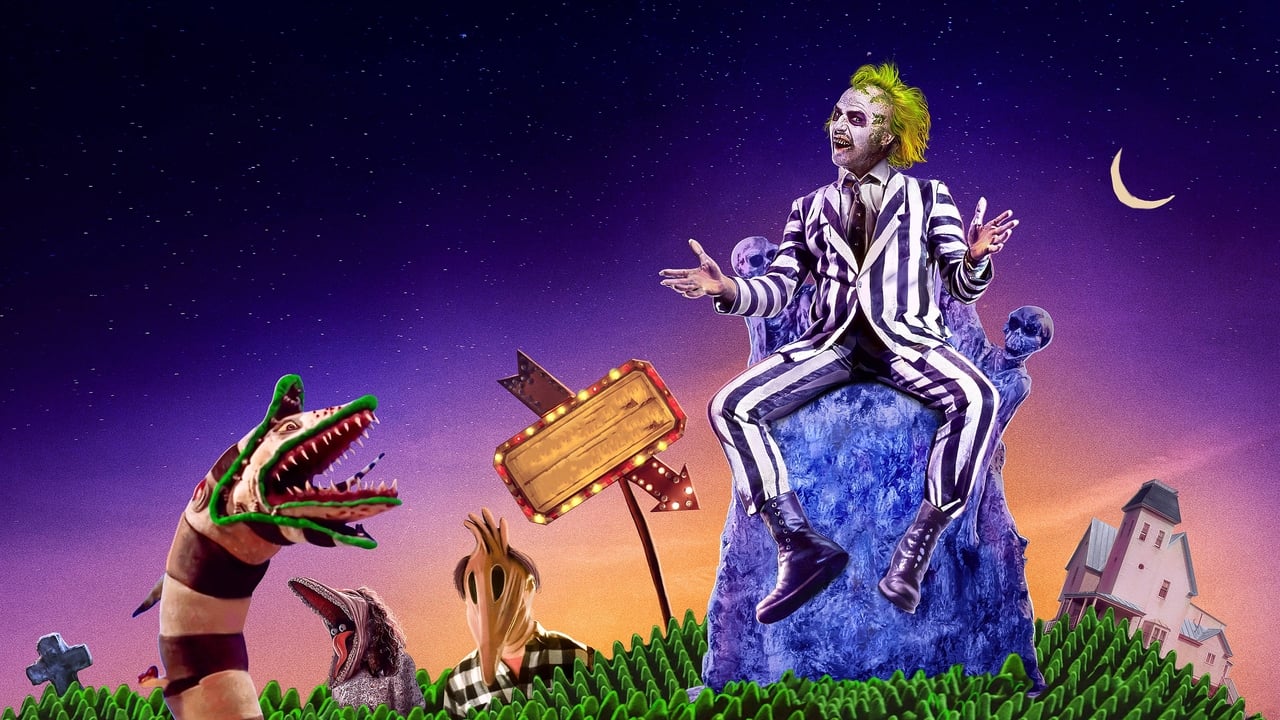
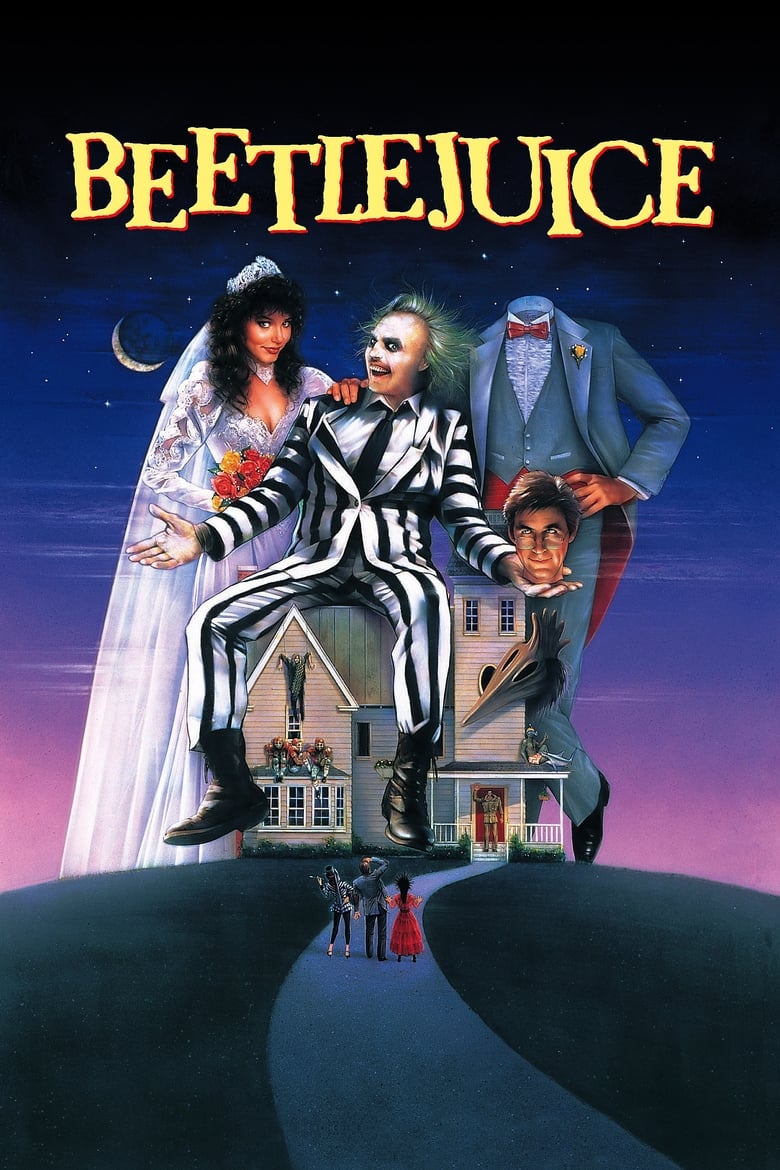
Beetlejuice
“In this house... if you've seen one ghost... you haven't seen them all.”
A newly dead New England couple seeks help from a deranged demon exorcist to scare an affluent New York family out of their home.
About Beetlejuice
What Beetlejuice gets right
There’s an instant confidence to Beetlejuice: a comfortably large country house, a married couple who are fond of fixing things, and an attic hobby — Adam is building a scale model of the town. None of that feels like set dressing. It’s the small, domestic stuff that the film treats seriously, and that deliberate normality makes the strange things land harder.
This is Tim Burton’s 1988 recipe for mischief — compact, mischievous and exact. The movie knows its length (92 minutes) and makes choices that respect it: it sets up a family, removes them from the world in an odd bureaucratic way, then watches how the living and dead try to share the same patch of floor. And at the centre of the mess is Betelgeuse — the name on an advert the Maitlands find when they’re looking for help. He’s the obvious disruptive element; not just a supernatural troublemaker, but the one whose arrival forces the movie to pick a side about what ‘home’ actually means.
The idea that sets Beetlejuice in motion
The film starts with a pair of ordinary domestic moments: a couple fixing up their house and a drive home that goes horribly wrong. A swerve to avoid a dog ends with their car in a river; they somehow wake up back at the house and can’t remember how they got there.
Small, disorienting details pile up — no reflections, a mysterious handbook — and the Maitlands learn they’ve drowned and become ghosts. That simple premise keeps the story brisk: people who belong to a place are suddenly cut off from it, and the house they love has been sold to newcomers.
They try the straightforward thing — scare the new owners out — and run into obstacles. The afterlife in Beetlejuice has rules and bureaucracy. After wrestling with those rules the Maitlands return, only to find the house completely redesigned and their attempts to reclaim it foiled by their invisibility to the living.
It’s concise and sensible as premises go: domestic loss plus a set of supernatural rules equals a comedy that can swing from quiet grief to full-blown chaotic farce.
Why Betelgeuse matters
Betelgeuse arrives in the story as a kind of professional chaos: he’s a ‘bio-exorcist’ the handbook links to, someone Juno explicitly warns the Maitlands not to call. That framing does an important job — it sets him up as trouble you can hire, which is both comic and unnerving.
When the Maitlands do summon him, they meet someone whose taste and morals collide with theirs; they find his crude, morbid demeanour offensive. That friction matters because it exposes the Maitlands’ quieter, domestic concerns — they care about the house, the model town in the attic, and the domestic routines that Betelgeuse forgets to respect.
He’s also the plot’s accelerant. Lydia invokes him in a desperate moment with a bargain — his staying is conditioned on marriage — and once he’s in play the movie escalates into full supernatural havoc: he becomes a giant snake, seduces, terrorises and is ultimately driven back into the miniature world the Maitlands keep.
Even when he ends up stuck in the waiting room, queueing for a caseworker, he matters because his presence makes the central choices sharper. He compels the living and the dead to decide what they will defend, and how far they’ll go to protect the idea of home.
Why Michael Keaton's performance matters
There’s a practical point here: Betelgeuse exists in the story as the kind of character Juno explicitly tells the Maitlands not to hire. That’s a performance brief in itself — the part needed to feel like a hired gun of the afterlife, someone loud enough to upset the household balance.
Because the film makes summoning him a deliberate, almost ritual act, the role functions as an interruption. He’s not incidental; he’s the catalyst who forces other characters to reveal what they care about. So, whatever else you take from the movie, the role of Betelgeuse is structurally crucial: he turns the Maitlands’ domestic problem into a much bigger argument about boundaries and belonging.
Beetlejuice has more on its mind than the plot suggests
On the surface it’s a haunted-house comedy. Underneath, it’s mainly an argument about family and what people do to protect their home. The Maitlands are ordinary homeowners turned spectral guardians; the conflict is less about ghosts versus humans and more about two households trying to occupy the same emotional territory.
There’s also a strand about belief: Lydia can see the dead and treats it as part of who she is. That openness to the supernatural contrasts with the living adults’ attempts to rationalise or monetise the uncanny — which is where the film mines a lot of its tension and its jokes.
Parental protection slips into the story quietly. The Maitlands’ actions are about keeping their daughter — their family dynamic — intact, even after death. That’s what makes their return to the model town and their refusal to be sidelined feel worthwhile, not merely mischievous.
Friendship and mortality thread through as well. The film never forgets death’s absurd bureaucracy, but it also insists people — and ghosts — care about ordinary relationships. Beetlejuice’s bigger emotional trick is treating the end of life like another domestic crisis you can argue about over tea.
Beetlejuice could not belong to any other decade
This is very much a film of 1988 — not because of fashion flourishes, but because of its appetite for mash-ups. The movie mixes genre tones quickly: comedy, horror, gothic oddness and dark fantasy sit side by side in a way that felt distinctly late-80s in its willingness to blend rather than choose.
That period liked its high-concept hooks with clear emotional stakes, and Beetlejuice fits that mould. It has a single neat conceit — homeowners turned ghosts dealing with bureaucracy — and runs with it in a punchy, uncompromising way.
The decade gave Burton space to be playful with genre rules, and this film uses that permission to make the afterlife bureaucratic and the domestic ridiculous. It’s a mix that reads very much as a product of its moment while still being brisk and self-contained.
So, while the film’s energy is of its era, the core engine — a tidy idea that unlocks a lot of comedy and feeling — is the reason it sits comfortably among other late-80s curiosities.
What has aged — and what hasn't
The film’s core — a domestic couple who lose their place and then fight to get it back — still reads clearly. The setup (a country house, a fatal car accident, the couple returning home unable to recall events) gives Beetlejuice a solid, human anchor that modern viewers can still relate to.
Lydia’s role as the one living character who can see the dead hasn’t dated; she remains the necessary bridge between worlds and a credible adolescent character in her own right. That thread keeps the supernatural from becoming merely spectacle.
What matters now is how the movie balances its darker jokes with the quieter family beats. The pitch — house redesigned by newcomers, the Maitlands unable to frighten them because they are invisible — still provides smart comedic and emotional conflict. Some of the film’s peripheral touches reflect their time, but the central argument about home, family and stubborn attachment continues to feel immediate. The story’s economy — how it uses the model town, the Handbook and the rules of the afterlife — helps it hold up.
Why Beetlejuice still matters
A few concrete things help explain why people keep coming back to the film. The Maitlands’ attic model of the town is more than a prop; it becomes a narrative engine that the plot uses to trap and reveal characters. That toy-town device gives the movie a memorable centre.
The afterlife’s Handbook and the strictures Juno lays down make the supernatural feel organised rather than random. Those rules let the film play with bureaucracy as comedy — the ghosts have forms and waiting rooms, and that odd specificity sticks in the mind.
Characters matter. Lydia’s ability to see the dead gives the story an emotional pathway; the Maitlands’ refusal to simply accept the house being redesigned fuels the movie’s fights and reconciliations. Even the minor discoveries — Otho finding the Handbook in the attic, the guests at the dinner party embracing the weird — produce memorable moments.
And the finale, where the supernatural clashes with the domestic and the Maitlands ultimately force a truce about living together, ties the film’s jokes back to a surprisingly warm idea: people (and ghosts) want to keep their home being their home. That tidy moral, wrapped in grotesque set pieces and comic mayhem, is why Beetlejuice still gets talked about.
Does Beetlejuice still hold up?
Yes — and not for the reasons you might expect. Beetlejuice still works because it keeps its focus tight: a deathly accident, a couple who love their house and a handful of rules about how the afterlife behaves. Those few precise elements let the film swing between tender domestic notes and full-tilt weirdness without losing track of either.
The model town in the attic and the Maitlands’ refusal to let their home be erased remain emotionally persuasive. The story’s conflicts — invisibility to the living, Lydia’s unique sight, and the handbook’s bureaucratic strictness — give the comedy stakes. It’s a film that treats the supernatural as a problem to be solved rather than a mood to bathe in.
It helps that Beetlejuice is economical: at 92 minutes it doesn’t overstay its welcome. Burton’s 1988 film knows when to push and when to pull back, and that keeps the pacing lively and the jokes sharp.
If you’ve never seen it, watch it for the way the film makes a house feel like a character worth fighting for. If you grew up with it, it still rewards revisiting because the film’s core argument — that people will defend their home, even when the rules change — remains uncomfortably relatable and oddly comforting.