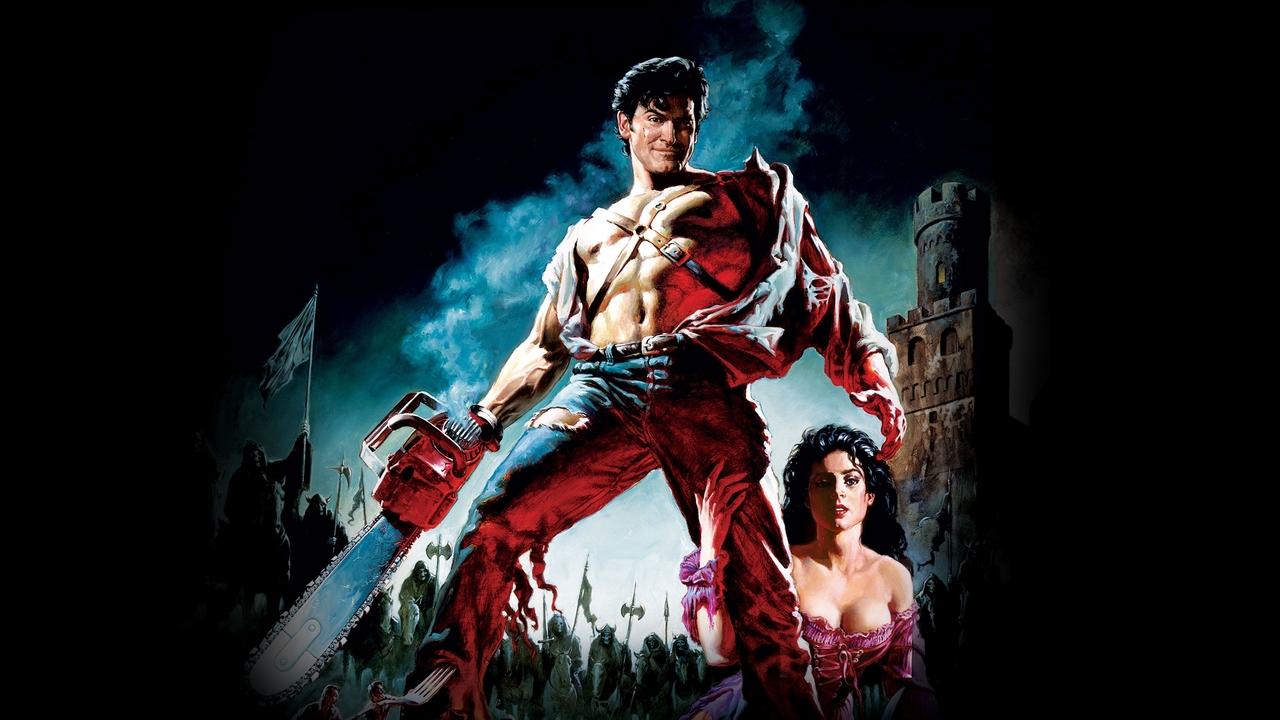
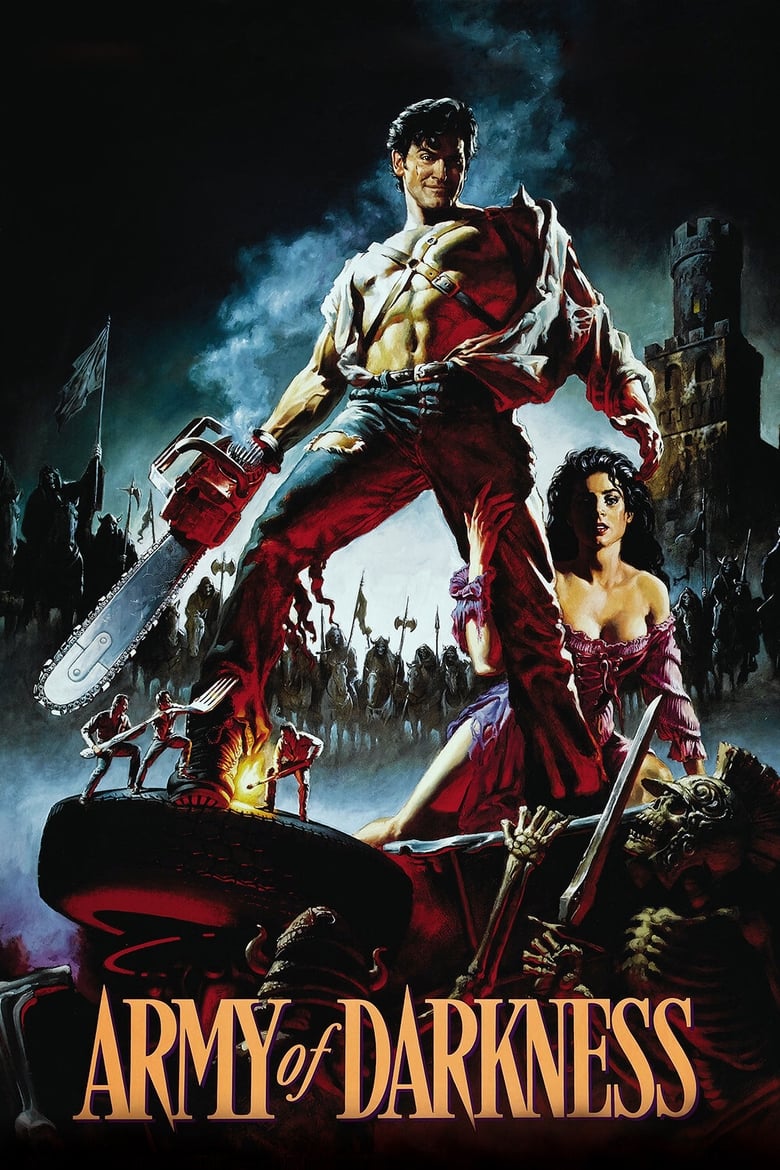
Army of Darkness
“Trapped in time. Surrounded by evil. Low on gas.”
Ash, a handsome, shotgun-toting, chainsaw-armed department store clerk, is time warped backwards into England's Dark Ages, where he romances a beauty and faces legions of the undead.
About Army of Darkness
What Army of Darkness gets right
Army of Darkness throws Ash Williams out of his element and into the middle of someone else’s war. He turns up in the Middle Ages, is taken by Lord Arthur’s men and has to prove he isn’t a spy — which is a tidy way of forcing a modern, mouthy protagonist into a very old problem.
That collision — a very American bloke in medieval chaos — is exactly the engine Sam Raimi steers. The film is compact (just 81 minutes), fast-moving and stubbornly unwilling to choose between being a monster movie, a fantasy romp, a time-travel caper or outright comedy. All of those labels stick, and none of them slows the pace. What keeps people talking is how many daft, vivid ideas Raimi squeezes into that short runtime: mirror doubles that turn nasty, a puzzle involving three versions of a cursed book, and a finale where Ash uses classroom knowledge from his old car to organise an assault. It’s the combination of inventiveness and cheek that gives the film its staying power.
The idea that sets Army of Darkness in motion
The film pivots on a simple stunt: a modern man ends up in the wrong century and, by the standards of that age, looks guilty until proven otherwise. After a public confrontation in which Ash dispatches a possessed enemy, he’s suddenly celebrated and his presence becomes both a problem and an asset.
His way home is handed to him as a task: there’s a cursed book that holds the route back, and the people who understand it tell him the ritual required. That premise — a hero who must follow a ritual while trying to keep a roomful of suspicious medieval types on side — keeps tonal control tight and gives the comedy a practical spine.
The film also leans on one thoroughly human gag: Ash fluffs a crucial piece of the ritual at the decisive moment and tries to bluff his way through the mistake. It’s the kind of comic panic that turns a supernatural problem into something painfully ordinary.
When he does reappear in the present day, he tells the tale at work — and the joke isn’t finished. A surviving undead threat turns up because the ritual wasn’t executed perfectly, which folds the medieval craziness back into Ash’s everyday life and closes the loop with a neat, punchy sting.
Why Ash Williams matters
Bruce Campbell’s Ash is framed as a fish out of water. He’s a man from another time, marched in front of distrustful medieval soldiers and forced to make himself useful in a world that begins by mistrusting him.
That outsider quality keeps him interesting: he’s never comfortable in the trappings around him, which means his choices — to fight, to joke, to try and get back to his life — always feel personal rather than heroic by default.
There’s a small romantic thread too: the plot gives him a connection in the form of Sheila, which raises the stakes beyond mere survival and helps the story care about what Ash stands to lose.
Crucially, Ash isn’t a passive passenger. At one point he accepts responsibility for leading outnumbered humans against the undead threat. The film depends on that shift — it’s what turns his presence from a one-man joke into a forward-driving force.
Army of Darkness could not belong to any other decade
Released in 1992, Army of Darkness sits at the start of a decade that liked its entertainment short on fuss and big on concept. Those early-90s instincts favour films that mix tones and move quickly from one set-piece to the next.
The movie’s blend of fantasy, horror, comedy, adventure and time-travel is exactly that kind of mash-up: it doesn’t spend long explaining itself because the idea is the thing. That willingness to cross genre lines feels very much of its moment.
Part of the film’s identity is economy. Clocking in at just over eighty minutes, it wastes none of that time; everything is designed to push the plot forward or land a gag, which reflects a 90s appetite for punchy, idea-driven entertainment. Put simply: being a 1992 film helps explain why Army of Darkness finds room for goblins, gore, pratfalls and a gag about classroom knowledge in the same breath. It’s shorthand for a decade that enjoyed stories that were clever and fast.
Why Army of Darkness never really went away
There are moments designed to lodge in the memory: Ash thrown into a pit, fighting the possessed and reclaiming his weapons, or the eerie business with mirror shards where reflections come to life and one copy has to be buried. Those beats are silly and slightly upsetting in equal measure — easy to recall and hard to shake.
The movie’s central puzzle — a cursed book presented as three nearly identical volumes and the scramble to identify the real one — gives the plot a crisp, almost game-like quality. That sense of a set-piece puzzle is one reason viewers remember the film as much for its structure as its jokes.
Then there’s the nightmare reversal: a failed ritual leads to a duplicate of Ash that rallies the dead into an army. The film builds to a big, goofy battle in which Ash organises a ragged group of humans, uses unexpected modern knowledge from his old car’s textbooks and carries through to a decisive victory.
Finally, the story loops back to the present in a way that refuses to be tidy. Ash retells the tale at work, but remnants of the madness tag along — a surviving undead threat turns up, the day is saved again, and the film signs off with a cheeky, swaggering finish. Those return-and-repeat beats keep the film alive in memory.
Does Army of Darkness still hold up?
Yes — if your taste runs to rough-and-ready ideas delivered at speed. Sam Raimi’s direction and the simple fact that Bruce Campbell’s Ash is central to every beating scene keep the film focused. At 81 minutes it refuses to linger, which is part of its charm.
If you enjoy a clever set-piece, there’s plenty to enjoy: the cursed-book conundrum forces quick thinking, and the comic panic around a botched ritual gives the supernatural elements a human, laughable edge.
There’s real pleasure in the film’s escalation. What starts as being a stuck-in-time joke becomes a proper struggle: Ash ends up organising an improbable defence, using classroom-style knowledge he happens to have on hand, and seeing it through to a satisfying, if daft, victory.
For modern viewers the payoff is simple — it’s an hour and a half of noisy invention that rarely apologises for being silly. If that sounds like your sort of thing, give it a spin: it’s a deliberate, grin-inducing dose of medieval nonsense with a grin on its face.