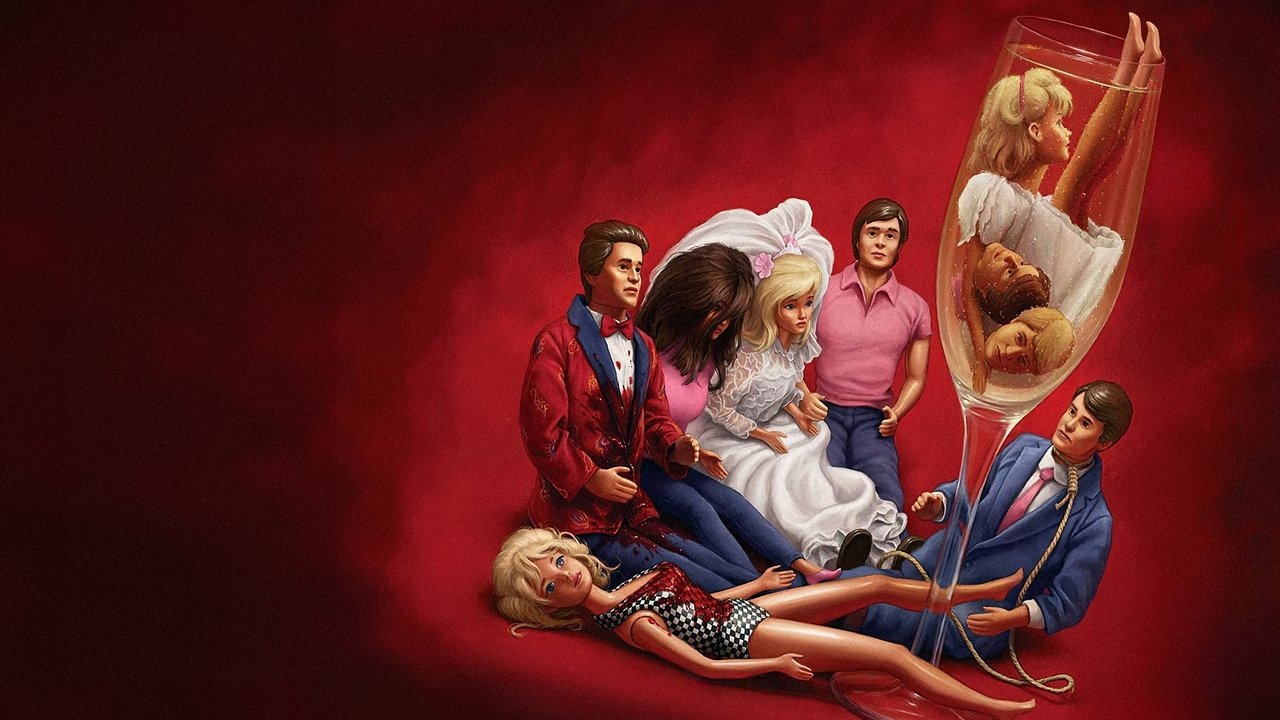
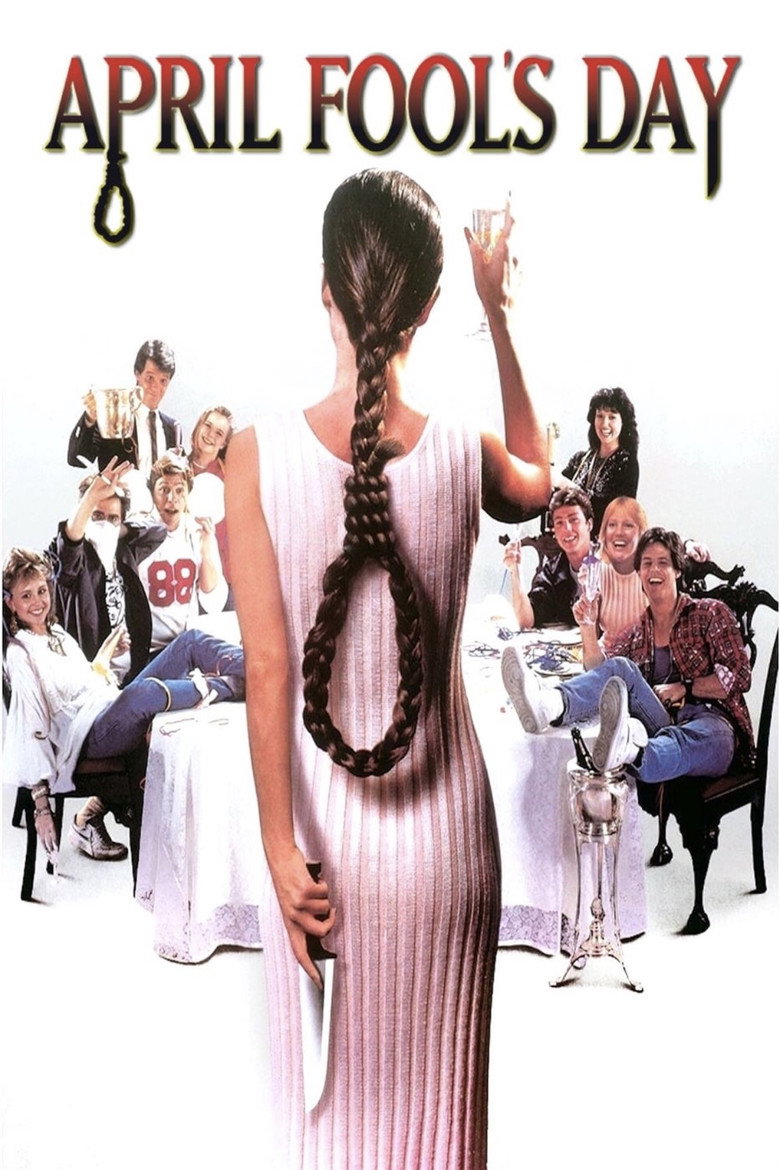
April Fool's Day
“Guess who's going to be the life of the party?”
On April Fool's Day weekend, a group of college friends gather together at a secluded island mansion to celebrate their final year of school, where they soon become prey for an unseen murderer.
About April Fool's Day
What makes April Fool's Day worth revisiting
You know the set-up immediately: a compact cluster of college friends decamp for an island mansion to celebrate spring break. That weekend of camaraderie is the engine — not just a backdrop — because the film keeps returning to how these people behave when company, pranks and boredom collide.
Fred Walton steers the whole thing briskly: at just eighty-eight minutes the movie is all forward motion, a short, tense orbit from seaside jokes to something darker. That economy matters — there's no time for indulgence, only for choices that look fun until they don't. And it's full of small casting decisions that stick in the mind. Deborah Foreman turns up twice as Muffy and her twin Buffy; Thomas F. Wilson appears as one of the group, Arch Cummings; familiar faces drift through the house. Walton stages his gag-heavy world so the audience is never quite sure whether the next alarm is theatre or threat.
The idea that sets April Fool's Day in motion
The basic promise is straightforward and effective: a group of friends, spending a weekend together, begin to disappear or turn up dead. That’s the lever the story pulls — communal fun becomes a proving ground for fear.
Because the cast of characters are already a compact social unit, disappearances have immediate emotional weight. When someone goes missing it doesn't feel like a random body count; it feels like a hole in the gang.
The movie also keeps the audience guessing about what’s honest and what’s staged. Kit and Rob’s detective work — putting clues together and realising earlier assumptions are wrong — is the film’s way of turning the mystery inward. The plot enjoys the space where prank and peril overlap.
Finally, there's a twist folded into the premise: the Muffy the group meet after the first night isn't who they thought. That doubling — a twin pretending to be her sister — reshuffles everything the audience was banking on.
Why Arch Cummings matters
Arch Cummings is one of the group, plain and simple — and that's exactly why he matters. Thomas F. Wilson plays Arch, who sits inside the clique the story keeps testing. He isn’t a lone detective or an obvious villain; he’s part of the social chemistry that makes the pranks and the panic land.
The film opens by presenting the friends as a unit: they joke on the pier, they travel together, they trust the weekend will be a private bubble. That trust gives the subsequent shocks their bite. Arch is useful because he helps define what the group looks like before things go wrong.
Characters like Arch are the movie’s human scale. The drama never happens in a vacuum; it happens between friends whose routines and jokes are being turned against them. Watching how Arch and the others react — or fail to react — is how the film measures tension.
There’s also a reminder built into the story that appearances are deceptive: the household’s double — the escaped twin — means no one’s role is fixed. That instability ripples through the group and makes even ordinary relationships feel fragile.
April Fool's Day has more on its mind than the plot suggests
On the surface it’s genre mechanics — mystery, slasher beats, practical jokes — but underneath the film keeps returning to three human ideas: friendship, mortality and loss. The weekend away is a ceremony of friendship, and the movie treats that bond as something fragile rather than invincible.
Mortality creeps in because the group’s sport is pretending death is a laugh. When death is simulated so often it becomes a prop, the line between acting and reality thins — and the film uses that blur to make fear feel personal, not just procedural.
Loss follows naturally from both of these. As friends vanish or are discovered, the weekend stops being youthful mischief and becomes a catalogue of what’s gone wrong. That transition — from party to funeral-awkwardness — is where the emotional punch lives. Put together, the three themes make the film less a series of shocks and more a small study of how a close-knit group copes when play turns into a threat that might be real.
The effects work that gives April Fool's Day its physical personality
One small production move changes the film’s logic: a character named Buck is a friend who does special effects and make-up in Hollywood. That single detail sits inside the story and explains why the house is full of elaborate, convincing practical jokes.
Because there’s an in-world technician, the film can stage gruesome set-pieces and later explain them without asking the audience to suspend disbelief. The existence of Buck gives the dress-rehearsal idea a believable spine.
It’s a neat diegetic shortcut. Instead of pausing for exposition about how the fake severed heads were made, the movie simply points to someone who knows how to build them. That keeps the pace brisk and the tonal switch — from play to panic — sharper.
So the physical world of the film feels coherent: the pranks aren’t magic, they’re crafted, which makes the moments when the line between fake and real blurs all the more unnerving.
April Fool's Day could not belong to any other decade
Released in 1986, April Fool's Day belongs to a moment when short, punchy horror pictures that mixed mystery and slasher elements were common currency. Its genre label — a hybrid of horror, slasher and mystery — places it squarely in that era’s appetites.
That mid-80s timing matters because the film trusts an audience used to quick, efficient scares. Walton doesn’t linger; he delivers a weekend’s worth of escalating mischief and terror in less than an hour and a half.
The movie’s premise — friends off together, pranks gone dangerous, a dress rehearsal that folds back on itself — plays like an idea dreamed up by people who had already seen the decade’s slasher shorthand and wanted to twist it.
You could argue it’s of its time because it treats youthful sociability as both a playground and a risk; the balance feels specific to a period when horror liked to turn familiar social situations into spectacle.
Why April Fool's Day still matters
People remember this film because of the way it reconfigures a very small cast of friends into a puzzle. The weekend at Muffy’s island mansion is easy to picture: close quarters, private jokes, and plenty of opportunity for a prank to go too far.
The practical conceit — a house rigged with gags that range from the childish to the disturbingly elaborate — gives the film a signature. Scenes like Nikki’s fall into the well and the discovery of severed heads cut through the levity and force the group to acknowledge real stakes.
Then there’s the narrative pivot: Kit and Rob slowly realise that their assumptions were wrong, and the revelation that the Muffy they’ve been with is actually someone else changes the game. The twin switch turns a social weekend into a ruse with teeth. Finally, the film closes on a chilling domestic gag: the jack-in-the-box present, the staged throat-slitting, and the tiny wink of the toy. It’s the kind of end-note that lodges in the memory—equal parts theatrical showmanship and reminder that not every surprise is innocent.
Does April Fool's Day still hold up?
Short answer: yes — if you want a compact, slightly off-kilter horror that treats friendship as both armour and liability. The film runs a tidy eighty-eight minutes, and in that time Fred Walton keeps a steady tension between staged scares and genuine threat.
The pleasures are specific. The house full of pranks — everything from daft gags to disturbing setups — gives the story a theatrical, game-like logic that pays off when the group’s assumptions start to fail. The moment Nikki finds evidence that looks real is exactly the shock the film depends on.
Its themes matter, too. Friendship cushions the early humour and makes loss feel sharper later on; mortality isn’t abstract, it’s literal and discovered by people who were laughing together hours before. That emotional switch is what keeps the film from being only a string of set-pieces.
If you’re tuning in now, expect a neat, economical mystery-slash-slasher with a twist that rearranges the weekend’s social scaffolding — the twin switch, the dress-rehearsal reveal, the final mock-threat with the jack-in-the-box. It remains worth watching because it asks a small, clear question: when fun is built on pretending the worst, what happens when pretending stops?