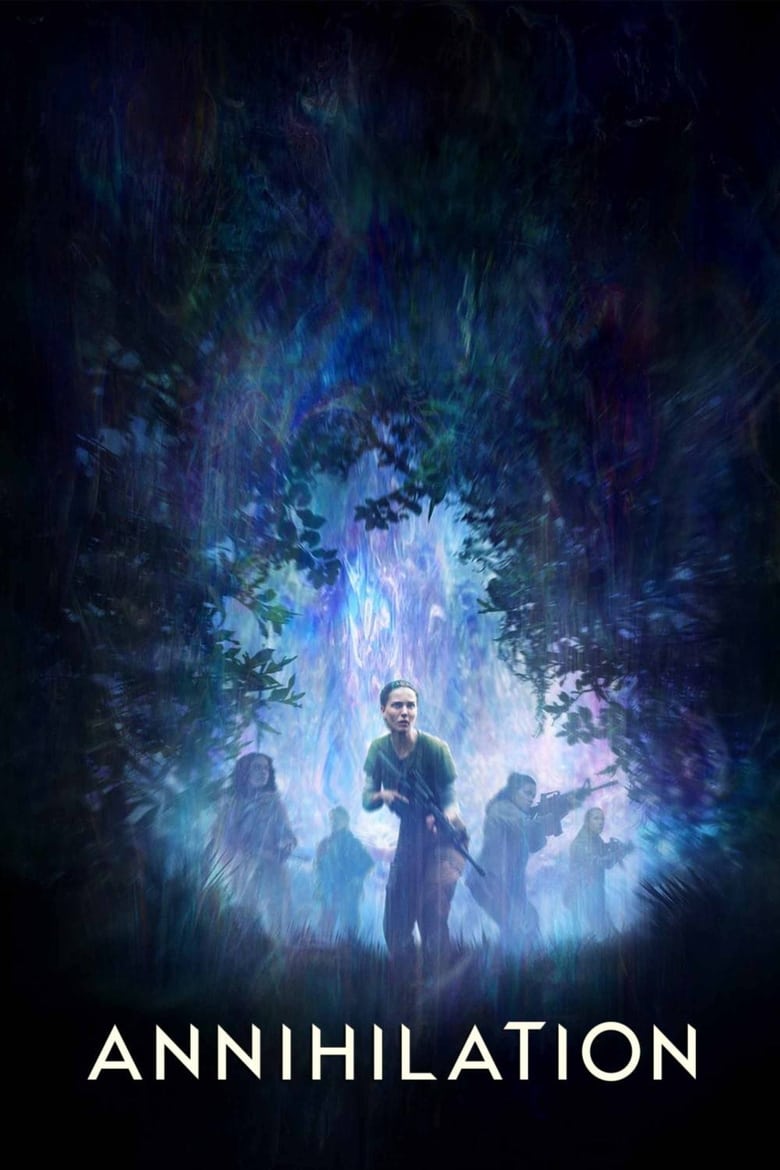
Annihilation
“Fear what's inside.”
A biologist signs up for a dangerous, secret expedition into a mysterious zone where the laws of nature don't apply.
About Annihilation
What Annihilation gets right
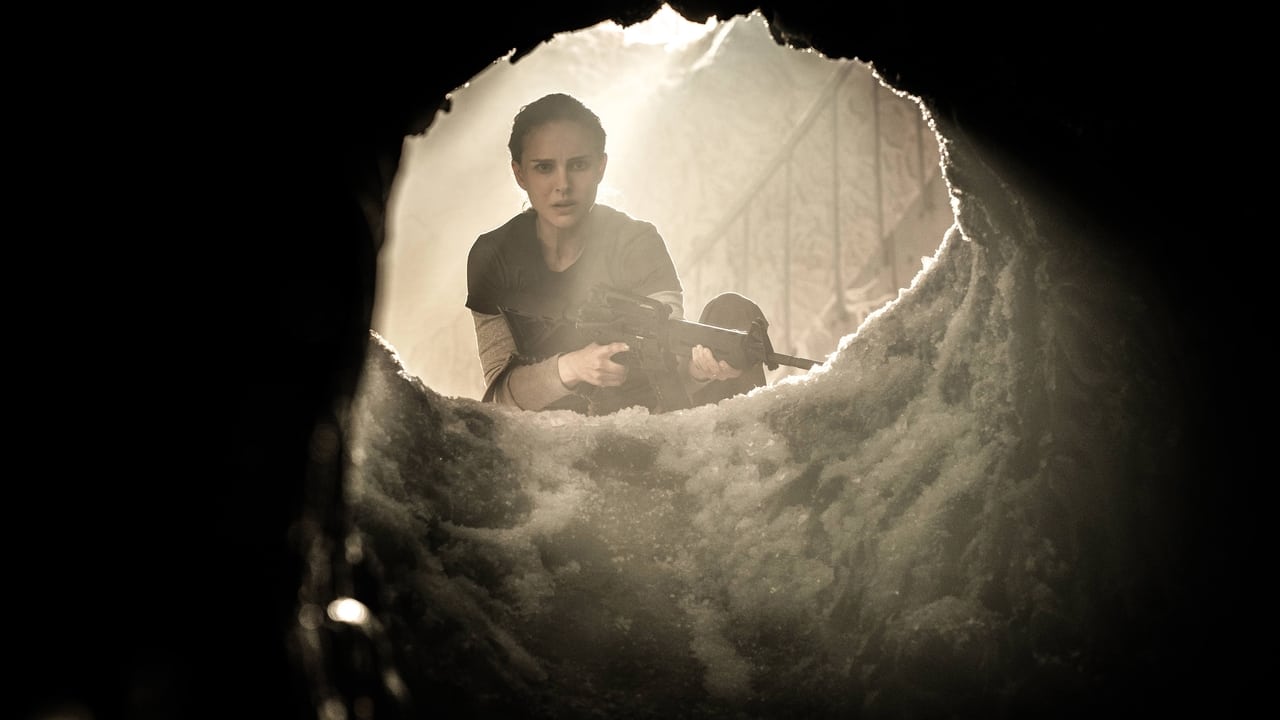
It opens with Lena sitting on the other side of an interrogation room. That moment matters because the film isn’t trying to be a straight chase thriller; it’s telling you from the start that everything we’re about to see is a story being reconstructed — memory, trauma and explanation are always in play.
Alex Garland wrote and directed Annihilation, and he wraps a tight, unsettling central idea in a package that mixes thriller, science fiction, horror and drama across its 115 minutes. The hook — a shimmering anomalous zone that appeared after a meteor struck the lighthouse — is simple, but the film uses it to ask harder questions than most genre pictures attempt. The ensemble cut through the murk: Lena goes in with Dr Ventress and three other scientists, and the film’s tension comes as much from what the Shimmer does to bodies and DNA as from what it does to people’s minds. Fear, loss, humanity and mortality are the themes the film keeps returning to, and they give the weirdness an emotional spine.
The idea that sets Annihilation in motion
The core premise is clean: a meteor creates the Shimmer, an expanding zone that warps everything inside it, and expeditions into that zone do not come back. Lena’s story begins when her husband, Kane, disappears on one expedition and then mysteriously returns a year later in a ravaged state.
Ventress recruits Lena for a new scientific mission into the Shimmer, and they enter with three other women. Almost immediately the team experience time and memory slipping — they find themselves days into their journey with blanks where events should be, and their radios stop working.
Inside the Shimmer the rules are different: animals and plants mutate, human bodies become strange, and recorded evidence — a tape from Kane’s earlier mission, for instance — gives glimpses of violence and disintegration. The story escalates toward a confrontation at the lighthouse at the heart of the Shimmer.
At that centre Lena encounters physical and psychological mirroring — a cloud that can mimic a person after taking a drop of blood — and the final collapse of the Shimmer forces the film to answer what it was doing with its ideas about identity and change.
Why Lena matters
Lena is the tether. We meet her being questioned about what happened, and the film keeps bringing us back to that framing. That interrogation makes every memory feel provisional — you’re always aware someone is trying to make sense of trauma, not just record it.
Her personal stakes are sharp and immediate: her husband Kane vanished on an earlier mission and then reappeared in their home a year later, ill and unstable. That disappearance and return is the reason she volunteers to go back in, and it gives the film its emotional engine.
She isn’t travelling alone. Ventress brings a small, focused team — a geomorphologist, a paramedic and a physicist among them — so Lena’s choices get reflected against other responses to the same pressure. The dynamics among the women let the film explore different ways people face the unknown.
When Lena reaches the lighthouse she keeps pushing even as logic unravels around her: she finds Kane’s remains and a videotape, confronts Ventress at the meteor’s hole, and faces a faceless mimic that mirrors her so closely it becomes literal. The end leaves the question of identity half-answered — Lena asks if Kane is really Kane, and the film closes on an uncanny, shimmering embrace.
Annihilation has more on its mind than the plot suggests
On the surface it’s a survival story in a very odd wilderness. But Garland keeps returning to quieter motifs: fear, loss and what being human looks like when the rules of biology are rewritten.
Several conversations — notably late-night reflections between Lena and Ventress — push the idea that humans have a peculiar instinct to destabilise themselves. That line of thought colours later events: the danger is not only from the Shimmer, but from what the characters already carry inside them.
The film literalises emotional states. Josie’s theory that the Shimmer ‘refracts’ dying minds into the world — that Cassie’s pain became part of the bear, for example — gives the supernatural a psychological weight. Trauma and fear aren’t abstract; they have bodies and consequences in Garland’s world. So Annihilation is less a mystery about an external invader and more a story about internal mutation: how grief and fear reshape people, and how identity can feel dissolved when everything familiar is rearranged.
Annihilation could not belong to any other decade
Released in 2018, Annihilation arrived at the end of the 2010s when audiences and filmmakers were increasingly willing to let genre do serious, inward-looking work. It’s a science fiction picture that treats scientific curiosity and interior grief as two sides of the same coin.
The film’s combination of intellectual ideas and genre mechanics feels very of the 10s: a director known for thoughtful scripts stepping into a full‑on genre piece and using it to ask difficult questions. That era liked its sci‑fi literate and willing to be uncomfortable.
It also fits the decade’s appetite for compact, serious films that don’t spoon‑feed every answer. Annihilation trusts viewers enough to sit with ambiguity — a storytelling approach that became more common across the decade.
So while the movie isn’t a time capsule of fashions or gadgets, it belongs to the 2010s because of how it blends idea‑driven scripts with mainstream genre ambition.
What has aged — and what hasn't
Some things land as strongly now as they did on first viewing. The personal core — Lena’s hunt for answers about Kane and the way loss propels her — still gives the film momentum. The premise of a returned, sick husband remains a powerful, immediate reason to watch.
The film’s engagement with fear and the idea that emotion can change the world around us still feels unsettling. Scenes that turn grief into something literal — pain made animal, memory made landscape — haven’t lost their ability to be quietly unnerving.
Where the film might feel less crisp is in its refusal to tidy up every question. Modern viewers used to clearer payoffs may find Annihilation’s ambiguity frustrating rather than rewarding, but that’s a creative choice, not a fault of ageing.
Overall, the parts that remain strongest are the film’s willingness to hold together mood, scientific imagination and personal stakes; if you come back to it now, those elements still do most of the heavy lifting.
Why Annihilation still matters
People remember Annihilation because it dared to be strange and a bit stubborn. The Shimmer — born from a meteor at St. Marks Light — is a tidy high‑concept kernel that the film spins into encounters with mutated wildlife, failing radios and tapes that reveal degrading human bodies. Those images stick.
The movie layers visceral shocks — an albino alligator with concentric rows of teeth, a soldier’s abdomen opening to reveal writhing intestines, a corpse become lichen — onto quieter philosophical moments. That mix of body horror and talky sequences keeps the tone unpredictable.
It’s also a film about teams and what happens when expertise bumps up against the incomprehensible. Ventress and Lena lead a small, almost intimate group of scientists; their discoveries — the abandoned village of humanoid plants, Josie’s prism theory about DNA being ‘refracted’ — turn the unknown into something almost domestic, which makes it nastier. Finally, the personal beats stay with you: Ventress’ admission of cancer and her decision to go to the lighthouse; the videotape from Kane’s earlier mission; the final dissolving of the Shimmer and Lena’s return to an uncertain home life where even an embrace leaves blurred irises. Those choices give the film an aftertaste that’s hard to forget.
Does Annihilation still hold up?
Yes — if you’re prepared to be guided through a film that privileges idea and mood over tidy answers. The frame device of Lena under interrogation keeps the movie honest about uncertainty: she’s recounting an expedition into the Shimmer, and the film trusts you to sit with partial memories and strange images.
It’s a 2018 Alex Garland film of 115 minutes that asks big questions about fear, loss and what makes us human while also delivering genuine jolts. The mix of genres—thriller, science fiction, horror and drama—means it can be cerebral and visceral without tipping too far into either.
If you want a neat closure, Annihilation will frustrate you. If you want a film that uses a science‑fiction conceit to bend bodies and minds and leave you thinking about identity and mortality, it still rewards repeat viewing. Lena’s final, ambiguous reunion with Kane — and that shimmering, uncanny last image — stays with you.
So go back to the Shimmer. Bring curiosity, patience and a taste for the unsettling. It doesn’t give you all the answers, but it gives you a journey that’s hard to shrug off.