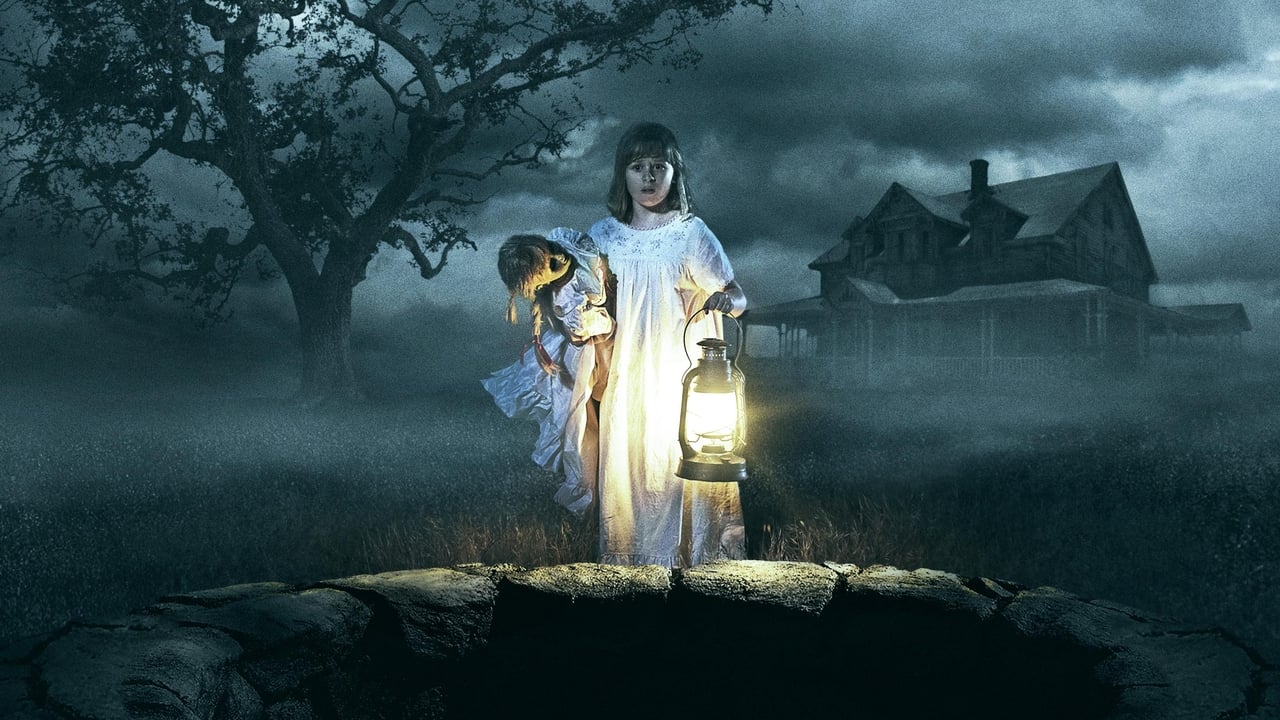
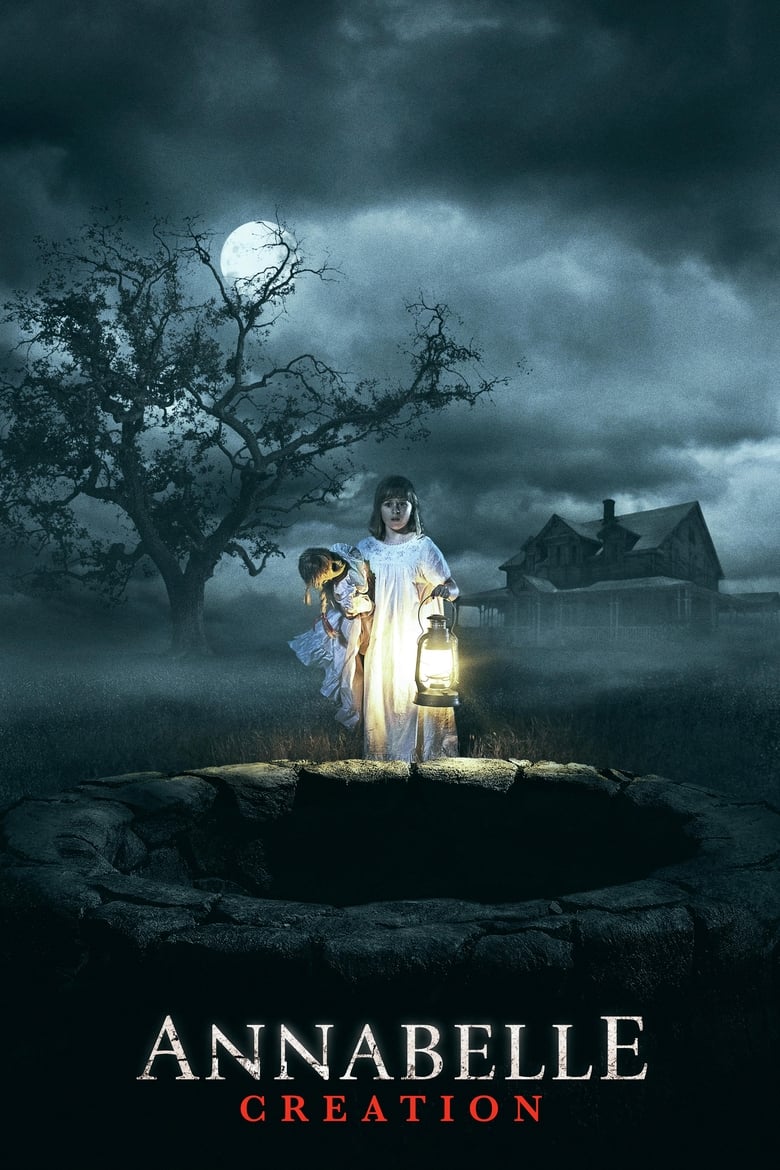
Annabelle: Creation
“You don't know the real story.”
Several years after the tragic death of their little girl, a doll maker and his wife welcome a nun and several girls from a shuttered orphanage into their home, soon becoming the target of the doll maker's possessed creation—Annabelle.
About Annabelle: Creation
What Annabelle: Creation gets right
The movie knows exactly what it’s about from the first beat: a toy-maker household hollowed out by a child's death. That grief sits in every decision, and Sandberg uses it like a character — stubborn, clumsy and dangerous.
Twelve years after that loss, the Mullins open up their house to Sister Charlotte and six homeless girls. It sounds like an act of charity; in the film it’s the moment the house begins to trade one kind of protection for another. From Janice finding a mysteriously unlocked bedroom to the porcelain doll tucked away in the closet, those small discoveries are the kind of precise, slightly old-fashioned set-ups that let a simple horror idea grow teeth. It’s tidy, slow-building and, crucially, personal.
The idea that sets Annabelle: Creation in motion
At its simplest, the movie puts a grieving couple, their closed-off house and a group of vulnerable children in the same frame and waits to see what will break first. The Mullins' wish to be reunited with their daughter is the tiny, terrible engine under everything.
Janice's curiosity — she finds a note saying 'Find me', a key and then the doll — is the precise misstep the story needs. It’s a classic horror switch: one private choice opens a communal danger.
What follows is not just a haunting but a series of exchanges where belief and denial trade places. When Samuel believes Linda and finds Janice changed, the household's private grief bursts into violence and blame.
The film carries that violence forward: the object the police take as evidence, the girl who later goes reclusive and takes a new name, and the hints that whatever was let loose keeps moving through homes and people long after the Mullins' doors are shut.
Why Sister Charlotte matters
Sister Charlotte arrives as the adult the girls can lean on — the practical presence in a house full of missing parents. She’s not a plot device; she’s the nearest thing the film has to responsibility and, at the same time, its most vulnerable anchor.
The Mullins welcome her and the orphans into their shelter, and those opening scenes establish Charlotte’s role: keeper, organiser, the person who tries to make a safe place out of a place that has already broken once.
Her actions matter not because she solves the mystery, but because she’s repeatedly put in the path of its effects: pulling children from wells, hearing screams outside, and confronting the uncanny when the demon mimics her to wheel Janice into the barn.
When the household’s secrets finally erupt — the mutilated owner, the disfigured mother, the locked closet — Charlotte is the one who gathers the scattered children and tries to keep the idea of home from collapsing entirely. That’s why the film keeps returning to her: she measures what safety looks like when safety has already failed.
Annabelle: Creation has more on its mind than the plot suggests
On the surface it’s a tale of a house haunted by a doll. Underneath, it’s a movie about how grief corrodes the rules that are supposed to keep people safe. Samuel and Esther’s loss of Bee sits behind every attempt to fix the damage.
Because the Mullins let the house and their guilt become a sort of penance — opening their doors as a shelter — the film ties parental protection to penance. Their attempt to make amends is earnest, and that earnestness is what the story chews on.
Home and safety are treated as fragile agreements. The house is offered as refuge, but the film asks: refuge from what? From guilt? From memory? From mortality? Those questions are woven into the scares, so the fear never feels incidental. Mortality and lifespan loom quietly. The Mullins’ desperation to reclaim a dead child is the terrible seed; once planted, it grows into something that can’t distinguish between restored life and a hostile takeover. That ambiguity is what keeps the audience unsettled.
Annabelle: Creation could not belong to any other decade
Released in 2017, the film sits comfortably in the 2010s horror moment that liked to rework old fright motifs with modern narrative cleanliness.
Instead of retro spectacle, it opts for tidy cause-and-effect: a clear wound (the child’s death), a clear misstep (the unlocked room) and a tidy chain of consequences. That procedural approach feels very much of its decade.
The 2010s were interested in horror that explained why the haunting happened, and Creation gives you an origin you can follow — a domestic tragedy that doubles as a supernatural seed. It’s part of the decade’s appetite for origin stories with moral screws.
So while it reaches back to older haunted-house tropes, it does so with a 2010s tendency to outline, explain and then let the terror proceed from a recognisable motive.
What has aged — and what hasn't
The film’s insistence on family as the real battleground still lands. The idea that a house can be full of good intentions and still be dangerous feels timeless, and the shelter plotline — the Mullins taking Sister Charlotte and the girls in — keeps the stakes immediate.
Its moral clarity also helps: the film makes it simple to follow the chain from loss to bargain to consequence. That means modern viewers won’t be baffled by the through-line; the emotional cause-and-effect still reads.
Some elements are more dated: if you’re looking for ambiguity or subversive modern horror tactics, Creation is content to steer the audience toward answers rather than sit in mystery. That straightforwardness is a design choice — it will either comfort or frustrate you depending on what you expect.
But the moments where Charlotte actually saves a child, where officers escort the survivors away, or where the grown-up danger returns to burn through another family — those beats still hit because they’re about people trying to hold life together when memory won’t let them.
Why Annabelle: Creation still matters
People remember this film for how plainly it connects a family’s grief to a string of unlucky, then violent, events. Samuel and Esther’s attempt to answer loss by bargaining for their daughter is the kind of small premise that keeps people talking because it’s easy to explain and hard to forget.
Janice’s curiosity — the 'Find me' note, the key and the porch of an unlocked room — is the sort of simple sequence that lodges itself in the memory. It’s a tidy, effective trigger for everything that follows.
That the story tracks the aftermath — police removing the doll, survivors being escorted away, the girl who later becomes reclusive and assumes a new name — gives Creation an air of inevitability. The horror doesn’t stop at the house; it migrates, and that continuity gives the film a narrative footprint. Finally, the detail that the couple once locked the doll away after priests were involved, only to reopen their home later as a form of contrition, is what keeps the picture emotionally resonant. It’s less about jump scares and more about the cost of trying to buy back what’s been lost.
Does Annabelle: Creation still hold up?
Yes — if what you want is a tightly plotted, emotionally direct haunted-house film about what a family will do to fill the hole left by death. The Mullins’ grief is the engine, and the film sticks to that engine with admirable stubbornness.
Stephanie Sigman’s Sister Charlotte is the human measure of the damage: she keeps trying to make the house a refuge, and the film keeps putting her in positions that test whether refuge is possible. That struggle is what gives the scares weight.
It won’t satisfy viewers who prefer horror that leaves everything mysterious or experiments with tone. But for a 2017 entry that chooses tidy motives and clear consequences, its choice to explain rather than obfuscate is part of the point.
In short: watch it for the way it turns a family’s ache into the film’s propulsive logic. It’s not merely a movie about a doll; it’s about what happens when grief starts opening doors.