
Altered States
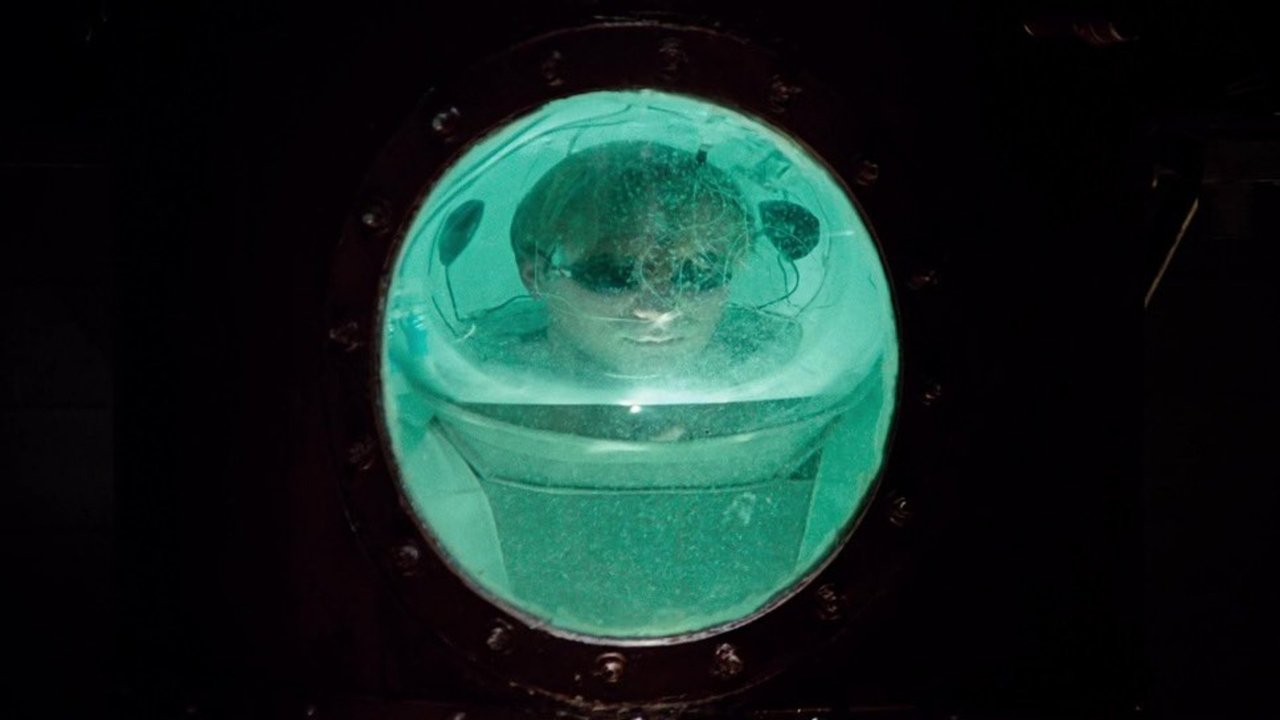
“In the basement of a university medical school, Dr. Jessup floats naked in total darkness. The most terrifying experiment in the history of science is out of control... and the subject is himself.”
A research scientist explores the boundaries and frontiers of human consciousness. Using sensory deprivation and hallucinogenic mixtures from Native American shamans, he explores these altered states of cognizance and finds that memory, time, and reality itself are states of mind.
About Altered States
Why Altered States still stands out
Put simply: Altered States is the sort of film that begins in a lab and ends somewhere you cannot entirely name. William Hurt plays Edward (Eddie) Jessup, a Columbia psychopathologist whose curiosity about altered consciousness becomes literal, physical and dangerous.
Ken Russell directs with the kind of bravado that makes a midnight screening feel like an experiment in itself. The film runs a crisp 102 minutes but uses them to move fast — from a scientist’s theory about other states of mind to experiments that stop being metaphors and start becoming bodies. What people remember first is the escalation: drug ceremonies, sensory-deprivation work and, ultimately, scenes where Eddie’s inner journeys externalise into something that actually changes him — even to the point of biological regression. It’s a strange, unsettling ride, and that mixture of scientific rigour and full-throttle imagination is exactly why it still feels worth revisiting.
The idea that sets Altered States in motion
The engine is a simple, unnerving idea: Eddie Jessup believes our other states of consciousness are as real as our waking life. That belief pushes him from classroom theory into actual experiments.
One small, decisive hook in the story is an early social moment — a faculty party where Eddie meets the fellow whiz kid who becomes Emily, his future wife — which roots his scientific curiosity in ordinary human relationships.
And then there’s what happens when he tries the Hinchi mixture: immediately after consuming it, Eddie experiences intense hallucinations — including a vision so literal it registers as petrifaction and erosion of himself and Emily. That sudden leap from hypothesis to visceral experience is the film’s promise and its problem.
From that point the movie asks a straightforward question: if those ‘other states’ can be summoned, what happens when they stop being just experienced and start changing the person having them?
Why Eddie Jessup matters
Eddie Jessup is the film’s compass. He’s a scientist who isn’t content with the abstract; he wants to reach inside and see what’s there. That desire makes him the obvious protagonist — and the obvious tragic figure — because the more he pushes, the less control he seems to have.
Crucially, Eddie’s experiments don’t stay private. His friends and colleagues are watching, measuring and at times alarmed. When those experiments begin to turn his body into evidence, his social circle becomes the safety net — and the witness — to whatever happens next.
At a narrative level, that’s why Eddie matters: the story is not about an idea in the abstract. It’s about a person who keeps testing the boundaries between science and self, and who drags everyone around him into the consequences when the work overwhelms him.
Put another way: he’s the kind of central figure who makes the film feel humane even at its strangest moments, because the transformations happen to someone we’ve already been placed inside.
Altered States has more on its mind than the plot suggests
Beneath the horror and the spectacle, the film is quietly concerned with courage. Not the macho kind, but the dangerous courage of curiosity — the decision to pursue knowledge when the stakes are personal and high.
There’s also a recurring human question: what do we owe the people we love when our need to know begins to hurt them? The movie folds that ethical worry into its sci-fi trappings rather than lecturing about it.
Those two ideas — courage and humanity — are the film’s moral texture. They turn what could have been an effects parade into something that asks you to choose sides: is Eddie bravely honest about the self he’s trying to find, or recklessly selfish? It never forces an answer. Instead, the film lets the consequences play out, which is why the thematic material sometimes feels more interesting than the plot beats themselves.
The effects work that gives Altered States its physical personality
The film’s physical personality relies on one persistent idea: experimentation as a bodily process. When the drugs become too dangerous to increase, Eddie returns to sensory deprivation, convinced the tank will deepen the effects at his current dose.
That decision — to rework an old tank and use isolation as an accelerant — gives the movie its most tactile sequences. The flotation-tank imagery makes the abstract idea of altered consciousness feel like something you might actually crawl into.
Because the story treats those sequences as procedures rather than set-pieces, the physical work on show reads as part of the science. It keeps the surreal moments tethered to the reality of someone testing, measuring and miscalibrating his own experiments.
In short: the material choices the characters make — returning to the tank, repairing equipment, chasing effects — are what make the film’s weirdness feel concrete rather than purely fantastical.
Altered States could not belong to any other decade
Released in 1980, the film sits on the cusp of a decade that liked its science with a dose of drama. Altered States feels of that moment because it treats scientific ambition as a personal narrative rather than a neutral backdrop.
The central character’s arc — a man who a decade after his early experiments is now a tenured Harvard professor — places the story firmly in institutions of expertise. That combination of academic gravitas and risky curiosity captures a particular late-1970s/early-1980s preoccupation: what happens when elite knowledge meets fringe practice.
It’s not about 1980s style so much as about the era’s appetite for high-concept cinema that mixes genre with big questions. That blend is part of why the film reads like a product of its moment without being a museum piece.
In short: the timing is essential. This is a film of its year because it asks the decade’s question — how far will we go in the name of discovery?
Why Altered States still matters
There are a few durable images that keep people talking: a scientist convinced his other states are as real as waking life; a trip to a ritual where a sacred mixture produces immediate, catastrophic hallucinations; and the choice to bring back a sample and push the experiment at home. Those beats anchor the film’s oddities in recognisable motives.
The movie also lives in its escalation. What begins as testing becomes evidence — an X-ray a colleague reads as a gorilla, visions that ‘externalise’ and, later, a genuine slippage into physical devolution. That progression from idea to bodily consequence is what gives the film its teeth.
Then there are the moments that are hard to forget: an episode where Eddie slips into a feral caveman form and goes off on a rampage, and later, the final, more profound regression into something like primordial matter. They’re extreme, but they serve the story’s insistence that inner states can become outer facts. Finally, the personal stakes: Emily searching a maelstrom for the man she loves, grabbing his hand and being enveloped in the process, and the desperate, physical fight to hold on to humanity. Those human moments — knitted into the weirdness — are why the film continues to matter to those who remember it.
Does Altered States still hold up?
Yes — if you’re willing to give a film the room to be both cerebrally ambitious and theatrically unafraid. Altered States asks a hard question about consciousness and then dramatizes what happens when someone decides to answer it at home: Eddie Jessup’s experiments move from the lab to the body, and the consequences are physical as well as philosophical.
That balance — courage in the pursuit of knowledge and a recognisable human cost — is the film’s strongest currency. It’s a movie that cares about the person doing the experimenting, not just the experiment, which keeps the weirdness from becoming merely decorative.
Practical considerations help: at 102 minutes, the film is economical enough to feel urgent; Ken Russell’s direction keeps the energy up; and the core story — a man who returns to sensory deprivation when drug doses become too dangerous — provides a steady logic to the escalating strangeness.
So should you watch it? If you like films that braid scientific curiosity with human stakes, and don’t mind a director who leans into spectacle, Altered States still rewards. It’s not for those expecting gentle comfort, but it is worth seeing for anyone who enjoys cinema that takes the risky proposition of 'what if' and lets it get physical.