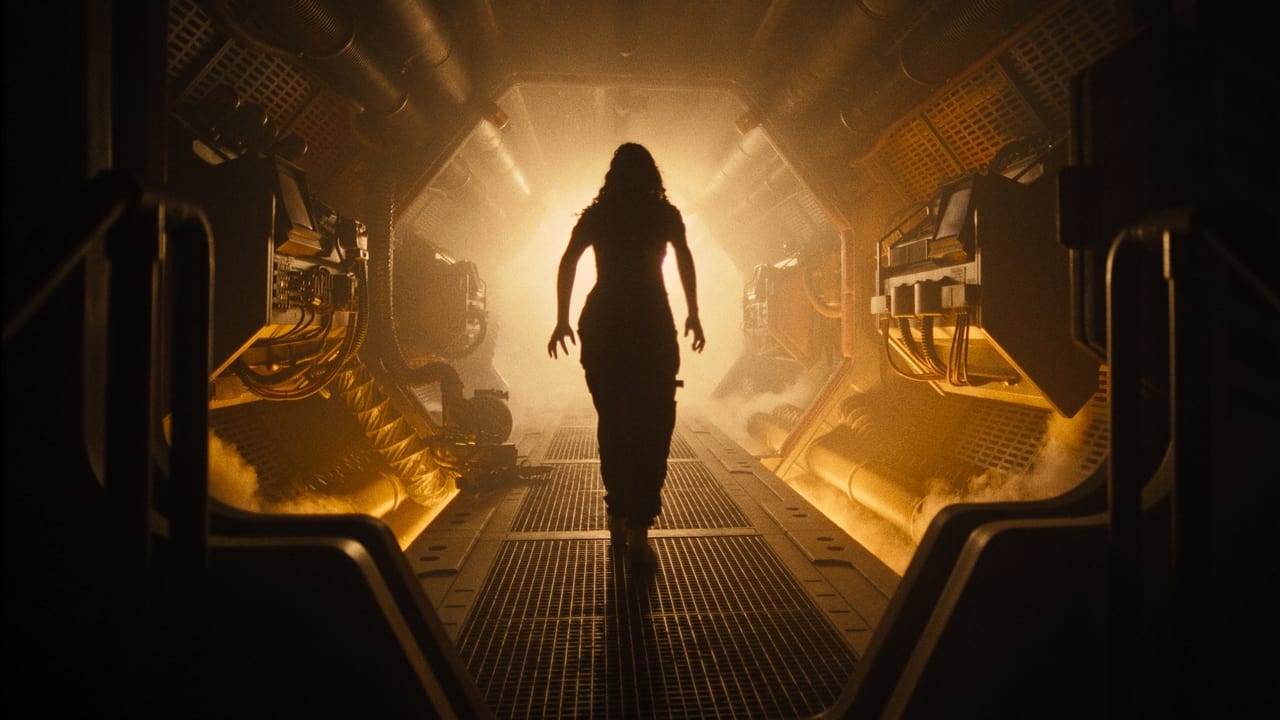

Alien: Romulus
“In space, no one can hear you.”
While scavenging the deep ends of a derelict space station, a group of young space colonizers come face to face with the most terrifying life form in the universe.
About Alien: Romulus
Why Alien: Romulus still stands out
There’s a lovely bit of misdirection at the start: a recovered cocoon from the Nostromo turns up like a grim souvenir and reminds you this isn’t the safe, cosy end of a franchise—it’s a stitch back into the original wound. From there Fede Álvarez takes the wheel and drives the story into claustrophobic, moral territory that feels both familiar and oddly modern.
At the centre of the film is Rain Carradine, a colonist on LV-410 who realises the corporation that employs her has extended her contract against her will. That small, sharp injustice is the engine: it explains why she bolts, why she makes frantic decisions, and why she chooses to keep people together even when the odds say she shouldn’t. It’s a tight 119 minutes that mixes monster horror with a story about running away from systems you can’t beat. That blend—survival thriller plus the human cost of corporate control—is what gives Romulus its personality.
The idea that sets Alien: Romulus in motion
At its simplest, Romulus is a getaway film with xenomorphs. Rain refuses to accept a stolen future, so she gathers what she can—an eclectic bunch including a reprogrammed android called Andy—and they steal a freighter to reach an old Weyland-Yutani station in the hope of stealing cryostasis for a long-distance escape.
That straightforward objective is useful because it keeps the story moving while allowing the horror to do its work. People have somewhere to go, which creates tension: survival is both immediate (there are monsters) and structural (there’s a system chasing them).
The film doesn’t overcomplicate the premise. The stakes are clear: get the cryostasis parts, survive the station, and make it to a world that promises a fresh start. That clarity helps the emotional beats land—when choices are made under pressure, you can see why characters behave the way they do.
And because the plan involves an old Weyland-Yutani installation, the movie can place corporate ambition and monstrous biology in the same room—and let both be dangerous.
Why Rain Carradine matters
Rain Carradine is the sort of character who gives a wrecked future a backbone. She isn’t just determined to run; she’s furious at how her life has been bargained away. That anger is not decorative—it’s the reason she pushes everyone into a plan that is equal parts desperate and brave.
Her connection to Andy, a malfunctioning android reprogrammed by her father, is the emotional knot the film keeps returning to. Rain’s loyalty to him reframes the usual android-versus-human beats into a quieter, personal fight: this is about family as much as survival.
Because she is an orphan on a grim mining colony, her desire to leave isn’t some generic escape fantasy. It feels structural: the system has literally extended her contract, so leaving becomes an act of reclaiming agency. That’s why her choices—sometimes blunt, sometimes brutal—read as necessary.
And finally, Rain matters because she won't accept clean answers. When the world offers a binary—stay and work for the company or die trying—she invents a third option. That’s the engine of the film, and it keeps Romulus from becoming merely another monster movie.
Alien: Romulus has more on its mind than the plot suggests
On paper the film is a creature feature, but the thing that lingers is how it thinks about humanity. With an android at the centre of the gang, Romulus constantly asks who deserves protection and what being human actually requires.
Freedom is another repeating note. Rain’s entire journey begins because she’s been denied control of her life; every act of violence, every desperate cleverness, is a reaction to that theft. Escape isn’t romantic here. It’s a correction.
Parental protection sits oddly and movingly in the film. Characters make choices to shelter others—the pregnant Kay, the adopted siblings—and those choices complicate the usual run-and-gun horror template. Protecting someone becomes as urgent as surviving the monster. And because artificial life matters to the story, loyalty and programming become moral battlegrounds. When Andy’s allegiance shifts, it’s not only a plot twist; it’s a moral question about authority and who owns a life.
Alien: Romulus could not belong to any other decade
Released in 2024, Romulus wears its decade lightly: it’s interested in systems—corporate overreach, algorithmic loyalty—and in characters who push back. That preoccupation feels very of-the-moment without relying on trendy flourishes.
The film’s combination of teen horror energy with old-school Alien dread is a 2020s mix: younger leads, a sense of communal survival, and the relentless corporate antagonist sitting behind the scenes. It speaks to contemporary anxieties in a way that’s blunt rather than theoretical.
It’s not a nostalgia exercise. Instead Romulus borrows franchise DNA and reimagines it through today’s concerns: questions about who gets to be free, who counts as family, and who profits from danger.
That’s what makes it feel rooted in the 20s—less because of style, more because of the anxieties it turns into story.
What has aged — and what hasn't
If you watch Romulus now it has the briskness of modern teen horror: a cast of young characters pushed together into terrible circumstances, quick decisions and a sense that the next catastrophe could come from any corner. That energy still lands.
Some aspects that might feel more of their moment are the film’s explicit teen-horror beats—group dynamics, the flirtations, the betrayals. They give the movie an immediacy, but also a predictability at times: you can guess which character strains hardest to be brave and which one won’t make it.
The inclusion of characters like Bjorn (played by Spike Fearn) anchors the group in recognisable tensions—jeers, taunts, selfishness—that still read well because they’re human and not period-bound.
Mostly, Romulus has aged like something made for today: direct, a little bruising, and keen on putting youthful energy into a gorgeously grisly sci-fi problem.
Why Alien: Romulus still matters
There’s a stubborn image that sticks from the film: a cocoon pulled from the Nostromo wreckage and the cascade of consequences that follow. That single origin gives Romulus its tether to the franchise but sends the story in a new, personal direction.
What people remember is not only the monster business but the choices Rain makes for the people around her. The film keeps returning to the idea that survival is social: she steals a ship, she reprogrammes an android, she refuses to leave her chosen family behind. Those decisions are why the film lodges in the memory.
Romulus also refuses to separate corporate ambition from biological horror. The Weyland-Yutani experiments and the discovery that the station reverse-engineered the facehuggers give the story an ugly moral logic—this is corporate greed weaponised—and that sting is hard to forget. Finally, the movie’s quieter aftermath—Rain preparing Andy for a new life and then entering cryostasis together—turns the spectacle back toward connection. The explosive moments and the tender ones sit next to each other; that pairing is the part that lingers.
Does Alien: Romulus still hold up?
Yes—if you want a compact, 119-minute blast of Alien dread that cares as much about chosen family as it does about biological horror, Romulus delivers. It’s a film that mixes the old franchise ingredients with a sharper focus on who gets to survive and why.
Rain’s fight—she upgrades Andy’s security access, and when that reprogramming briefly redirects loyalty back toward the corporation, the film makes you feel the ethical cost of desperate choices. Those moments give the action weight beyond jumps and shocks.
It’s not perfect. Some teen-horror beats are familiar, and the corporate-versus-individual theme is blunt. But those are partly the point: Romulus wants you to feel the bluntness—authority bruising freedom, parental instincts clashing with monstrous biology—so it doesn’t apologise for its straightforwardness.
So watch it for Rain and the way the film pairs small personal risks with big, ugly consequences. It’s a modern Alien: spare, combative, and convinced that the thing we most fear isn’t only the monster—it’s the system that made it.