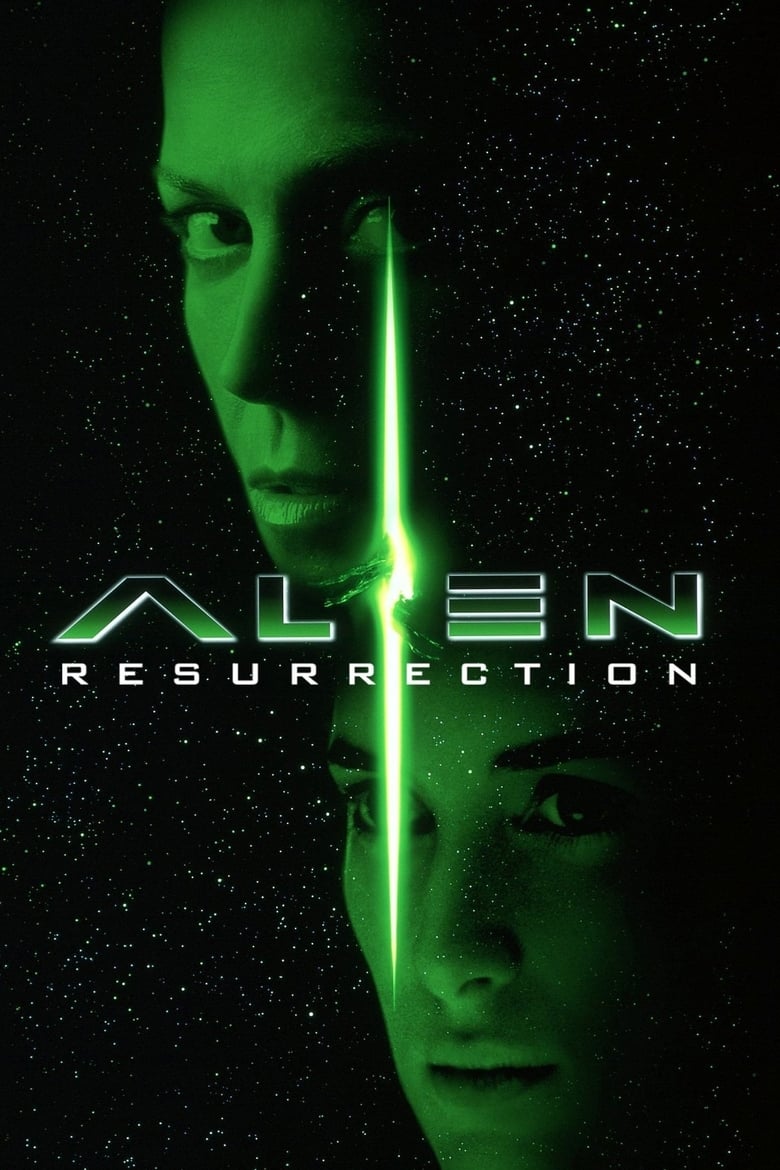
Alien Resurrection
“It's already too late.”
Two hundred years after Lt. Ripley died, a group of scientists clone her, hoping to breed the ultimate weapon. But the new Ripley is full of surprises … as are the new aliens. Ripley must team with a band of smugglers to keep the creatures from reaching Earth.
About Alien Resurrection
What Alien Resurrection gets right
Here’s the hook: two hundred years after Ripley died, scientists stitch her back together as a clone — Ripley 8 — from old blood samples. That sentence alone promises trouble, because it hands the story a Ripley who is the same person and not the same person at once.
Jean‑Pierre Jeunet directs a lean 108‑minute chase around a damaged space station that keeps returning to the same strange idea: what happens when an identity is manufactured and contaminated? The film deliberately sits at the intersection of horror and science fiction, and it doesn’t pretend to pick one lane. On the human side, Sigourney Weaver’s Ripley remains the engine; on the other, Winona Ryder appears as Annalee Call and a crew of mercenaries (including Ron Johner and Dom Vriess) provide the rough, combustible company. And then there’s the biology: Ripley’s clone has been mixed with Xenomorph DNA, which changes everything — physically and, crucially, psychologically.
The idea that sets Alien Resurrection in motion
The premise is simple and merciless: Ripley is cloned two centuries after her death. That alone turns a familiar protagonist into a puzzle — someone who can remember the past but who was also grown for purposes she never consented to.
The stakes are practical: there are living Xenomorphs on the station, and a default system that would send them back toward Earth. That single procedural detail — the ship’s command to return in an emergency — gives the story a deadline and a clear moral problem.
So the plot becomes a sprint: Ripley 8 and a ragged band of survivors decide the only responsible thing is to prevent the aliens ever reaching people again. It’s a tidy, high‑stakes rationale for a film that wants both body horror and moments of strange tenderness.
Because the setup asks a concrete question about containment, the movie can move briskly between personal reckonings and escalating physical danger without losing its nerve.
Why Ellen Ripley matters
Sigourney Weaver plays Ellen Ripley, yes, but this film gives her a curious, fragmented afterlife. Ripley 8 is literally manufactured from older Ripley DNA; she carries more than a face. The clone retains pieces of the original’s memories and, because of the genetic mixing on the Auriga, shares a psychic thread with the aliens.
That dual‑inheritance — of human memory and alien biology — is what makes Ripley 8 interesting as a character. She’s a life built in someone else’s lab, forced to learn herself while everyone else around her treats her as a specimen or a weapon.
Her discovery of a lab filled with the failed attempts to recreate Ripley changes the film’s tone in a single beat. It’s grotesque, but it also makes Ripley 8’s struggle legible: she isn’t just escaping monsters outside the ship; she’s confronting the consequences of what people do when they try to control life.
Even the small details underline that complexity. The station’s artificial intelligence has a voice — an institutionally human control — and later a new creature recognises Ripley 8 as mother, acting on a bond that rewrites what motherhood and belonging mean in this world.
Alien Resurrection has more on its mind than the plot suggests
At its plainest, the film asks what keeps a life human when that life is manufactured. That question — humanity — sits at the centre of every moral choice the characters make.
Freedom is the second chord. Many of the people and creatures here are penned, studied or controlled; the story repeatedly frames escape as the only honest answer, even when escape means destruction.
Fear is never merely jump scares; it’s the old, existential kind that arrives when you can’t tell whether you’re being hunted or used. The movie enjoys putting characters in cramped moral corners and seeing which of them choose survival, guilt or sacrifice. Mortality and lifespan hang over the whole thing. If lives can be recreated, what count as endings? If lifespan can be extended in a lab, who owns that extension? These questions turn routine action into a film that asks you to feel the cost as well as watch the mayhem.
Alien Resurrection could not belong to any other decade
This is very much a 1997 movie: an era when big‑idea science fiction still comfortably sat alongside horror and black comedy. The film arrives at the tail end of the 1990s and carries that decade’s appetite for mixing tones.
Its instincts — to be gleefully nasty one moment and oddly sentimental the next — feel of their time in a way that is more temperament than fashion. That late‑90s taste for genre‑crossing gives the movie permission to surprise you with where it chooses to land emotionally.
You can tell from the casting and the choices it makes that this isn’t trying to be a straight franchise instalment; it’s willing to be strange and slightly overstuffed in the way 1990s studio sci‑fi sometimes was.
Put simply: 1997 is the moment this story needed. It’s a film that belongs to the decade because the decade gave space to films that wanted to be several things at once.
Why Alien Resurrection still matters
There are a handful of images and ideas from this movie that stick: the grotesque cloning lab, the station turned into a hive of living experiments, and the horrifyingly believable notion that someone would keep a creature alive to study its eggs. Those beats give the film a physical horror you don’t forget.
But the afterlife of the film is less about set pieces and more about emotional stubbornness. Ripley 8’s hybrid nature — she carries alien traits and yet keeps pieces of Ripley’s memory — creates moments that feel uncomfortably intimate: a monster’s offspring recognising a human as mother, for instance, and acting on that bond.
Annalee Call’s ability to interface with the Auriga and set it on a collision course shows the film is willing to fold agency into its strange characters: not everything heroic here looks like a salute; sometimes heroism looks like hacking a ship to finish the job.
Finally, the ending — the survivors watching the Auriga explode and Ripley 8 admitting she is a stranger — leaves the series’ central figure in a new place. That line lands: the Ripley we knew is gone, replaced by someone who carries history and biology in equal measure. It’s a weird, moving place for a monster movie to end.
Does Alien Resurrection still hold up?
Short answer: yes, if you’re up for a late‑90s genre mash that prefers strange ideas to tidy reassurance. The clone premise — Ripley 8 grown from old samples and contaminated with Xenomorph DNA — gives the film a genuine, unsettling question to carry through its 108 minutes.
The script consistently brings that question back to the characters: Ripley 8 retains fragments of memory, she shares a psychic link with the aliens, and when a newborn hybrid reaches for a human shape, the result is unexpectedly emotional as well as unsettling. Those moments are why the film remains worth watching.
It’s not a comfort film. It’s noisy, occasionally brutal and happy to be uncomfortable. But that’s part of its charm. The film asks you to care about manufactured lives and then makes you watch what happens when people try to own those lives. So watch it for the weirdness, for the moral strain, and for a finale that refuses to give Ripley an easy return to the past. In the end she is, quite literally, a stranger here — which feels like the most honest place the franchise could have left her.