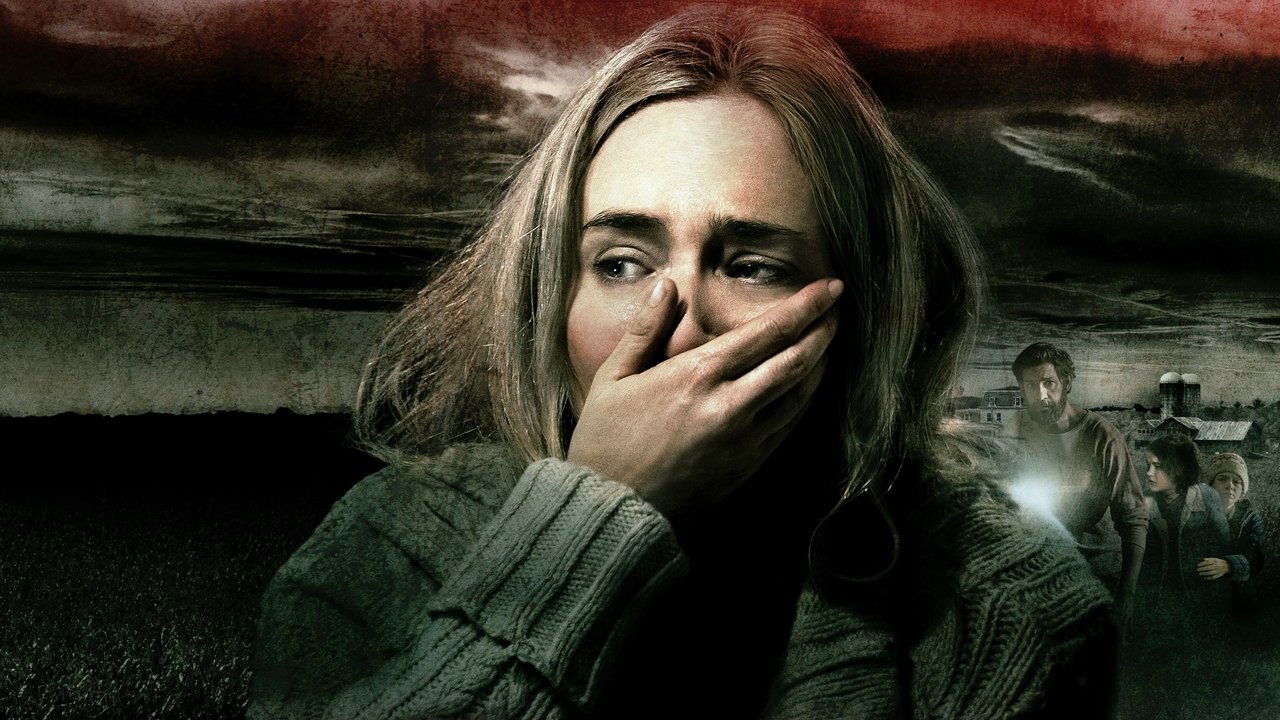

A Quiet Place
“If they hear you, they hunt you.”
A family is forced to live in silence while hiding from creatures that hunt by sound.
About A Quiet Place
What makes A Quiet Place worth revisiting
Imagine a movie where silence isn't just an aesthetic choice but the everyday rulebook. In A Quiet Place, Krasinski gives us precisely that: a tight, 90-minute genre film built around creatures who hunt by sound and a family who must learn to live in near-total quiet.
The threat is straightforward — blind predators with terrifyingly acute hearing and near-impenetrable armour — and that simplicity lets the film do something clever: it turns ordinary domestic details into tense set-pieces. Sand paths, whispered sign language and the catalogue of small precautions the Abbotts keep are how survival reads on a day-to-day level. At the centre is Evelyn Abbott, played by Emily Blunt, a mother whose whole project is to make sure her children grow up able to think and act for themselves even when the world outside keeps trying to kill them. That practical, parental focus is what gives the film its particular urgency.
The idea that sets A Quiet Place in motion
The film's engine is simple and cruel: one noisy lapse can undo everything. Early on we learn how fragile the family's equilibrium is — a child's toy powers a tiny explosion of sound and the consequences are immediate and devastating, leaving Regan carrying guilt that casts a long shadow.
That sense of ongoing consequence is why smaller beats matter: over a year after that first tragedy, life has to continue — Evelyn is pregnant again, and the household rhythms have to absorb another looming change while the danger looms outside.
Tension is mostly procedural. When the family is separated, Evelyn must improvise to keep herself and the baby safe: a quiet diversion in the basement gets her out of immediate danger. Elsewhere, the children take risks to signal for help — an extinguished signal fire, a fall into a silo, and a desperate scramble that almost becomes another loss.
The quietest plot device turns into the loudest solution. A faulty hearing aid, the same object that symbolises attempts to mend what was lost, emits a high-pitched whine that the creatures can't tolerate — and that accidental discovery becomes the family's most important weapon.
Why Evelyn Abbott matters
Evelyn is not an abstract maternal ideal — she is the pivot around which the family's survival strategies turn. She's the parent who keeps track of the small safety rituals, and whose priorities are unmistakable: protect the children and make sure they can still think for themselves in a world that has been reduced to reflex.
The Abbotts' life — sand on the paths to hide crunching leaves, sign language for every exchange — is largely organised around keeping Evelyn's project alive. That practical insistence on routine gives the film its strongest emotional anchor: family as a set of skills, not simply an idea.
Evelyn also has some of the film's most harrowing moments thrust upon her. Her pregnancy is a looming fact throughout the story, and the film stages the terrifying logistics of childbirth under extreme conditions rather than treating it as a mere plot tick.
By the end the image that lingers is not a melodramatic grandstanding but a defiant, practical gesture: Evelyn preparing to defend the family in the only terms the world now recognises. That choice — to be ready, to keep the kids safe — is the point.
A Quiet Place has more on its mind than the plot suggests
On its face the movie is a high-concept horror: sound equals death. Under the surface it becomes a film about family as a system of care — every domestic habit matters because habit equals survival.
Home in A Quiet Place is a collection of defences: practical measures like sanded walkways and the use of sign language turn the Abbott farm into a functioning sanctuary, fragile but organised.
Parental protection is not sentimentalised. The film repeatedly puts decisions in the register of responsibility — taking batteries from a toy, improvising in labour, or readying a shotgun — rather than letting us off the hook with melodrama. Mortality, fear and loss are always just off camera. The family's routines are the camouflage against grief; once a quiet ritual is broken, the movie shows how quickly loss becomes personal and lingering, not merely spectacular.
A Quiet Place could not belong to any other decade
A Quiet Place arrived in 2018, late in the 2010s, at a moment when filmmakers were happy to smuggle big ideas into compact, intense films. Its timing places it firmly in that decade's appetite for high-concept premises with an emotional centre.
Part of what feels of-the-moment is the casting and sourcing of young talent: the production brought in actors who had been making strong work on television and in small films, a common 2010s pattern of cross-pollination between mediums.
Put simply: it feels like a 2010s movie because it trades on one clear idea executed tightly — a characteristic shape of genre pictures from that era — and because it makes the domestic stakes look and feel as urgent as the monster problem outside.
What has aged — and what hasn't
The film's heartbeat is its family mechanics, and that still reads well. The rituals — sand on the paths, sign language, the constant attention to sound — are simple enough that the premise hasn't become quaint; they remain convincing ways for a household to live under threat.
The toy that changes everything still lands as a brutal, economical plot turn: one small child's act spirals into a loss that isn't just shock horror but a source of ongoing guilt and consequence. That kind of emotional continuity hasn't dated.
Scenes that hinge on ordinary caregiving under pressure — particularly Evelyn's pregnancy and the logistics of protecting a newborn — retain a peculiar, modern terror. Domestic responsibility is the film's suspense engine, and that idea hasn't frayed.
What also holds up is the film's refusal to turn its sonic gag into a neat trick. The discovery that high-pitched noise harms the creatures grows organically from the story and becomes meaningful in ways that feel earned rather than convenient.
Why A Quiet Place still matters
People remember A Quiet Place because it made terror domestic. The central conceit — blind creatures that home in on the smallest sound — gave everyday household choices dramatic weight, and audiences found that bodily, immediate anxiety hard to forget.
The film's most indelible beats are also its simplest: a child's toy batteries, a sudden, irreversible loss, and the long tail of guilt that follows. Those moments anchor the movie emotionally and make its scares sting in a different register than an effects-driven monster picture.
There are quieter sequences that keep replaying — attempts to distract a creature with improvised noises, the ritual of lighting fireworks to lead an enemy away, the desperate improvisation around childbirth — which together make the story feel lived-in. Finally, the turning of a flaw into a weapon — the hearing aid that emits a pain-inducing pitch — gives the family agency. That is why the film remains resonant: it doesn't merely show a family under attack, it shows them learning, adapting and using what they already have to survive.
Does A Quiet Place still hold up?
Yes — and here’s why in plain terms: the film is short, focused and built around a single, terrifying idea that it explores from domestic angles rather than spectacle. The creatures are a clear, consistent threat, but the drama lives in the family's choices about home, safety and parenting.
Those family choices are not window-dressing. The toy that leads to a child's death, Regan's private guilt, Lee's efforts to help his daughter hear, and Evelyn's childbirth under threat are all story elements that keep the stakes human. When the film turns the hearing aid's flaw into a weapon, it feels earned because it grows from earlier, intimate details.
Watching it now, the film's insistence on chores and routines — the sand paths, the sign language, the nightly precautions — still feels tense rather than quaint. That's because the movie treats survival as labour, and labour carries a weight that doesn't age out quickly.
If you haven't seen A Quiet Place, it's worth your time. If you have, it rewards a rewatch: the loudest moments mean more because the quiet ones were paid for in real losses. It's a horror film about doing the small, difficult things that keep people alive.