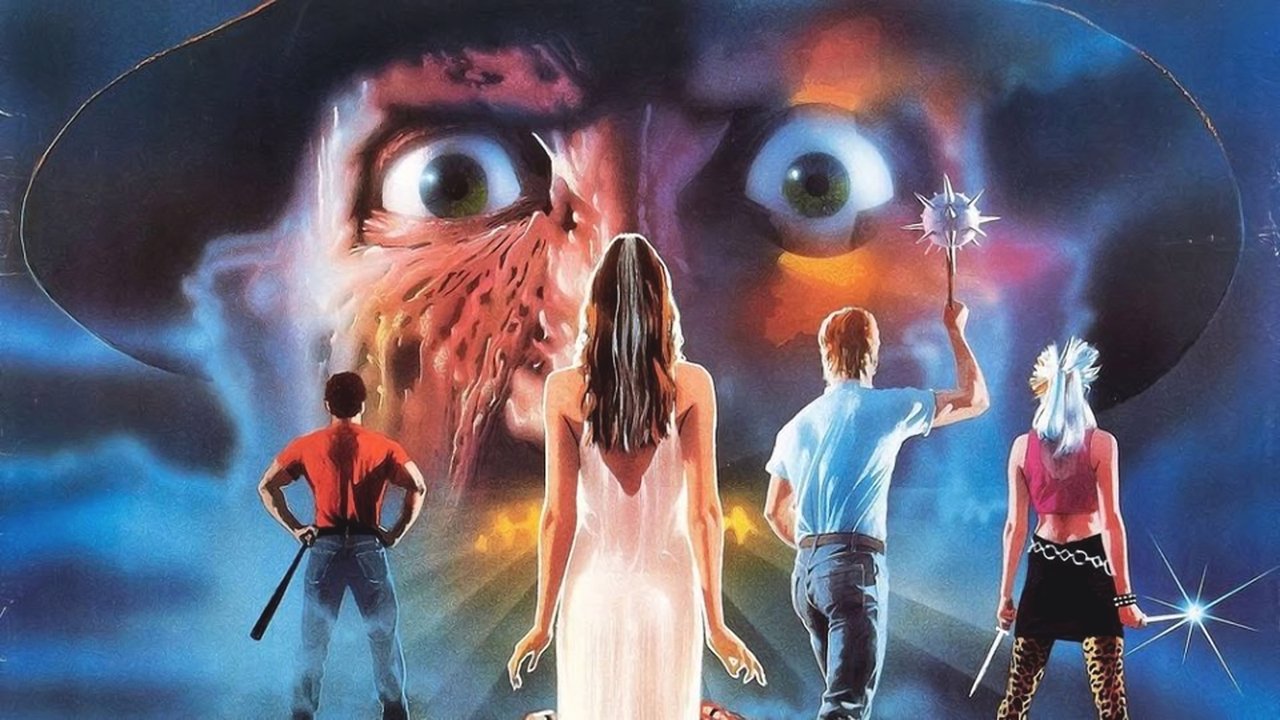
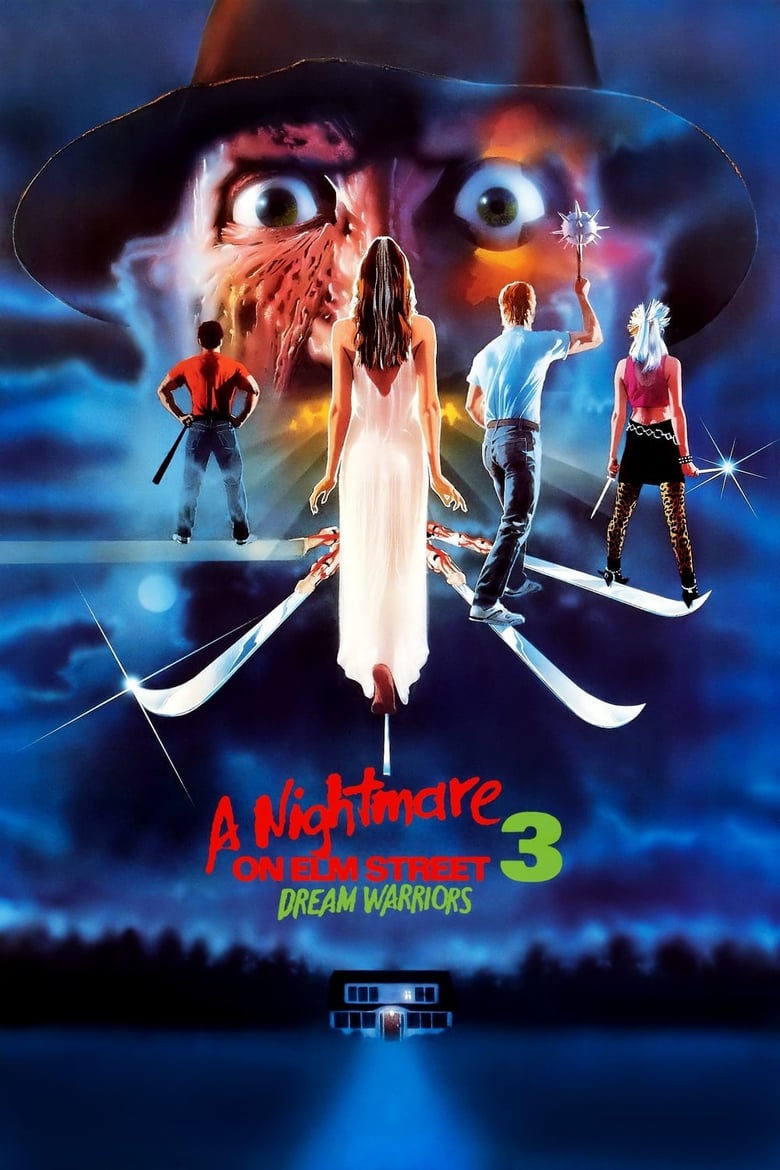
A Nightmare on Elm Street 3: Dream Warriors
“If you think you'll get out alive, you must be dreaming.”
A psychiatrist, familiar with the knife-wielding dream demon Freddy Krueger, helps teens at a mental hospital battle the killer who is invading their dreams.
About A Nightmare on Elm Street 3: Dream Warriors
Why A Nightmare on Elm Street 3: Dream Warriors is still worth talking about
The movie opens by asking a very simple, very mean question: what if the thing that kills you comes when you fall asleep? Kristen Parker’s nightmares aren’t private terrors — they spill into the real world and are the first big moment that convinces you Dream Warriors isn’t going to play fair with boundaries.
That collision — children’s vulnerability meeting a relentless supernatural predator — gives the film its engine. Chuck Russell directs with a compactness that keeps the cast moving, and the trim 92-minute runtime means it rarely lingers on anything that doesn’t push the situation forward. And the cast anchors the weirdness. Heather Langenkamp returns as Nancy Thompson, the survivor who has knowledge this new generation desperately needs, while Robert Englund’s Freddy remains the unpredictable centrepiece. Patricia Arquette’s Kristen, Ken Sagoes’s Roland and Rodney Eastman’s Joey are not background teens; they’re the reasons the story matters.
Why Nancy Thompson matters
Nancy Thompson isn’t a cameo or an emblem; she’s actively useful. As the new intern therapist at Westin Hills, she’s the one who knows what the kids are facing because she once survived it herself.
Her first major scene in the hospital is telling: Kristen is panicking, terrified of sleep, and Nancy calms her by reciting Freddy’s nursery rhyme. It’s a small, intimate beat that does two things at once — it comforts Kristen and proves Nancy is not above using the monster’s own language to disarm him.
Nancy also bridges the film’s private and public worlds. She’s involved in the search for the truth about Freddy’s origin and goes so far as to prod at family ties — even asking her father where the bones are hidden — which pulls the adults into a children’s fight in a way that feels personal, not procedural.
Finally, Nancy’s story connects to the movie’s reckonings with family. The funeral revelation about Amanda Krueger being Sister Mary Helena is one of those tidy but bitter payoffs that shows Nancy’s involvement matters: she isn’t just a plot device; she’s part of the generation trying to finish what was started years ago.
A Nightmare on Elm Street 3: Dream Warriors has more on its mind than the plot suggests
Beneath the gore and the dream logic, the film keeps coming back to family. These kids are connected by more than the street they live on; they’re the surviving children of people who once tried to stop Freddy, and that lineage gives their plight emotional weight.
Parental protection is another recurring idea. At its simplest, the hospital setting and the adults’ responses hinge on whether children are safe and who, if anyone, is prepared to defend them — and sometimes the adults are as fallible as the teenagers they’re trying to help.
Courage shows up as a practical tool. The movie turns nightmares into training ground: group hypnosis and shared dreams are not just tricks, they’re rehearsal spaces where the group learns to fight back. That makes bravery not theatrical but useful.
There’s also a darker note about home and mortality. The strange fact that Freddy’s violence crosses the threshold between dream and waking life warps the idea of shelter into something fragile; the house is meant to be refuge, but here it is liable to betray you.
A Nightmare on Elm Street 3: Dream Warriors could not belong to any other decade
Released in 1987, Dream Warriors sits at a particular point in the decade when horror liked to mix teen drama with supernatural cleverness. It’s a film that speaks to teenagers’ anxieties directly and without apology.
That 1980s blend — genre cross-pollination and brisk pacing — lets the movie be both a slasher and a kind of youth drama. The era’s appetite for taking outsize ideas and running them at full tilt suits the story about shared nightmares and fight-back strategies.
You could point to the film’s general energy as an 80s trait: it doesn’t linger on exposition. Instead it sets up a problem fast — a girl whose dreams are lethal — and uses that urgency to structure its scenes. So yes, it’s very much a product of 1987, but that feels like an advantage: it uses the decade’s talent for inventive horror to let the emotional themes land without getting lost in self-importance.
What has aged — and what hasn't
Some things in Dream Warriors age better than others. The basic teen-movie scaffolding — a group of troubled young people forced to stick together — still plays. The film is anchored in its status as a teen horror, and that focus on young experience keeps the stakes immediate.
Kristen’s terror of sleep still reads as a clean, terrifying idea: she fights the orderlies because falling asleep is the most dangerous thing she can do. That fear is simple and timeless enough that it continues to create tension for a modern viewer.
The film’s concerns about family and home also survive. Whether the adults are helpful, bumbling or absent, the emotional tug of parental protection remains recognisable, and that’s what gives the kids’ actions consequence beyond jump-scares.
Where it’s more of a mixed bag is tone: Dream Warriors swings between earnest drama and out-and-out horror. That oscillation can feel a little jolting now, but for many viewers it’s part of the film’s personality rather than a fatal flaw.
Why A Nightmare on Elm Street 3: Dream Warriors still matters
People remember Dream Warriors because it reframes the Elm Street story as something that can be fought together. Kristen’s ability to pull people into her dreams and Nancy’s immediate recognition of the pattern — calming a terrified girl with the monster’s rhyme — are the film’s emotional handshake with its audience.
The hospital’s roster of patients gives the film a community rather than a series of isolated victims. Nancy meeting Phillip, Roland, Jennifer, Will, Taryn and Joey turns the movie into an ensemble drama, so when someone dies it feels like a real loss to that group rather than just another body count.
The group hypnosis and the shared-dream sequences are what many viewers recall first: the idea that dream powers can be trained and used together gives the film a hopeful spine, even as Freddy proves relentless and inventive.
And yet the movie doesn’t promise a neat victory. There are bones to be laid to rest, desperate searches involving family, and genuine losses. The end — where the children attend funeral rites and a final, unsettling hint suggests Freddy might return — leaves the story unresolved in a way that still lingers.
Does A Nightmare on Elm Street 3: Dream Warriors still hold up?
Yes — with a health warning. Dream Warriors remains worth watching because it gives us characters to care about and a clear reason for their fight: teenagers who cannot sleep and a survivor who knows the rules. Kristen’s dreams and Nancy’s return make the film feel purposeful rather than arbitrary.
The movie’s interests — family, protection and courage — still land. There’s emotional weight in asking adults to help and in showing the kids’ attempts to defend themselves, and that keeps the film from being a mere exercise in inventive killings.
As a 92-minute piece of 1987 horror directed by Chuck Russell, it’s compact and propulsive. It also balances its shocks with quieter moments: group therapy that becomes shared resistance, a search for Freddy’s bones that turns into a real moral quest, and an ending that refuses to be entirely consoling. So if you’re in the mood for a slasher that wants to be more than a parade of set pieces — a film where the teenagers are allowed to be scared and to fight back, and where Nancy Thompson means something — give it an evening. It won’t tidy everything up for you, but it will make you care enough to stay awake.