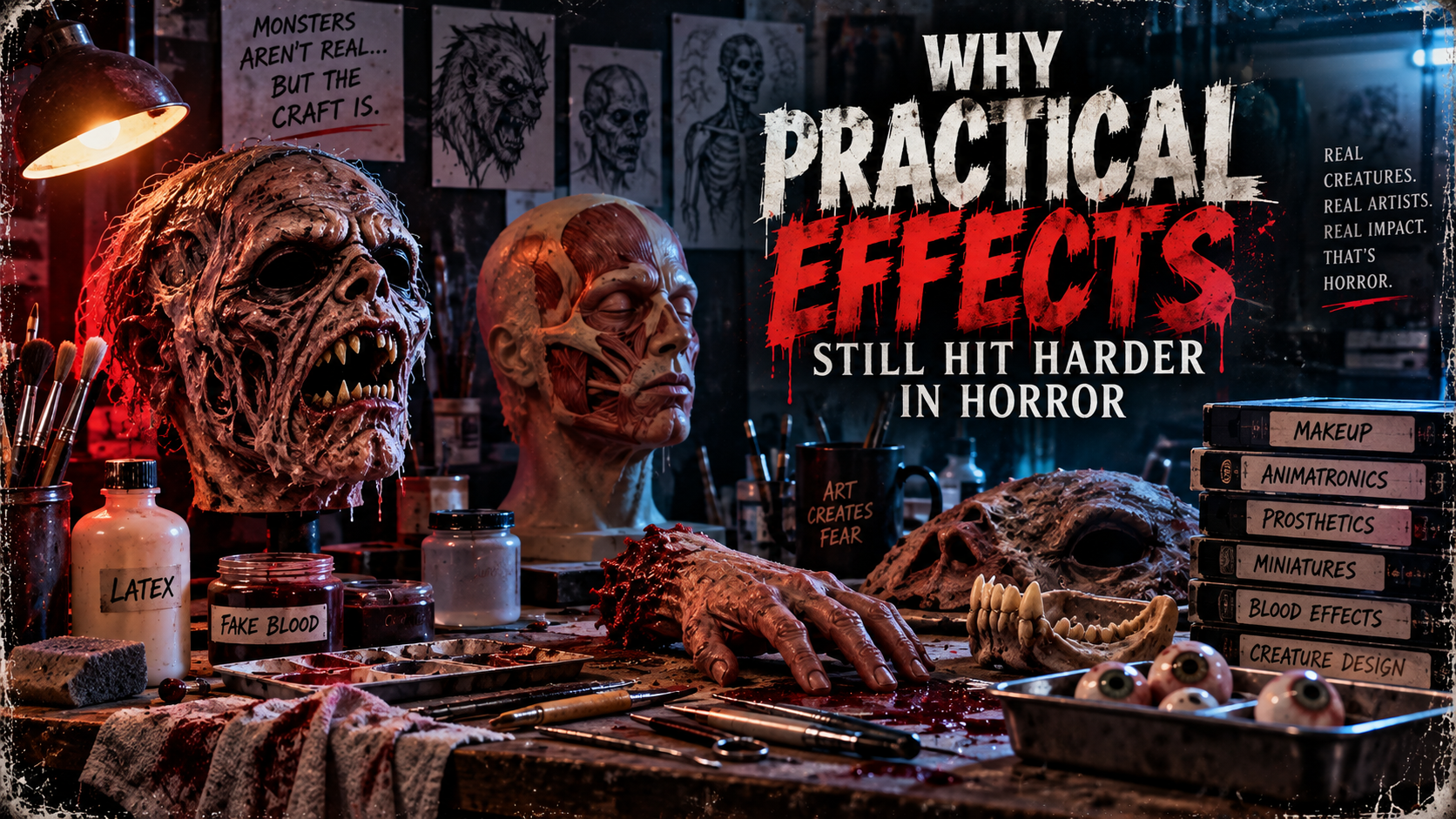
Horror Gains Something When the Actors Can Touch the Monster

There’s a fundamental difference between imagining a creature and having one standing three feet away.
An actor can see it.
They can touch it.
Light falls across it naturally.
Its shadow hits the wall.
Blood lands on clothing, furniture and faces.
If somebody grabs a prosthetic creature, their fingers actually press into its surface.
Those tiny interactions help sell an illusion.
This doesn’t mean actors can’t give extraordinary performances opposite digital creations. Of course they can.
But practical effects provide physical information automatically.
The cinematographer sees what the creature looks like under the actual lights. The director can alter the camera angle when part of the illusion isn’t working. The performer knows precisely where to look.
And perhaps most importantly for horror, everybody on set can see whether the thing is frightening.
Sometimes they discover it isn’t.
Then somebody adds more slime.
Rob Bottin Refused to Give the Monster One Shape
If there is a Mount Rushmore of practical horror effects, The Thing is probably carved somewhere near the centre.
John Carpenter's 1982 film presented effects designer Rob Bottin with an unusual problem.
What does the Thing look like?
The brilliant answer was:
Anything.
The organism assimilates other life forms, meaning it doesn’t require a single monster design.
Instead, the film becomes a parade of biological impossibilities.
A head detaches from a body, sprouts legs and attempts to escape.
Dogs transform into masses of flesh and tentacles.
Bodies split apart.
Human anatomy rearranges itself into configurations nature clearly never intended.
Bottin and the effects team used an enormous range of physical techniques to create those transformations.
BFI has described The Thing as setting a benchmark for special makeup effects, while noting how some contemporary critics reacted negatively to the film’s graphic imagery.
That’s almost difficult to imagine today.
The effects once criticised as excessive are now among the principal reasons the movie is celebrated.
And perhaps that’s because they haven’t become less impressive with age.
We’ve simply become more aware of how difficult they were to achieve.
An American Werewolf in London Made Transformation Hurt
Werewolf movies had shown transformations long before 1981.
John Landis and Rick Baker wanted audiences to feel one.
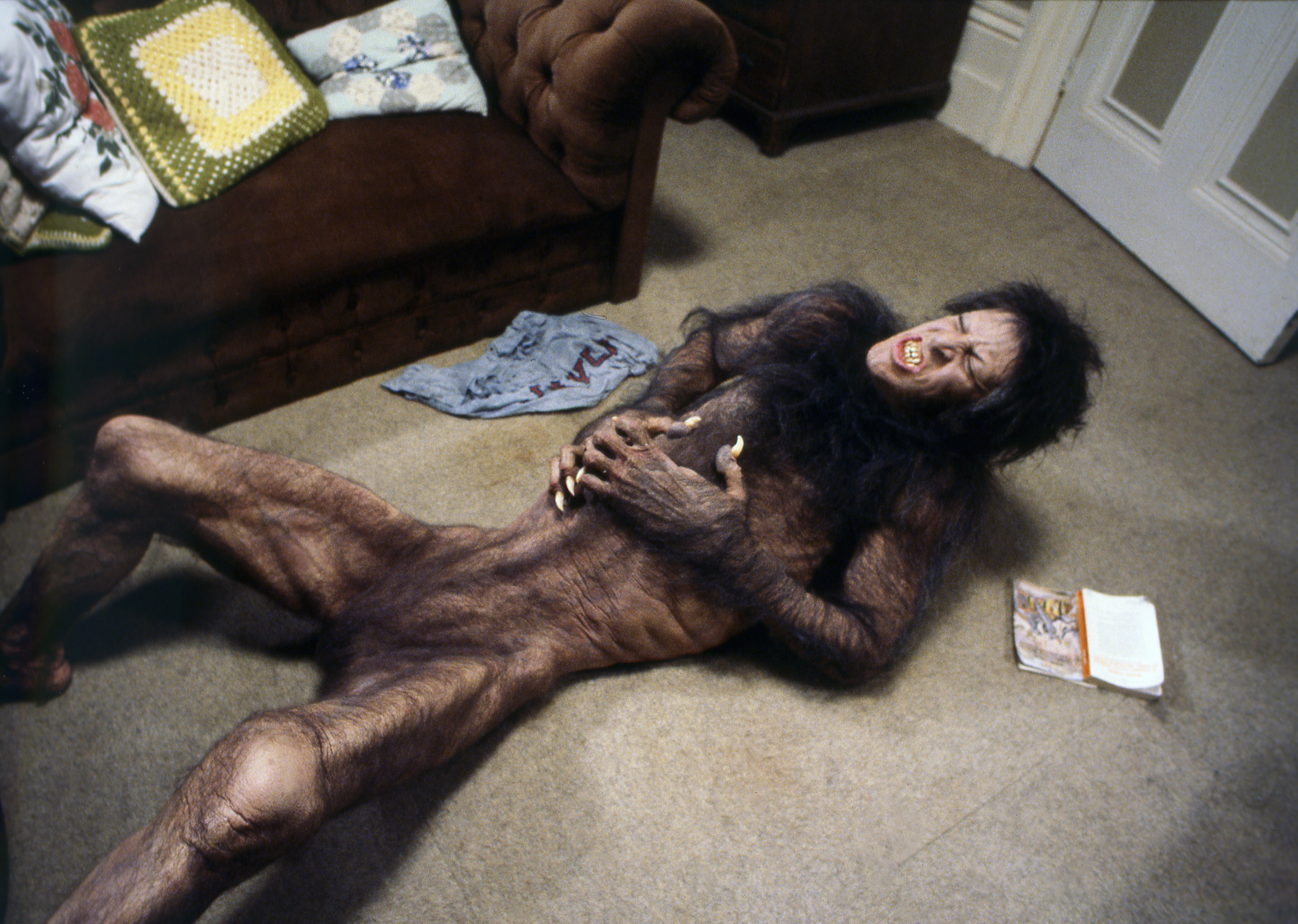
The transformation in An American Werewolf in London is deliberately cruel because Landis refuses to give David somewhere convenient to hide.
There's no heavy fog.
No rapid montage disguising the difficult parts.
No strategically placed darkness.
David transforms in a brightly lit room.
His hands stretch.
His face changes.
His spine contorts.
His feet lengthen.
And actor David Naughton sells every second as agony.
Rick Baker’s work on the movie subsequently won the inaugural Academy Award for Best Makeup in 1982. The category itself had only just been introduced.
The sequence works because the transformation isn’t treated like a magical costume change.
The human body is being reconstructed against its will.
Bones shouldn’t change shape.
A human skull shouldn’t become a muzzle.
Watching physical materials apparently force a familiar body into an unfamiliar shape gives the scene its power.
The werewolf is frightening.
But becoming the werewolf might be worse.
The Fly Turned Makeup Into a Tragedy
David Cronenberg's The Fly took a different approach.
Seth Brundle doesn't transform in one spectacular sequence.
He deteriorates.
Slowly.
At first, the changes could almost be interpreted as improvements. He’s stronger. More energetic. More confident.
Then his body begins betraying him.
Skin changes.
Fingernails come away.
Teeth deteriorate.
Human features disappear.
Chris Walas and Stephan Dupuis won the Academy Award for Best Makeup for their work on the film.
But the achievement isn’t simply that Jeff Goldblum eventually looks monstrous.
It’s that the makeup tells a story.
Every stage moves Brundle further from the person Veronica knew.
By the time the final creature emerges, the tragedy has already happened.
The monster isn’t something that attacked Seth Brundle.
The monster is what happened to him.
Practical makeup makes us watch that process directly on Goldblum’s face.
Hellraiser Made Its Monsters Beautiful and Repulsive
Then came Hellraiser.
Clive Barker's 1987 film didn't simply introduce the Cenobites.
It introduced an entire aesthetic.
Leather.
Hooks.
Chains.
Wounds.
Scarred flesh.
And Pinhead's perfectly arranged grid of pins.
But one of the film's most extraordinary effects doesn't involve the Cenobites at all.
It's Frank Cotton returning.
A body begins reconstructing itself beneath the floorboards.
There's blood.
Bone.
Tissue.
Something vaguely human gradually pulls itself into existence.
The sequence is grotesque because it appears tactile.
You can imagine what everything would feel like.
You probably wish you couldn’t.
Barker understood something fundamental about practical horror:
Texture matters.
Digital imagery can reproduce texture extraordinarily well today, but physical materials already possess it.
Latex has a surface.
Fake blood reflects light.
Gelatine moves.
Prosthetics wrinkle.
Horror can exploit all of those imperfections.
Sometimes disgusting is easier to believe when you feel as though you could reach out and touch it.
Not that you’d want to.
The Evil Dead Proved Imagination Could Beat Money
Practical effects aren't only associated with expensive studio productions.
Horror has always been the genre where somebody looks at an empty wallet and says:
We’ll figure something out.
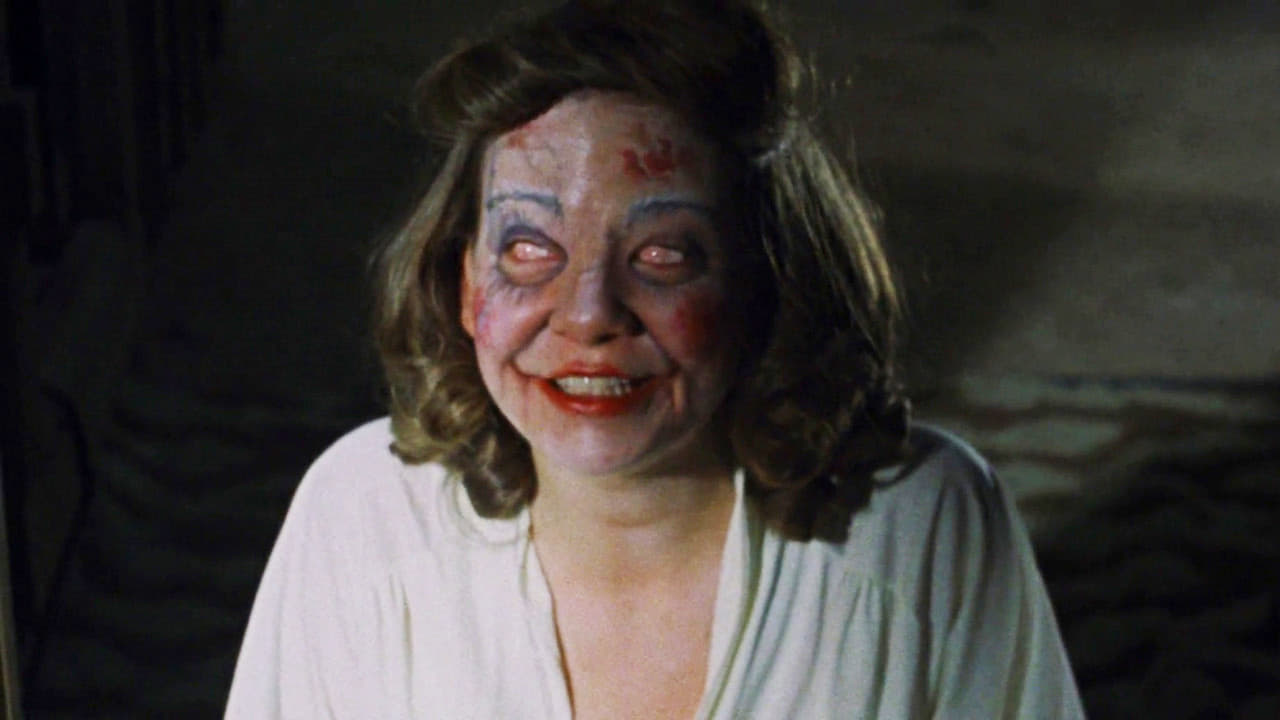
Sam Raimi’s The Evil Dead is a great example.
Its Deadites, injuries, dismemberments and bodily destruction weren’t created because the filmmakers had unlimited resources.
Quite the opposite.
The movie’s roughness became part of its personality.
By Evil Dead II, Raimi and his effects teams pushed that physical insanity even further. Bodies disintegrate. Eyeballs fly. A severed hand develops a personality. Blood erupts with almost cartoonish enthusiasm.
The effects don't always attempt photorealism.
They attempt impact.
That's an important distinction.
Horror doesn't always need audiences to think something is real.
Sometimes it merely needs them to react.
Laugh.
Winch.
Look away.
Then immediately look back.
Why Something Slightly Fake Can Feel More Real
Here's one of the strangest things about practical effects.
Sometimes we can see the trick.
Watch enough older horror and you'll spot latex.
You'll notice a puppet moving differently from a living creature.
You'll occasionally see where a prosthetic begins.
The blood might be too bright.
And yet the effect can remain incredibly powerful.
Why?
Because the physical object really existed in front of the camera, even if the creature it represents did not.
Our brains receive conflicting information.
We know that isn't a severed head.
But something shaped like a severed head is definitely bouncing across the floor.
Digital effects have the opposite challenge.
A digital creature can be anatomically perfect and beautifully rendered, but filmmakers must work extremely hard to convince our brains that it occupies the photographed environment.
The best visual-effects artists are astonishingly good at doing exactly that.
Which is why the argument shouldn't really be:
Practical good. CGI bad.
That's far too simple.
The Best Modern Horror Often Uses Both
Digital effects solved problems practical artists could barely have imagined.
They can remove wires.
Extend sets.
Alter faces.
Create impossible environments.
Blend multiple practical elements together.
Erase mechanisms operating puppets.
Make subtle alterations to creature movement.
And, when necessary, create monsters that simply couldn't be built physically.
The problem isn't CGI.
The problem is assuming one technique should replace every other technique.
Some of modern genre filmmaking's strongest effects combine methods.
Build part of the creature.
Give the actor something physical to interact with.
Photograph real textures.
Then use digital effects to remove limitations, extend movement or complete the illusion.
The audience doesn't need to know where practical work ends and digital work begins.
In fact, if the filmmakers have done their jobs properly, we shouldn't be thinking about the technique at all.
We should be worrying about what's coming through the door.
Modern Horror Never Really Abandoned Practical Effects
For all the discussion about CGI replacing practical work, physical effects have never disappeared.
Filmmakers kept using them.
Guillermo del Toro has consistently championed physical creature work alongside digital techniques.
The Alien franchise still uses physical creature elements, even as visual effects expand what the Xenomorph can do.
Modern slashers still need makeup effects for injuries.
Possession films still use prosthetics.
Body horror practically demands them.
And when filmmakers announce that a new horror production is using practical creatures, fans often react with immediate excitement.
That’s revealing.
Audiences have developed affection not only for the finished effect but for the craft behind it.
People want to see the creature workshop.
They want behind-the-scenes photographs.
They want to know how the head exploded.
Horror effects have become a form of performance in their own right.
Practical Effects Leave Fingerprints on a Movie
There's another reason these effects endure.
You can feel the people behind them.
Somebody sculpted that face.
Somebody mixed those materials.
Somebody painted those veins.
Somebody designed the mechanism.
Somebody spent three hours applying the makeup.
Somebody crouched beneath the set operating a puppet.
Somebody stood just outside the frame holding a bucket containing something revolting.
And occasionally the effect didn’t work.
So they rebuilt it.
That’s filmmaking.
Messy, collaborative, inventive filmmaking.
Practical horror effects expose that process more clearly than almost anything else because the final result is a physical artefact.
The monster existed.
Maybe only as foam latex, mechanical parts, paint and glue.
But for a few seconds after the director shouted action, it lived.
Horror Is About Bodies — And Practical Effects Understand Bodies
Perhaps this is ultimately why practical effects have such a special relationship with horror.
Horror is obsessed with the body.
What can enter it.
What can leave it.
How it can change.
How easily it can break.
A physical effect begins with the same material reality.
It occupies space.
It has weight.
It bends.
It tears.
It drips.
When Norris's chest opens in The Thing, we know intellectually that we're watching an elaborate illusion.
When David transforms in An American Werewolf in London, we know David Naughton's bones aren't actually stretching.
When Seth Brundle falls apart in The Fly, we know Jeff Goldblum isn't decomposing in front of us.
But cinema has always depended upon a simple agreement between filmmaker and audience.
Show us something convincing enough, and for a moment we'll believe you.
Practical effects make that agreement unusually easy.
Because somewhere underneath the monster, the blood and the prosthetics is one tiny piece of truth:
Something really was there.
And in horror, sometimes that's all it takes.