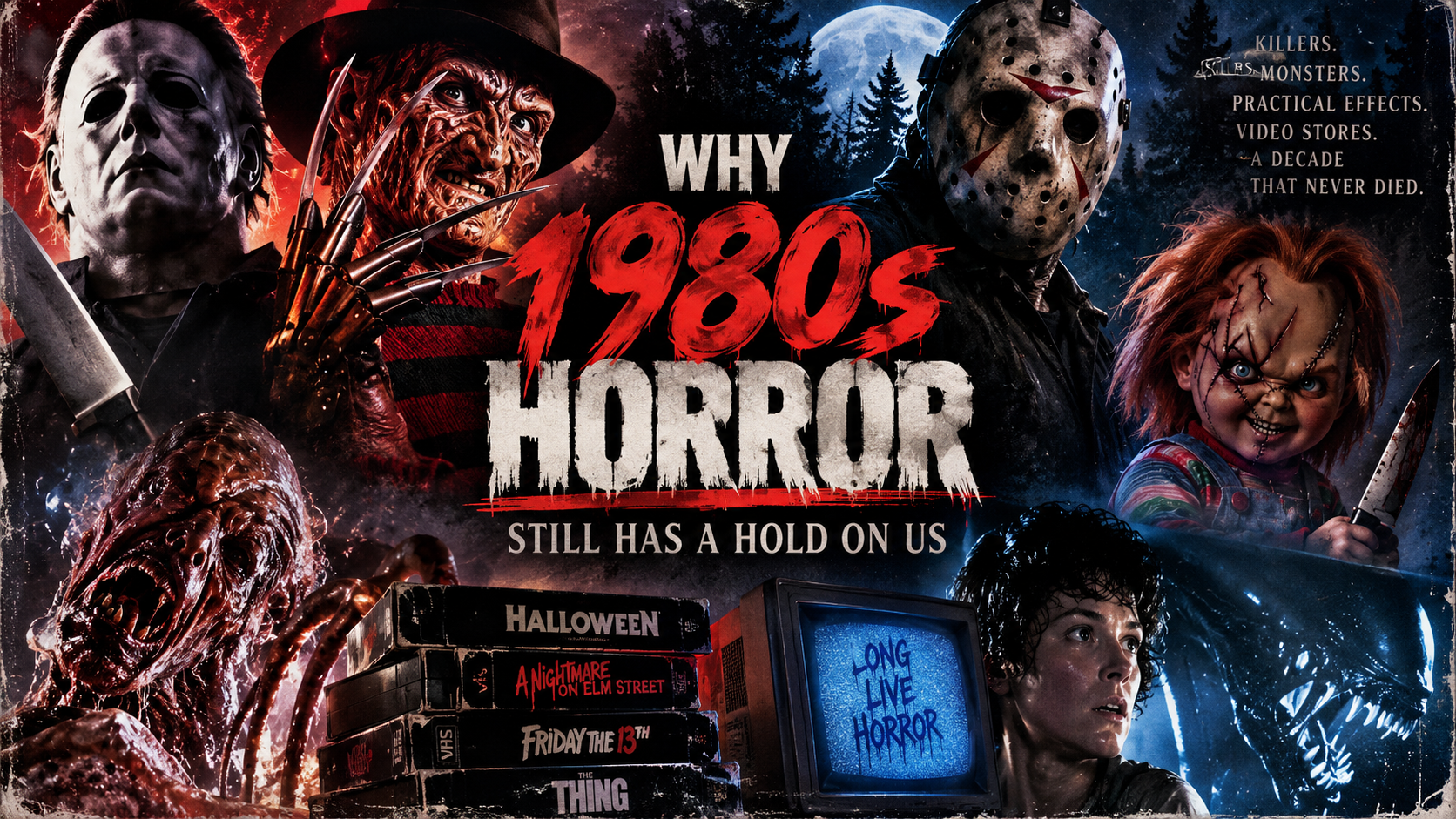
Halloween Lit the Fuse — Then Everybody Wanted a Killer
The modern slasher didn’t suddenly appear on 1 January 1980.
Films like Psycho, Black Christmas, and The Texas Chain Saw Massacre had already laid the groundwork, and John Carpenter’s Halloween arrived in 1978 to show how frightening a masked figure walking slowly through suburbia could be.
Then came the explosion.
Friday the 13th arrived in 1980 and moved the killing to Camp Crystal Lake. What followed was an extraordinary wave of stalk-and-kill movies: Prom Night, The Burning, My Bloody Valentine, The Prowler, The House on Sorority Row, Sleepaway Camp and many more.
BFI notes that Halloween spawned a wave of early-80s imitators before A Nightmare on Elm Street revitalised the form.
The formula became familiar because it worked.
Take a group of young people. Isolate them. Introduce a threat. Give the killer an identity audiences can recognise from the back row of a cinema.
But then something strange happened.
The killers became the stars.
Freddy, Jason and the Faces Horror Could Sell
Think about the great horror imagery of the 1980s and you don't necessarily remember the heroes first.
You remember the mask.
The glove.
The striped jumper.
The hockey mask.
The puzzle box.
The Good Guy doll.
Horror had always possessed iconic monsters — Dracula, Frankenstein’s creature and the Wolf Man had proved that decades earlier — but the 1980s created a new generation built for an increasingly commercial age.
Jason became inseparable from his hockey mask, although it didn’t appear until Friday the 13th Part III. Freddy was even more distinctive: a burned face, a fedora, a striped jumper, and a glove fitted with blades.
And unlike the silent Michael Myers or Jason, Freddy could talk.
He could joke.
Eventually, he could practically host the movie.
Wes Craven’s masterstroke in A Nightmare on Elm Street was also to give his killer territory nobody could escape. Freddy didn’t need to get inside your house.
Eventually, you had to sleep.
BFI describes the supernatural element as what separated Freddy from many of the decade’s other slashers: his hunting ground was the dreams and subconscious of his victims.
That single idea was enough to create one of horror cinema’s most enduring monsters.
Practical Effects Made the Impossible Look Horribly Real
If the killers gave 1980s horror its faces, practical effects gave it its flesh.
And sometimes its slime.
And occasionally several extra heads.
This was an extraordinary period for special makeup and creature effects because filmmakers were attempting increasingly outrageous transformations while digital effects were not yet available to rescue them.
If a filmmaker wanted a human to transform into a werewolf, somebody had to figure out how to make it happen in front of a camera.
If a severed head needed to grow legs and crawl across the floor, somebody had to build it.
If a chest needed to open into a mouth and bite someone’s arms off...
Well, somebody had to build that too.
John Carpenter’s The Thing remains perhaps the ultimate example. Rob Bottin's effects turned the creature into something that never needed one definitive shape. Bodies split, stretched, assimilated and reconstructed themselves into forms that looked fundamentally wrong.
BFI credits the film with setting a benchmark for special makeup effects, even noting that some contemporary critics initially considered its gore excessive. Its reputation was later reassessed.
That physicality matters.
An actor isn’t merely reacting to something that will exist later. Something disgusting sits three feet away from them.
Light hits it.
Slime reflects from it.
It occupies the same room.
The audience knows it’s an effect, of course.
But part of your brain still whispers:
That thing was actually there.
An American Werewolf in London Changed Bodies Before Our Eyes
Few sequences demonstrate the power of practical horror better than David Kessler's transformation in An American Werewolf in London.
John Landis' film did something particularly cruel.
It didn’t hide the transformation in darkness.
David changes under bright interior lighting while his body stretches and contorts in front of us.
The effects work led by Rick Baker became a landmark of creature filmmaking, but the movie also demonstrated another quality that 1980s horror repeatedly embraced: horror could be funny without ceasing to be horrific.
The film moves between comedy, tragedy and gruesome violence with remarkable confidence. BFI has similarly highlighted its unusual balance between laughs and scares.
That willingness to mix tones runs through the decade.
Re-Animator is grotesque and hilarious.
The Return of the Living Dead gives us zombies and punk comedy.
Gremlins somehow became both a Christmas movie and a creature feature.
The Evil Dead II turns demonic possession into something approaching live-action slapstick without forgetting to cover the walls in blood.
The genre didn’t always behave itself.
That’s part of the reason it remains so much fun.
The Decade Was Much Stranger Than Nostalgia Remembers
It’s easy to look backwards and imagine 1980s horror as an endless procession of masked men chasing teenagers.
It wasn’t.
David Cronenberg transformed the human body in films like Videodrome and The Fly.
Clive Barker gave audiences a very different vision of supernatural horror with Hellraiser.
Sam Raimi was throwing cameras through forests in The Evil Dead.
James Cameron turned Alien's claustrophobic nightmare into the ferocious action-horror of Aliens.
Stanley Kubrick turned an empty hotel corridor into one of cinema’s most recognisable images in The Shining.
And films such as The Company of Wolves used practical effects and dark fairy-tale imagery to approach werewolf mythology from an entirely different direction; BFI notes that its transformations were achieved with animatronics, makeup and other physical techniques rather than digital effects.
There wasn’t one version of 1980s horror.
Dozens of them were happening simultaneously.
VHS Gave Horror a Second Life
Then there was the way we watched these movies.
Horror and home video were made for each other.
A film didn’t have to disappear when it left cinemas. It could sit on a video-store shelf for years, waiting for somebody to be intrigued by a lurid cover promising something their parents almost certainly wouldn’t approve of.
For a generation of horror fans, discovering movies became almost as important as watching them.
You didn’t have an algorithm telling you what came next.
You had a wall of VHS cases.
Maybe a friend had heard about something.
Maybe the artwork looked terrifying.
Maybe you weren’t technically old enough to rent it.
Sometimes the movie was brilliant.
Sometimes the cover was considerably better than the film inside.
But that unpredictability became part of horror culture.
Films that struggled theatrically could find audiences later. Forgotten movies could become cult favourites. Fans could rewind favourite scenes until the tape itself began complaining.
That relationship between horror and physical media helped films survive far beyond their original release.
You Can Hear an Eighties Horror Movie Before You See It
The decade had more than a visual identity.
It had a sound.
John Carpenter had already demonstrated the extraordinary effectiveness of minimalist electronic scoring with Halloween, and synthesiser-heavy music became deeply associated with genre filmmaking.
Sometimes the score pulsed beneath the movie like a heartbeat.
Sometimes it sounded cold and mechanical.
Sometimes it seemed to belong to the killer.
Those sounds have become so deeply embedded in horror culture that modern filmmakers frequently return to them when trying to evoke the period.
But the best scores weren’t nostalgic in 1982.
They were contemporary.
That’s an important distinction.
What we now call a retro aesthetic was simply filmmakers using the equipment, music and visual language around them.
They weren’t trying to make an eighties horror movie.
They were making a horror movie.
Horror Keeps Going Back
Look at modern horror, and the fingerprints are everywhere.
Halloween returned.
Evil Dead returned.
Hellraiser returned.
Child's Play returned.
Predator returned.
Alien never really went away.
Friday the 13th and A Nightmare on Elm Street remain instantly recognisable even during long gaps between films.
And Scream — itself a 1990s reinvention of slasher cinema — built much of its identity around characters who understood the horror movies that came before them. BFI's contemporary review described it as dissecting the slasher formula while still functioning as an effective horror film in its own right.
Modern horror isn’t simply copying the eighties.
The genre has evolved enormously.
But filmmakers keep returning to the decade’s monsters, practical effects, visual language and franchises because audiences never completely let them go.
Maybe Horror Was Never Supposed to Look Perfect
Modern filmmaking can create things that would have been impossible forty years ago.
Yet horror fans still celebrate an exploding latex head.
Why?
Perhaps because imperfection has character.
You can occasionally see how an old practical effect works. A puppet moves slightly strangely. Prosthetics don’t behave exactly like skin. Blood has the wrong consistency entirely.
And somehow that often makes us love the movie more, not less.
There are fingerprints on these films.
People built the monsters.
Artists painted them.
Technicians hid underneath them.
Performers got covered in whatever revolting mixture the effects department had prepared that morning.
The results weren’t always convincing.
But they were frequently imaginative.
And horror thrives on imagination.
The 1980s gave us films that were nasty, funny, ambitious, cheap, inventive, excessive and occasionally ridiculous.
It gave us monsters that became celebrities.
It gave us effects artists who showed audiences things they’d never seen before.
And it gave horror fans a library of movies we’re still watching, arguing about and introducing to somebody else four decades later.
Perhaps that’s why 1980s horror still has such a hold on us.
The decade ended.
The nightmares didn’t.